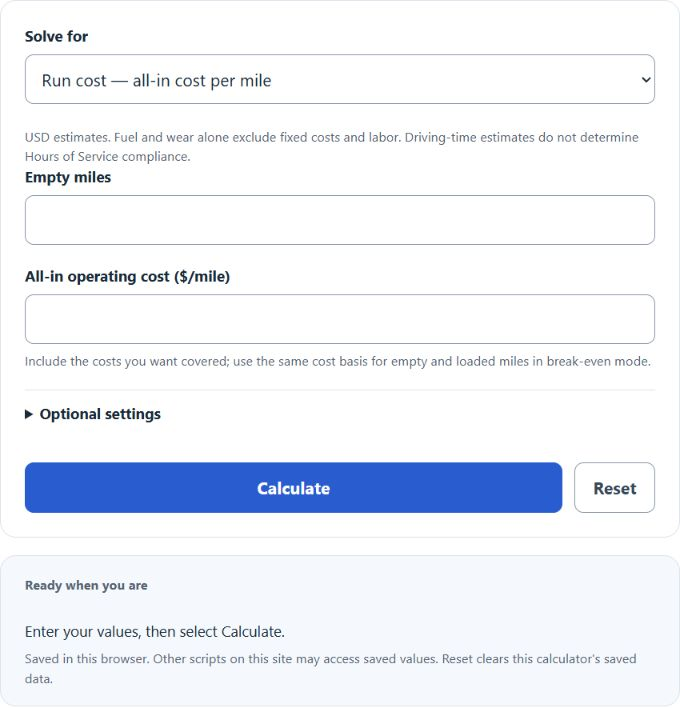
Calculate the true cost of deadhead miles, your deadhead percentage, and the break-even rate you need on your next load to cover empty miles.
Deadhead Cost Formula
DC = DM * CPM
BER = ((DM + LM) * CPM) / LM
DH% = DM / (DM + LM) * 100
- DC is the deadhead cost ($)
- DM is the deadhead (empty) miles driven
- CPM is the all-in cost per mile ($/mile)
- BER is the break-even rate per loaded mile ($/mile)
- LM is the loaded miles on the next load
- DH% is the deadhead percentage (%)
The calculator solves for three things. The cost mode multiplies your empty miles by your cost per mile, either a single all-in figure or one built from diesel price, empty MPG, and maintenance and tire wear. Enter an average speed to estimate driving time; this does not assess Hours of Service compliance. The break-even mode spreads the cost of all miles driven, empty plus loaded, across only the loaded miles, giving the minimum rate per loaded mile you must be paid; enter an offered rate and it returns the trip profit or loss after the deadhead. The percentage mode divides empty miles by total miles. Enter a cost per empty mile for cost outputs and select a weekly, monthly, or yearly period for a constant-period annual projection.
Illustrative Fuel and Wear Costs and Annual Deadhead Costs
These illustrative figures assume diesel at $3.60 per US gallon and the stated fuel economy and wear assumptions. They are not current market averages or all-in costs: labor, insurance, financing and other fixed costs are excluded.
| Configuration | Empty MPG | Fuel $/mile | Wear $/mile | Fuel + wear $/mile |
|---|---|---|---|---|
| Dry van (empty trailer) | 6.5 | $0.55 | $0.10 – $0.15 | $0.65 – $0.70 |
| Reefer (unit running) | 5.5 – 6.0 | $0.60 – $0.65 | $0.12 – $0.17 | $0.72 – $0.82 |
| Flatbed (empty) | 6.5 – 7.0 | $0.51 – $0.55 | $0.10 – $0.15 | $0.61 – $0.70 |
| Bobtail (no trailer) | 8.0 – 10.0 | $0.36 – $0.45 | $0.08 – $0.12 | $0.44 – $0.57 |
The second table shows what a given deadhead percentage costs over a full year at $0.67 per empty mile. Find your weekly total miles, then read across to your deadhead percentage. Cutting from 20% to 10% at 2,500 miles per week returns about $8,710 a year.
| Weekly total miles | 10% deadhead | 15% deadhead | 20% deadhead | 25% deadhead |
|---|---|---|---|---|
| 2,000 | $6,968/yr | $10,452/yr | $13,936/yr | $17,420/yr |
| 2,500 | $8,710/yr | $13,065/yr | $17,420/yr | $21,775/yr |
| 3,000 | $10,452/yr | $15,678/yr | $20,904/yr | $26,130/yr |
Example Problems
Example 1: Cost of a deadhead run. You must deadhead 175 miles to a pickup. Diesel is $3.60 per gallon, your truck gets 6.5 MPG running empty, and you figure $0.12 per mile in maintenance and tire wear. Fuel cost per mile is 3.60 / 6.5 = $0.554, so your cost per empty mile is 0.554 + 0.12 = $0.674. The deadhead cost is 175 * 0.674 = $117.92, burning about 26.9 gallons of diesel and roughly 3.2 driving hours at 55 mph, excluding stops.
Example 2: Break-even rate for the next load. You deadhead 200 miles for a 650-mile load and your all-in operating cost is $1.20 per mile. Total trip cost is (200 + 650) * 1.20 = $1,020. The break-even rate is 1,020 / 650 = $1.57 per loaded mile. To clear $0.40 per loaded mile in profit you need (1,020 + 0.40 * 650) / 650 = $1.97 per loaded mile. If the load is offered at $2.10, revenue is $1,365, revenue per total mile is $1.61, and the trip nets $345 after the deadhead, so it clears the target.
Frequently Asked Questions
What is a good deadhead percentage?
A suitable deadhead percentage depends on routes, equipment and operating requirements; the calculator does not assign a universal industry rating. At 20%, one mile in five is empty. Track consistent periods and compare empty-mile cost with the revenue and alternatives available.
Do deadhead miles count against Hours of Service?
Business-purpose repositioning generally counts as driving even with an empty trailer or no trailer. Under the standard federal property-carrier rules, driving is generally limited to 11 hours within a 14-hour window after 10 consecutive hours off duty; exceptions and other limits apply. Qualifying personal conveyance is different. Consult FMCSA guidance and your carrier; this calculator does not determine compliance. At 55 mph, 200 miles requires about 3.6 driving hours before stops.
Should you take a cheap backhaul instead of deadheading?
Compare the alternatives using each route’s revenue, empty and loaded operating costs, detours, waiting time and schedule constraints. A 300-mile load at $1.50 per loaded mile earns $450 before costs. Whether it beats driving empty depends on the incremental costs and opportunities; distance alone does not decide.