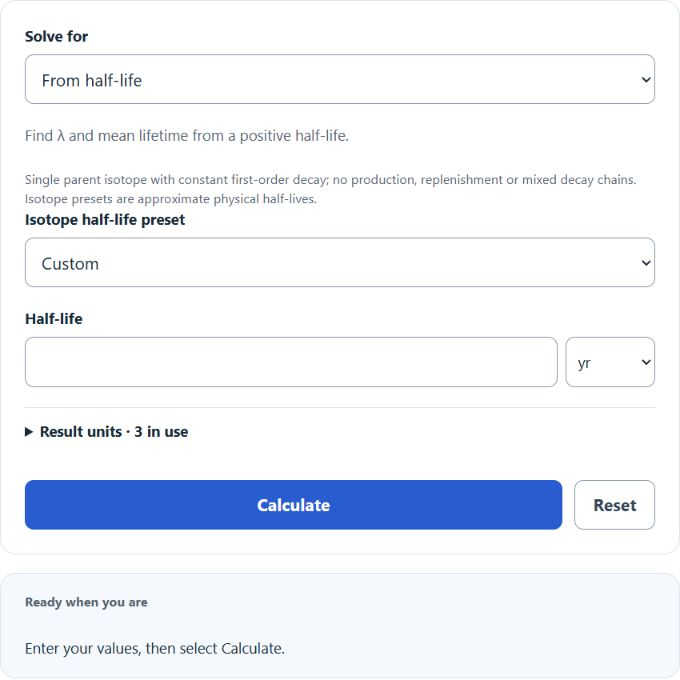
Calculate decay constant, half-life, and mean lifetime from isotope half-life, amount change over time, or convert between λ, t½, and τ.
Decay Constant Formula
The decay constant λ describes how fast a radioactive isotope decays. It is tied directly to the half-life and the mean lifetime through these formulas:
- λ = decay constant (per unit time)
- t½ = half-life (time for the amount to drop by half)
- N₀ = initial amount
- N(t) = amount remaining after time t
- t = elapsed time
- τ = mean lifetime
- ln(2) ≈ 0.693147
Choose the known quantity: half-life, amount change, decay constant, or mean lifetime. The calculator returns λ, half-life and mean lifetime. Amount change uses one shared amount unit; the model assumes one parent isotope with constant first-order decay and no replenishment.
Reference Values
Use these tables to sanity-check your inputs and to interpret the result.
Half-life and decay constant for common isotopes
| Isotope | Half-life | λ |
|---|---|---|
| Technetium-99m | 6.01 hr | 0.1153 hr⁻¹ |
| Radon-222 | 3.8215 day | 0.1813 day⁻¹ |
| Iodine-131 | 8.02 day | 0.0864 day⁻¹ |
| Cobalt-60 | 5.271 yr | 0.1315 yr⁻¹ |
| Carbon-14 | 5,700 yr | 1.22×10⁻⁴ yr⁻¹ |
| Uranium-238 | 4.463×10⁹ yr | 1.55×10⁻¹⁰ yr⁻¹ |
Fraction remaining after n half-lives
| Half-lives elapsed | Fraction left | Percent left |
|---|---|---|
| 1 | 1/2 | 50% |
| 2 | 1/4 | 25% |
| 3 | 1/8 | 12.5% |
| 4 | 1/16 | 6.25% |
| 5 | 1/32 | 3.125% |
| 7 | 1/128 | ~0.78% |
| 10 | 1/1024 | ~0.10% |
Worked Examples and FAQ
Example 1: From half-life. Carbon-14 has a half-life of 5,700 years. The decay constant is λ = ln(2)/5700 = 0.6931/5700 ≈ 1.22×10⁻⁴ yr⁻¹. The mean lifetime is τ = 1/λ ≈ 8,223 yr.
Example 2: From an amount change. A 100 g sample drops to 25 g over 11,400 years. Using λ = ln(N₀/N)/t = ln(100/25)/11400 = ln(4)/11400 = 1.386/11400 ≈ 1.22×10⁻⁴ yr⁻¹. That matches Carbon-14, which makes sense since 11,400 years is exactly two half-lives.
What units does λ use? Whatever time unit you choose. If t½ is in seconds, λ is per second (s⁻¹). If t½ is in years, λ is per year (yr⁻¹). Select the desired result units in the expandable Result units area. A per-second value is also shown. Years use 365.25 days; isotope reference values are approximate.
What is the difference between half-life and mean lifetime? The half-life is when 50% remains. The mean lifetime τ is the average time an atom exists before decaying, and it is longer: τ = t½ / ln(2) ≈ 1.4427 × t½.
Can the decay constant change? For practical purposes, no. λ is a fixed property of the isotope and does not depend on temperature, pressure, or chemical state.
Why must the remaining amount be less than the initial amount? The formula assumes decay, so N(t) < N₀. If the remaining amount is equal to or larger, the calculator flags it because ln of a number ≤ 1 would give zero or a negative λ.