Calculate deceleration from initial and final speed, time, distance, or braking force and mass, with results in m/s², ft/s², and g-force.
- All Physics Calculators
- Acceleration Calculator
- Velocity Calculator
- Rate of Change Calculator
- Deceleration Force Calculator
- Braking Acceleration Calculator
Deceleration Formula
The calculator uses one of three formulas, depending on the calculation selected in Solve for.
From speed and time:
From speed and distance:
From force and mass (Newton's second law):
- a = deceleration (m/s²)
- vi = initial speed (m/s)
- vf = final speed (m/s, use 0 if the object stops)
- t = time taken to slow down (s)
- d = distance traveled while slowing (m)
- F = braking or retarding force (N)
- m = mass of the object (kg)
Speed and time give the average deceleration over the interval. Speed and distance use a constant-acceleration model without reversal. Force and mass use the net retarding force; a positive force opposes motion. Distance to final speed and Time to final speed assume constant positive deceleration and exclude reaction time. A positive result means the object is slowing down. A negative result means the final speed is higher than the initial speed, so the object is actually accelerating.
Reference Values
The calculator reports results in m/s², ft/s², and g (where 1 g = 9.80665 m/s²). The scenario values below are illustrations, not measured performance or safety thresholds. Actual braking depends on the vehicle, road and conditions.
| Scenario | Illustrative deceleration | In g |
|---|---|---|
| Light braking in a car | 1.5 m/s² | 0.15 g |
| Normal stop at a traffic light | 3 m/s² | 0.3 g |
| Hard braking, dry road | 6 to 8 m/s² | 0.6 to 0.8 g |
| Emergency stop, sports car | 10 m/s² | ~1.0 g |
| Illustrative high deceleration | 200 to 400 m/s² | 20 to 40 g |
| Unit | Conversion to m/s² |
|---|---|
| 1 ft/s² | 0.3048 m/s² |
| 1 g | 9.80665 m/s² |
| 1 km/h per second | 0.2778 m/s² |
| 1 mph per second | 0.4470 m/s² |
Worked Examples
Example 1: Car braking from 60 mph to a stop in 4 seconds.
Convert 60 mph to 26.82 m/s. Final speed is 0. Apply a = (26.82 - 0) / 4 = 6.71 m/s². That is about 0.68 g; this numerical example does not establish safe braking performance.
Example 2: Truck slowing from 30 m/s to 10 m/s over 200 m.
Apply a = (30² - 10²) / (2 × 200) = (900 - 100) / 400 = 2.0 m/s². That is roughly 0.2 g, a controlled, moderate slow-down.
FAQ
Is deceleration just negative acceleration?
In one-dimensional motion without reversal, positive deceleration is the rate of decrease in speed and is opposite the signed acceleration. This calculator returns it as a positive number when the object is actually losing speed.
What if my final speed is higher than my initial speed?
The result will be negative. That means the object sped up rather than slowed down. Check your inputs or swap the values.
Does the formula assume constant deceleration?
Speed and time give average deceleration even when it varies. Distance and time predictions assume a constant rate without reversal. Force and mass give instantaneous deceleration when the net retarding force and mass are known.
Why does force and mass calculation ignore speed?
Newton's second law links force, mass, and acceleration directly. At that instant, net retarding force divided by mass gives deceleration. The force itself may vary with speed and time.
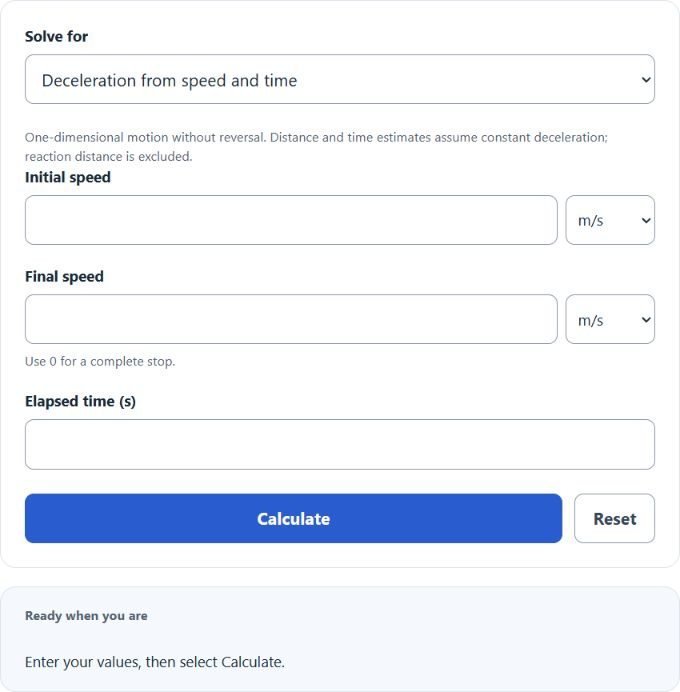
Deceleration uses a = (vi − vf) / t. A positive result means slowing down; signed acceleration has the opposite sign.