Calculate the average rate of change between two distinct function inputs, or the rate of gain from an initial value, final value, and elapsed days. The average function rate is the secant slope; it is not an instantaneous derivative.
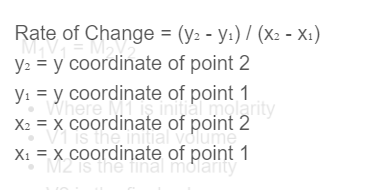
Rate of Change Formula
The following formula is used to calculate a rate of change.
y₂ = y coordinate of point 2
y₁ = y coordinate of point 1
x₂ = x coordinate of point 2
x₁ = x coordinate of point 1
To calculate the rate of change divide the change in y by the change in x position.
Rate of Change Definition
The rate of change of a line is often referred to as the slope, or rise over run. It's a measure of how quickly a line is changing in the y-direction with every step in the x-direction.
Swapping x and y gives the average change in x with respect to y, provided the change in y is nonzero.
How to calculate a rate of change?
How to calculate a rate of change?
- First, determine the coordinate points of point 1.
For this example we will say the first point is (1,2).
- Next, determine the coordinate points of point 2.
For this example, we will say the second point is (5,10).
- Finally, calculate the rate of change.
Using the formula we find the rate of change to be (10 − 2)/(5 − 1) = 8/4 = 2.
FAQ
An average rate of change is a change in output divided by a nonzero change in input. The input can be time or another quantity.
Yes, a slope is another word for the rate of change of y with respect to x.