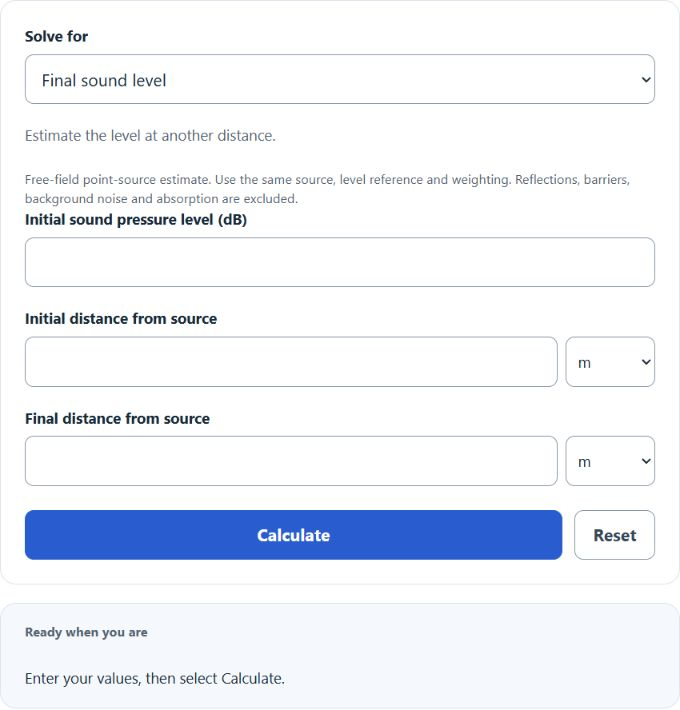
Calculate the missing sound level or distance from initial and final dB readings using the 20×log10 distance relationship and unit conversions for meters, feet, cm and inches.
- All Physics Calculators
- All Distance Calculators
- Decibel Calculator
- dB Gain Calculator
- Insertion Loss Calculator
Decibel Distance Formula
The decibel distance calculator uses the inverse distance law for sound spreading in a free field. This means sound level decreases as distance from the sound source increases, assuming no major reflections, barriers, wind, or absorption effects.
- L1 = initial sound level, in decibels (dB)
- L2 = final sound level, in decibels (dB)
- D1 = initial distance from the source
- D2 = final distance from the source
To solve for the initial sound level, the formula is rearranged as:
To solve for the final distance, the formula is rearranged as:
To solve for the initial distance, the formula is rearranged as:
Choose the sound level or distance to solve, then enter the other three values. Distances can be entered in meters, feet, centimeters, or inches. Internally, distance values are converted to meters for the calculation, then converted back to the selected output unit.
Common Distance Changes and Decibel Drop
These values assume free-field spreading from a point source. A doubling of distance lowers the sound level by about 6 dB.
| Distance Change | Distance Ratio | Approximate Level Change |
|---|---|---|
| Distance doubles | 2:1 | -6.02 dB |
| Distance triples | 3:1 | -9.54 dB |
| Distance increases 10 times | 10:1 | -20 dB |
| Distance is cut in half | 1:2 | +6.02 dB |
Example Calculations
Example 1: Find the sound level at a farther distance
You measure 90 dB at 1 meter and want to estimate the sound level at 4 meters.
The estimated sound level at 4 meters is 77.96 dB.
Example 2: Find the distance needed for a lower sound level
A sound is 100 dB at 2 meters. You want to know the distance where it will be 80 dB.
The estimated distance for 80 dB is 20 meters.
FAQ
Why does the formula use 20 log instead of 10 log?
The distance relationship is based on sound pressure level, not sound power level. Sound pressure decreases in inverse proportion to distance, and decibels for pressure ratios use 20 log10. Sound power ratios use 10 log10.
Does sound always drop by 6 dB when distance doubles?
It is a good estimate for a point source in a free field, such as an open outdoor area with little reflection. Indoors, near walls, near the ground, or around barriers, the actual change can be different because reflected sound and absorption affect the measured level.
Can this be used for feet and meters together?
Yes. The distance ratio must use consistent units, so the calculator converts all distance inputs to meters before applying the formula. You can enter the initial distance in one unit and the final distance in another unit.