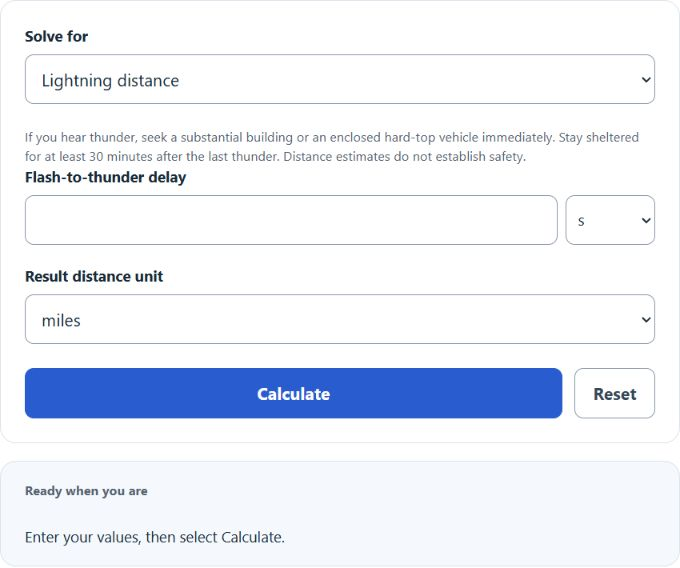
Estimate lightning distance from thunder delay, or find the delay from a known distance, using 343 m/s and seconds, minutes, hours, miles, kilometers, or meters. If thunder is audible, move immediately to a substantial building or an enclosed hard-top vehicle and remain sheltered for at least 30 minutes after the last thunder; this distance estimate does not determine safety.
Lightning Distance Formula
The lightning distance calculator estimates how far away a lightning strike occurred by measuring the delay between the flash and the sound of thunder. For normal storm distances, the light from the strike reaches you almost immediately, so the time gap is mainly the time required for sound to travel through the air.
- D = distance to the lightning strike
- T = time delay between the flash and the thunder
- SS = speed of sound in air
If you know the distance and want to estimate the delay you should hear, the equation can be rearranged as follows:
Unit Versions of the Formula
This calculator uses a constant sound speed of 343 m/s, typical near 20°C. Its distance and time conversions use exact unit factors. In common units:
For quick mental estimates outdoors, many people use these simple approximations:
The calculator retains more numerical precision than these rules of thumb. Atmospheric variability still limits accuracy; a longer delay does not indicate that remaining outdoors is safe.
How to Use the Lightning Distance Calculator
- From safe shelter, note a visible lightning flash. Do not remain outdoors to time thunder.
- Start counting immediately in seconds.
- Stop when you hear the thunder from that flash.
- Enter the time delay to calculate distance, or enter distance to calculate the expected delay.
- Select the unit you want to view: meters, kilometers, or miles.
This calculation is especially helpful when you want a quick estimate of storm proximity without doing unit conversions by hand.
Quick Reference Table
| Thunder Delay | Distance (meters) | Distance (kilometers) | Distance (miles) |
|---|---|---|---|
| 3 seconds | 1,029 m | 1.03 km | 0.64 mi |
| 5 seconds | 1,715 m | 1.72 km | 1.07 mi |
| 10 seconds | 3,430 m | 3.43 km | 2.13 mi |
| 15 seconds | 5,145 m | 5.15 km | 3.20 mi |
| 20 seconds | 6,860 m | 6.86 km | 4.26 mi |
| 30 seconds | 10,290 m | 10.29 km | 6.39 mi |
Why the Estimate Works
Lightning and thunder come from the same event, but they travel to you at very different speeds. The flash is electromagnetic radiation, which arrives effectively instantly at local storm distances. Thunder is a pressure wave moving through air, so it takes much longer to arrive. That travel-time difference makes distance estimation possible.
What Affects Accuracy?
The calculator is very useful for real-world estimates, but the result is still an approximation. Actual thunder travel can vary because of:
- Air temperature: sound travels faster in warmer air and slower in colder air.
- Wind: wind can carry sound toward you or away from you.
- Terrain and buildings: hills, trees, and structures can reflect or distort thunder.
- Storm geometry: the part of the cloud you see may not be the exact point producing the thunder you hear most clearly.
Even with those variables, the flash-to-thunder method remains one of the simplest and most practical ways to estimate nearby lightning distance.
Practical Interpretation
- Short delay: the storm is very close.
- Longer delay: the strike occurred farther away.
- Decreasing delay over time: the storm may be moving toward you.
- Increasing delay over time: the storm may be moving away.
FAQ
Does this calculator measure the distance to the storm or to one lightning strike?
It estimates the distance to the specific lightning event associated with the flash and thunder you observed. Because thunderstorms are spread out, different strikes can occur at different distances from your location.
Why is the answer sometimes given in miles and sometimes in kilometers?
The underlying calculation is the same. The only difference is the unit used for reporting the final distance. This calculator lets you switch between metric and imperial units for convenience.
Can I use minutes instead of seconds?
Yes. If the calculator allows minutes or hours, it converts that value into seconds before applying the same distance formula.
Why doesn’t thunder always sound immediate after the flash?
Thunder is sound, and sound moves much more slowly than light. The larger the delay, the farther the lightning occurred from your position.
Is the result exact?
No. It is a practical estimate based on a constant speed of sound. Real atmospheric conditions can change the result; numerical precision is not evidence of a safe distance.