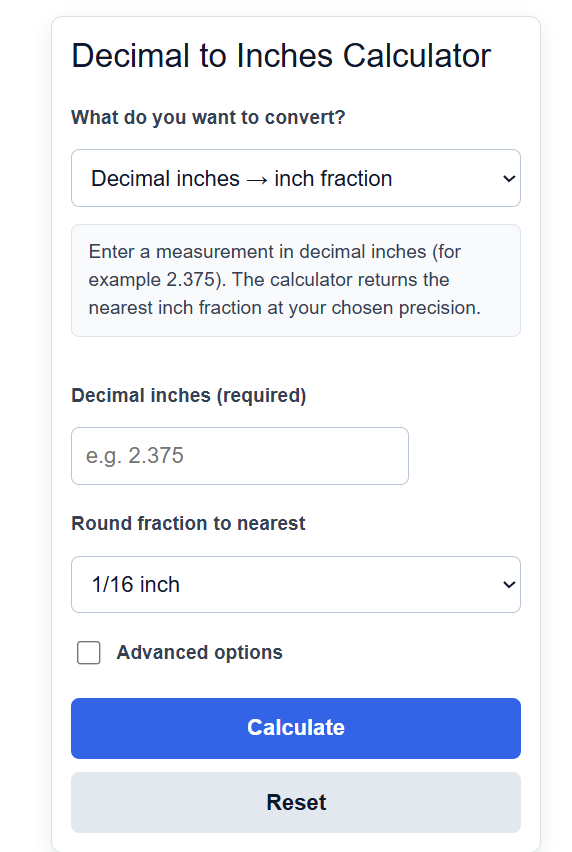
Convert decimal inches, decimal feet, or metric lengths to reduced inch fractions, or reverse a mixed fraction to decimal and metric values with rounding error.
Decimal to Inches Formula
To turn a decimal measurement into the nearest inch fraction, separate the whole inches from the leftover decimal, multiply that leftover by the fraction denominator you want, round to a whole number, and place it over the denominator.
Fraction = round((D - floor(D)) * N) / N
The other modes feed into the same step after a unit change:
Inches = Feet * 12
Inches = Millimeters / 25.4
Decimal = Whole + Numerator / Denominator
- D: the measurement in decimal inches.
- floor(D): the whole inches, found by dropping everything after the decimal point.
- N: the fraction denominator, such as 16, 32, or 64, which sets the precision.
- Feet: a length given in decimal feet, such as 5.5.
- Millimeters: a metric length; centimeters and meters are converted to millimeters first.
- Whole, Numerator, Denominator: the parts of an inch fraction such as 2 and 3/8.
The decimal inches mode rounds the decimal part to the closest fraction at your chosen denominator and reduces it to lowest terms, so 6/16 is shown as 3/8. The decimal feet mode multiplies by 12 first, then splits the result into feet, inches, and a fraction. The metric mode divides by 25.4 to get decimal inches before rounding. The fraction mode runs in reverse, adding the whole inches and the fraction together to give an exact decimal value. A higher denominator gives a closer fraction but a smaller rounding error.
Common Decimal and Metric Equivalents
These charts show how everyday decimal inch values and millimeter readings line up with standard inch fractions at 1/16 inch precision.
| Decimal Inches | Nearest Fraction |
|---|---|
| 0.0625 | 1/16″ |
| 0.125 | 1/8″ |
| 0.25 | 1/4″ |
| 0.375 | 3/8″ |
| 0.5 | 1/2″ |
| 0.625 | 5/8″ |
| 0.75 | 3/4″ |
| 0.875 | 7/8″ |
| Millimeters | Decimal Inches | Nearest 1/16″ |
|---|---|---|
| 1 mm | 0.039″ | 1/16″ |
| 5 mm | 0.197″ | 3/16″ |
| 10 mm | 0.394″ | 3/8″ |
| 25.4 mm | 1.000″ | 1″ |
| 50 mm | 1.969″ | 2″ |
For most woodworking and home projects, rounding to the nearest 1/16 inch matches a standard tape measure. Machining and metalwork often use 1/32 or 1/64 inch for a closer match.
Example Problems
Example 1. You measure 2.375 decimal inches and want the nearest 1/16 inch fraction. The whole part is 2 inches. The decimal part is 0.375. Multiply 0.375 by 16 to get 6, so the fraction is 6/16, which reduces to 3/8. The answer is 2 3/8 inches.
Example 2. A drawing lists 10 millimeters and you need an inch fraction at 1/32 inch precision. Divide 10 by 25.4 to get 0.3937 decimal inches. Multiply 0.3937 by 32 to get 12.6, which rounds to 13, so the fraction is 13/32 inch.
Frequently Asked Questions
How do you convert a decimal to inches? Keep the whole number as whole inches. Take the decimal part, multiply it by the denominator you want (16 for sixteenths, 32 for thirty-seconds), round to the nearest whole number, and write that over the denominator. Reduce the fraction if both numbers share a common factor.
Why is my fraction slightly off from the decimal? Inch fractions use denominators that are powers of two, so most decimals do not land exactly on a fraction. The calculator picks the closest available fraction and reports the small rounding error so you can see how far off it is. Choosing a larger denominator lowers that error.
What precision should I use? Use 1/16 inch for general carpentry and tape measure work, 1/32 inch for trim and cabinetry, and 1/64 inch for fine machining or metalwork. A larger denominator gives a more exact fraction but smaller, harder to read markings.