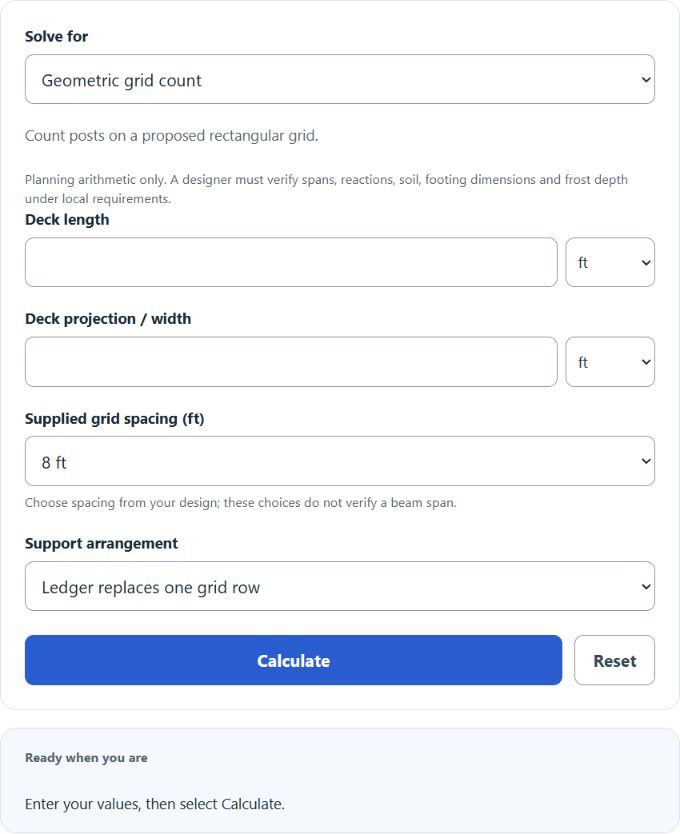
Estimate a proposed grid count, calculate bearing area from a supplied footing reaction, or estimate concrete for chosen round-footing dimensions. These planning calculations do not establish structural adequacy.
- All Construction Calculators
- Deck Picket Calculator
- Deck Board Calculator
- Deck Weight Limit Calculator
- Deck Post Spacing Calculator
- Deck Strength Calculator
- Load Per Square Foot Calculator
- Concrete Yield Calculator
Deck Footing Formula
The following formulas are commonly used for a simplified estimate of the required bearing area per footing and the equivalent round footing diameter (bearing only):
Variables:
- Af is the required footing bearing area per footing (ft²)
- L is the length of the deck (ft)
- W is the width of the deck (ft)
- q is the design surface load on the deck (psf)
- SF is an additional safety factor (dimensionless, use 1 if your soil value is already allowable)
- R is the verified governing vertical reaction at the footing (lb); total deck load divided equally by the footing count is not generally its design reaction
- qallow is the allowable soil bearing pressure (psf)
- d is the equivalent round footing diameter corresponding to Af (inches)
To estimate bearing area only, obtain the governing footing reaction from the actual support configuration and applicable loading, then divide that reaction by verified allowable soil pressure. Apply an additional factor only when required by the design basis. An equivalent circle diameter does not check footing thickness, concrete, anchorage or minimum code dimensions.
What is a Deck Footing?
A deck footing is a crucial structural element that provides the foundation for a deck. It is typically made of concrete and is buried into the ground, acting as a base for the deck’s support posts. The footing is designed to distribute the weight of the deck and prevent it from sinking or shifting, which could lead to structural instability. The size and depth of the footing depend on the size and weight of the deck, the type of soil, and local building codes. It is essential to install the footing correctly to ensure the longevity and safety of the deck.
How to Calculate Deck Footing?
The following steps outline how to calculate the Deck Footing.
- First, determine the length of the deck (in feet).
- Next, determine the width of the deck (in feet).
- Next, calculate the area of the deck by multiplying the length and width (Area = Length × Width).
- Next, choose a design load q (psf) based on your local code and deck use (a common residential assumption is 50 psf total: 40 psf live + 10 psf dead, unless your code differs).
- Next, determine the actual support layout and governing reaction at each footing. Equal division of the entire deck load is only a hypothetical illustration; ledger support, tributary area, overhangs and continuous beams affect reactions.
- Next, determine the allowable soil bearing pressure and any additional safety factor, then calculate required bearing area per footing: Af = (Load per footing × Safety factor) / Allowable soil bearing. (For round footings, d = 12 × √(4Af/π).)
- Finally, choose a footing depth based on local requirements (often governed by frost depth) and, if needed, estimate concrete volume for your chosen diameter and depth. After inserting the variables, check your answer with the calculator above.
Example Problem:
Use the following variables as an example problem to test your knowledge.
Length of the deck (in feet) = 12
Width of the deck (in feet) = 8
Depth of the footing (in feet) = 2
Design load (psf) = 50
Allowable soil bearing (psf) = 1500
Number of footings = 6
Additional safety factor = 1.0
For an equal-load arithmetic illustration only, deck area = 12 × 8 = 96 ft² and total load = 96 × 50 = 4,800 lb. Dividing by six gives 800 lb; this is not a verified reaction for an actual deck. The Bearing area mode accepts 800 lb only if that reaction is appropriate for the design.
Required bearing area per footing = 800 / 1500 = 0.533 ft², which corresponds to an equivalent round footing diameter of about 9.9 inches (typically rounded up to a standard size per local code).