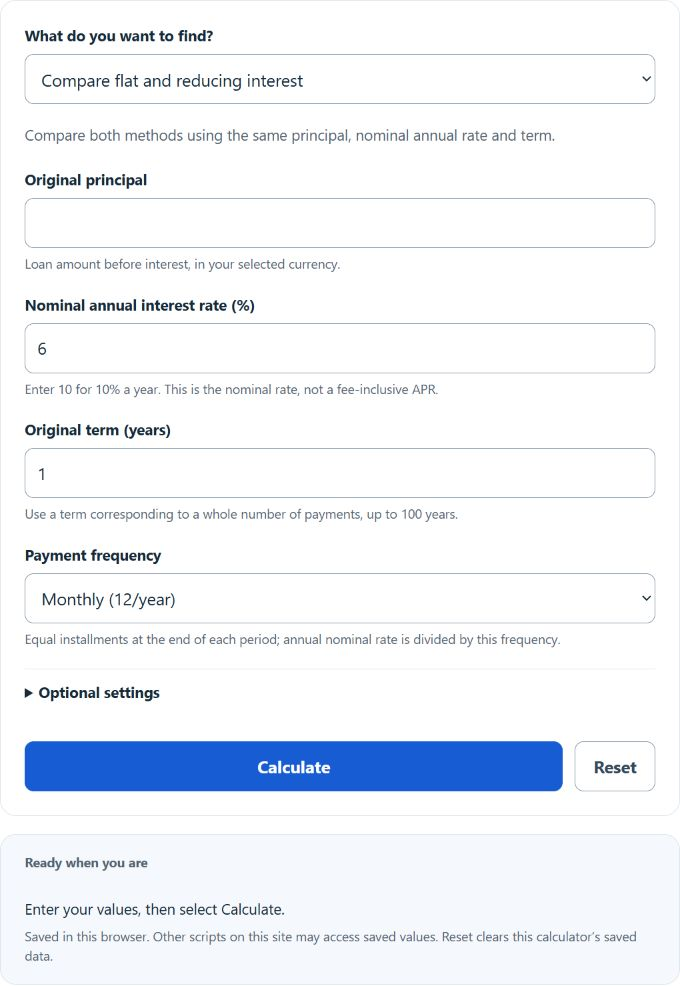
Compare flat and reducing-balance payments and total interest at the same nominal annual rate and term. You can also calculate a reducing-balance payment schedule or payoff time with optional extra principal.
Flat vs Reducing Interest Formula
A flat rate loan charges interest on the full original principal for the whole term, while a reducing balance loan charges interest only on the outstanding balance, which falls with every payment.
Flat EMI = (P + (P * R * T) / 100) / (T * 12)
Reducing EMI = (P * i * (1 + i)^n) / ((1 + i)^n - 1)
Where:
- P is the loan amount (principal).
- R is the annual interest rate as a percent.
- T is the loan tenure in years.
- i is the monthly interest rate, equal to R / 100 / 12.
- n is the total number of monthly payments, equal to T * 12.
For the scheduled flat method, total interest equals P * R * T / 100 and is split evenly across every month. Early settlement may involve an unearned-interest rebate or fees under the loan agreement. For the reducing method, each month's interest is charged on the remaining balance, so the interest share of each EMI shrinks over time and the total interest paid is lower for the same nominal rate.
Interest Cost Comparison
The table below compares total interest on a $100,000 loan over 5 years (60 months) at several nominal rates, calculated both ways. At these positive rates and this multi-payment term, flat interest is higher because it is based on the original principal rather than the declining balance.
| Nominal Rate | Flat Total Interest | Reducing Total Interest | You Save |
|---|---|---|---|
| 6% | $30,000 | $15,997 | $14,003 |
| 10% | $50,000 | $27,482 | $22,518 |
| 14% | $70,000 | $39,610 | $30,390 |
The two methods use different interest bases, so the same nominal rate does not mean the same cost. An equivalent reducing rate depends on the term and payment timing; fees also affect a loan’s APR.
Example
Suppose you borrow $100,000 at a 10% annual rate for 5 years.
Flat method: total interest is 100,000 * 10 * 5 / 100 = $50,000. Total payable is $150,000, and the monthly EMI is 150,000 / 60 = $2,500.00.
Reducing method: the monthly rate is 10 / 100 / 12 = 0.008333 and there are 60 payments. The EMI works out to $2,124.70, total payable is $127,482.27, and total interest is $27,482.27. Choosing the reducing balance loan saves $22,517.73 in interest for the same nominal rate.
FAQ
Why is a flat rate loan more expensive than a reducing balance loan at the same rate?
A flat rate charges interest on the original principal for the entire term, even though you are steadily paying that principal down. A reducing balance loan only charges interest on what you still owe, so the interest you pay falls every month.
How do I convert a flat rate to an effective reducing rate?
There is no universal multiplier. Match the actual payment cash flows over the same term and frequency, and include fees when comparing APR. This tool compares both methods at the same entered nominal rate; it does not convert a quoted flat rate into a fee-inclusive APR.
Which loans use which method?
Flat rates are common on some auto loans, personal loans, and short term consumer financing. Reducing balance is standard for mortgages, credit cards, overdrafts, and most student loans.