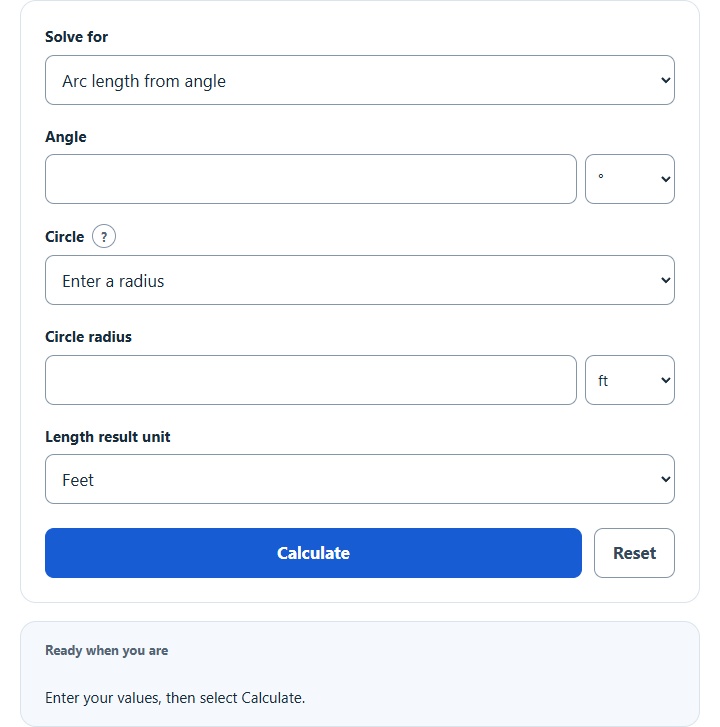
Convert degrees to feet as arc length from an angle and radius, find how many feet are in a degree of latitude, or convert feet back to degrees.
- All Unit Converters
- Arc Length Calculator
- Degrees to Inches Calculator
- DMS Calculator (Degrees Minutes Seconds)
- MOA Calculator (Minute of Angle)
- Central Angle Calculator
- Circle Length Calculator
Degrees to Feet Formula
For a circular arc, the following formula converts a nonnegative central angle in degrees to arc length in feet when the radius is known. An angle alone does not determine a length.
- Where L is the length in feet
- a is the angle in degrees
- r is the radius of the circle in feet
To calculate feet from degrees, divide the angle by 360, multiply by 2 times pi, then finally, multiply by the radius.
| Angle (°) | Arc @ 1 ft r (ft) | Arc @ 10 ft r (ft) | Arc @ 50 ft r (ft) | Arc @ 100 ft r (ft) |
|---|---|---|---|---|
| 0.5 | 0.009 | 0.087 | 0.436 | 0.873 |
| 1 | 0.017 | 0.175 | 0.873 | 1.745 |
| 2 | 0.035 | 0.349 | 1.745 | 3.491 |
| 3 | 0.052 | 0.524 | 2.618 | 5.236 |
| 5 | 0.087 | 0.873 | 4.363 | 8.727 |
| 7.5 | 0.131 | 1.309 | 6.545 | 13.090 |
| 10 | 0.175 | 1.745 | 8.727 | 17.453 |
| 12 | 0.209 | 2.094 | 10.472 | 20.944 |
| 15 | 0.262 | 2.618 | 13.090 | 26.180 |
| 20 | 0.349 | 3.491 | 17.453 | 34.907 |
| 22.5 | 0.393 | 3.927 | 19.635 | 39.270 |
| 30 | 0.524 | 5.236 | 26.180 | 52.360 |
| 45 | 0.785 | 7.854 | 39.270 | 78.540 |
| 60 | 1.047 | 10.472 | 52.360 | 104.720 |
| 75 | 1.309 | 13.090 | 65.450 | 130.900 |
| 90 | 1.571 | 15.708 | 78.540 | 157.080 |
| 120 | 2.094 | 20.944 | 104.720 | 209.440 |
| 135 | 2.356 | 23.562 | 117.810 | 235.619 |
| 180 | 3.142 | 31.416 | 157.080 | 314.159 |
| 360 | 6.283 | 62.832 | 314.159 | 628.319 |
| * Rounded to 3 decimals. Arc length s = r × θ, with θ in radians. Conversion: 1° ≈ 0.017453 rad, so per 1 ft radius: 1° ≈ 0.017 ft. | ||||
Longitude degrees to feet at a latitude
Select Longitude span at a latitude, enter the longitude difference in decimal degrees, and enter the geodetic latitude. North is positive and south is negative. The result follows the constant-latitude parallel on the WGS84 ellipsoid; it is not the shortest route between two coordinates. Enter an angular span, not an absolute longitude coordinate. At either pole, all longitudes meet and the parallel length is zero.
s = (π / 180) × Δλ × N × cos φ, where s is distance in meters, Δλ is the nonnegative longitude span in degrees, φ is latitude, and N = a / √(1 − e² sin² φ). The WGS84 parameters are a = 6,378,137 m and f = 1 / 298.257223563, with e² = f(2 − f). Divide meters by 0.3048 for international feet. This models the ellipsoid at zero height and excludes terrain and elevation.
For example, a 1° longitude span at 60° latitude is 55,800.002 m, or 183,070.871 ft, along the parallel. The same span at the equator is 111,319.491 m. The existing Earth, degrees of latitude option remains a spherical-Earth meridian estimate; the longitude mode accounts for the shrinking parallel radius as latitude approaches either pole.
Degrees to Feet Conversion
What is a conversion between degrees and feet?
Converting degrees to feet is typically talked about when looking at a circle and converting an angle to the corresponding length of the arc of that angle. For geographic latitude and longitude, select an appropriate Earth model; a longitude degree does not represent a constant surface distance at every latitude.
Example Problem
How to convert degrees to feet?
First, determine the total angle in degrees.
For this example, the angle is found to be 50 degrees.
Next, determine the radius of the circle that contains the angle.
In this case, the radius of the circle is measured to be 50 feet.
Finally, calculate the arc length in feet using the formula above:
L = (a/360)*2*pi*r
L = (50/360)*2*pi*50
L ≈ 43.633 feet