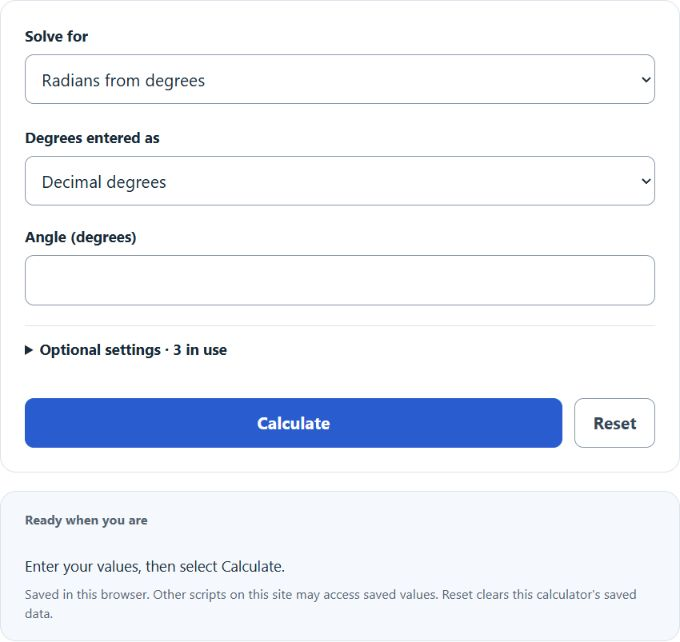
Calculate radians from degrees in one step with the degrees to radians calculator, plus convert radians to degrees and other angle units.
Degrees to Radians Formula
To convert an angle from degrees to radians, multiply the angle in degrees by pi and divide by 180.
rad = deg * pi / 180
To go the other way and convert radians to degrees, multiply the angle in radians by 180 and divide by pi.
deg = rad * 180 / pi
For any other angle unit, the conversion runs through a full circle, which equals 360 degrees, 2*pi radians, 400 gradians, or 1 turn.
rad = (value / unit per turn) * 2 * pi
- rad = angle measured in radians
- deg = angle measured in degrees
- pi = the constant 3.14159265..., the ratio of a circle's circumference to its diameter
- 180 = the number of degrees in a half circle (pi radians)
- value = the input angle in the chosen "from" unit
- unit per turn = how many of that unit make one full turn (360 for degrees, 400 for gradians)
The calculator uses the solve-for selector to pick a mode. "Radians from degrees" applies the first formula and can read degrees as a decimal or as degrees, minutes, and seconds. "Degrees from radians" applies the second formula and accepts a decimal value or a multiple of pi. "Convert between angle units" uses the general relationship to move between degrees, radians, gradians, turns, arcminutes, arcseconds, and milliradians. The decimal-places, trailing-zeros, and exact-pi options only change how the answer is displayed, not the underlying math.
Common Angle Conversions
These are the angles you meet most often in trigonometry. The radian column is shown both as a multiple of pi and as a decimal.
| Degrees | Radians (pi form) | Radians (decimal) |
|---|---|---|
| 0° | 0 | 0.0000 |
| 30° | pi/6 | 0.5236 |
| 45° | pi/4 | 0.7854 |
| 60° | pi/3 | 1.0472 |
| 90° | pi/2 | 1.5708 |
| 180° | pi | 3.1416 |
| 270° | 3pi/2 | 4.7124 |
| 360° | 2pi | 6.2832 |
One full turn in each angle unit the calculator supports is listed below. Dividing your value by these numbers tells you what fraction of a circle it represents.
| Unit | Amount in one full turn |
|---|---|
| Degrees | 360 |
| Radians | 2pi (about 6.2832) |
| Gradians | 400 |
| Turns | 1 |
| Arcminutes | 21,600 |
| Arcseconds | 1,296,000 |
| Milliradians | 2000pi (about 6283.2) |
Example Problems
Example 1: Convert 45 degrees to radians.
Start with the degrees to radians formula and substitute 45 for deg.
rad = 45 * pi / 180 = pi/4 = 0.7854 radians
Example 2: Convert pi/3 radians to degrees.
Use the radians to degrees formula and substitute pi/3 for rad.
deg = (pi/3) * 180 / pi = 180 / 3 = 60 degrees
FAQ
Why divide by 180 to get radians?
A half circle measures 180 degrees and also measures pi radians, so 180 degrees and pi radians describe the same angle. Multiplying by pi/180 swaps the degree scale for the radian scale while keeping the angle the same size.
How do I enter degrees, minutes, and seconds?
Set the solve-for mode to "Radians from degrees" and change the format to degrees, minutes, seconds. Choose the angle sign separately, then enter nonnegative whole degrees, arcminutes from 0 to 59, and arcseconds less than 60. Blank arcminutes or arcseconds mean zero. The sign applies to the whole angle, including negative angles smaller than one degree.
Can the answer stay as a multiple of pi?
Yes. The π form setting shows an exact fraction of pi for ordinary decimal-degree or DMS input and for entered coefficients of pi when an exact fraction can be represented. Decimal radians are treated as the entered number, without guessing an exact multiple of pi. Very long or scientific-notation entries may show only the numerical conversion.