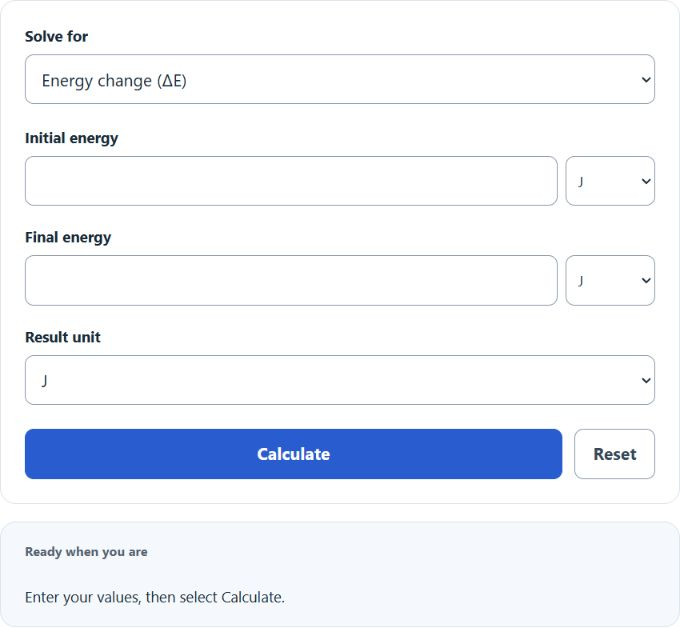
Calculate change in energy, heat from mass, specific heat and temperature change (constant heat capacity, no phase change), or energy from power and time using J, kJ, cal, BTU, kWh, W, and h.
Delta E Formula
The following formula is used to calculate the change in energy (ΔE) in a system:
Variables:
- ΔE is the change in energy
- E_final is the final energy state
- E_initial is the initial energy state
To calculate the change in energy, subtract the initial energy state from the final energy state.
What is a Delta E?
Delta E (ΔE) is the change in energy between two states of a system. It is found by subtracting the initial energy from the final energy. A positive value of ΔE means the system ended with more energy than it started with (energy gained), while a negative value means the system ended with less energy (energy lost). Energy is commonly reported in joules (J), but other units such as kJ, calories (cal, kcal), BTU (International Table), and kWh may also be used. The widget uses thermochemical calories and mechanical horsepower.
How to Calculate Delta E?
The following steps outline how to calculate the Delta E:
- Determine the initial energy state, Einitial, in a consistent unit (such as joules).
- Determine the final energy state, Efinal, in the same unit.
- Subtract the initial value from the final value: ΔE = Efinal − Einitial.
- If you are estimating energy transferred as heat during a temperature change (no phase change, c approximately constant), you can estimate sensible heat with q = m c ΔT using a heat capacity appropriate to the material and process. The dry-air quick fill uses constant-pressure cₚ and estimates enthalpy change, rather than constant-volume internal-energy change. If energy comes from a device running at constant power, you can use E = P t; power quick fills are illustrative and actual device power may vary.
- After inserting the values and calculating the result, check your answer with the Delta E calculator above.
Example Problem:
Use the following variables as an example problem to test your knowledge.
Initial energy state: Einitial = 250 kJ
Final energy state: Efinal = 325 kJ (so ΔE = 325 − 250 = 75 kJ)