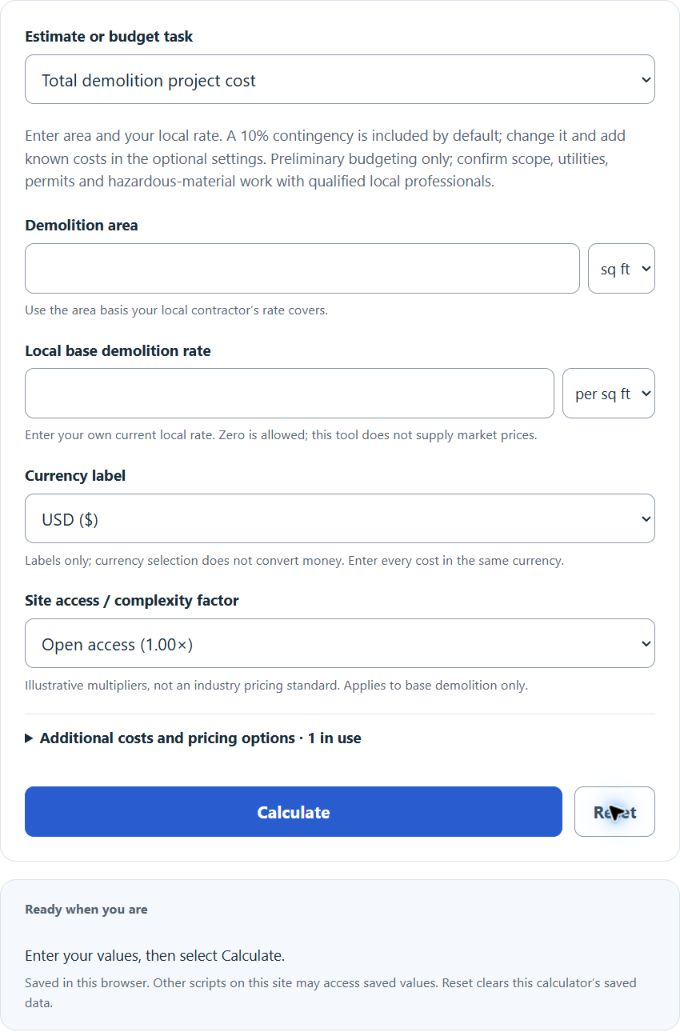
Estimate demolition costs by area and local rate, then add disposal, permits, hazardous materials, foundation removal, contingency, and contractor markup.
Related Calculators
- Gross Floor Area Calculator
- Waste Factor Calculator
- House Weight Calculator
- Building Coverage Calculator
- All Construction Calculators
Demolition Estimate Formula
This calculator uses your local base rate, an illustrative access factor and known added costs. It applies contingency and markup in sequence, then subtracts salvage credit:
B = A × r × x
D = B + F
T = D × (1 + c) × (1 + m) − S
r = [(T + S)/((1 + c)(1 + m)) − F]/(A × x)
Variables:
- T is the total estimated project cost, in the selected currency
- A is the demolition area, in square feet or square meters
- r is your local base cost per unit area; its units must match A
- x is the selected illustrative site access factor, from 1.00 to 1.50
- F is the sum of added disposal, permits, hazardous-material work, foundation removal and other direct costs
- c is contingency as a fraction; the default 10% is c = 0.10
- m is contractor markup as a fraction; for example, 20% is m = 0.20
- S is salvage or recycling credit, deducted last; B is base demolition and D is the direct subtotal
Multiply area by the matching local rate and access factor to obtain base demolition. Add the known direct costs, apply contingency, then apply markup, and subtract salvage. Do not add costs already included in the local rate. Budget mode rearranges this same equation to find the compatible base rate. A budget that exactly covers the added costs can yield a zero base rate; a lower budget is rejected.
What is a Demolition Estimate?
A demolition estimate is a detailed calculation of the costs associated with tearing down a structure, such as a building or a house. This estimate is typically provided by a professional demolition contractor and includes various factors such as the size and type of the structure, the materials used in its construction, the method of demolition to be used, the disposal of debris, and any necessary permits or inspections. The estimate may also factor in potential complications, such as the presence of hazardous materials like asbestos or lead, which require special handling and disposal. The demolition estimate provides a comprehensive overview of the expected costs, allowing property owners to budget appropriately for the project.
How to Calculate Demolition Estimate?
The following steps outline how to calculate a Demolition Estimate:
- First, determine the size of the structure to be demolished (in square feet).
- Next, determine the type of structure (e.g., residential, commercial, industrial).
- Next, obtain a current local base rate for the structure and material, and confirm which services it includes. Select a matching area unit.
- Calculate base demolition by multiplying area by the matching local rate and the selected access factor. The factors are illustrative assumptions, not an industry pricing standard.
- Consider additional factors that may affect the cost, such as hazardous materials removal, site accessibility, and disposal fees.
- Enter added costs and salvage in the optional settings. The default contingency is 10%; markup defaults to 0%. The calculator applies contingency before markup and deducts salvage last.
- Finally, present the Demolition Estimate to the client or relevant parties.
Example Problem:
Use the following variables as an example problem to test your knowledge:
Size of structure (in square feet) = 2000
Type of structure = Residential
Illustrative local base rate = USD 10 per square foot, not a current market-price recommendation. With area 2,000 sq ft, access factor 1.00, no added costs or credits, 10% contingency and 0% markup: base demolition = USD 20,000 and estimated total = USD 22,000. With USD 5,000 added costs, 20% markup and USD 1,000 salvage, the same example totals USD 32,000.