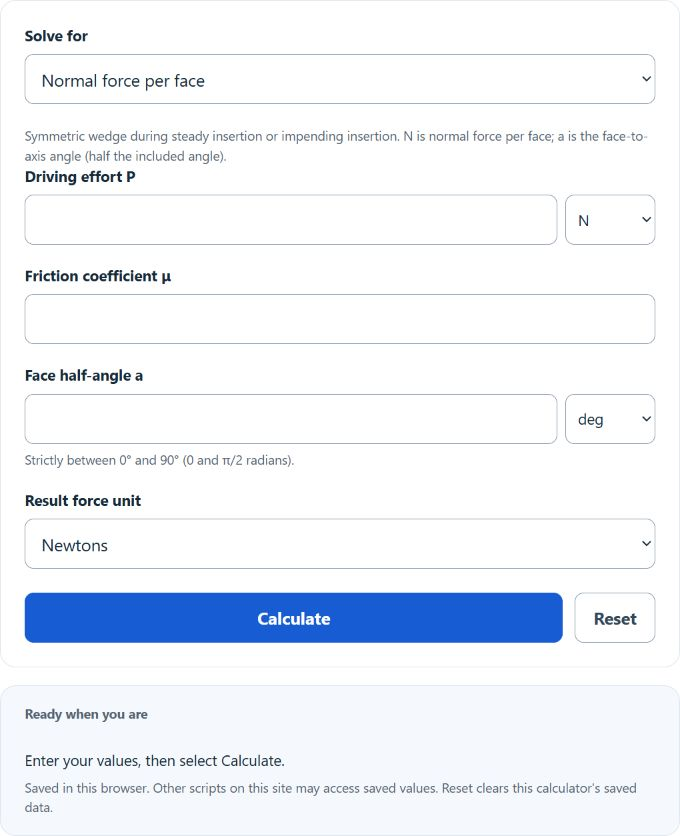
Calculate wedge force, effort force, coefficient of friction, or wedge angle from any 3 known values in degrees or radians for wedge design.
- All Physics Calculators
- All Force Calculators
- AMA (Actual Mechanical Advantage) Calculator
- Lever Force Calculator
- Screw Jack Force Calculator
- Toggle Force Calculator
- Effort Force Calculator
Wedge Force Formula
The wedge force calculator estimates the normal force on each face of a symmetric wedge during steady or impending insertion, assuming equal face friction and negligible wedge weight. Because a wedge converts input force through geometry, the final force depends on three things: the applied effort, the wedge angle, and the friction at the contact faces.
- WF = normal force on each wedge face, not total separating force
- EF = effort force applied to the wedge
- μ = coefficient of friction between the wedge and the contacting surfaces
- a = face-to-driving-axis half-angle, strictly between 0° and 90°; the included wedge angle is 2a
Input summary
| Input | Description | Typical Unit | Design Impact |
|---|---|---|---|
| Effort Force | The force used to drive the wedge forward | N, kN, lbf | Increasing effort force increases wedge force proportionally |
| Coefficient of Friction | Surface resistance between the wedge and mating faces | Unitless | Higher friction reduces the output force for the same effort |
| Wedge Angle | The face-to-axis half-angle (half the included angle) | Degrees or radians | For common wedge geometries, a smaller angle usually produces greater mechanical advantage |
| Wedge Force | The normal contact force on each face | N, kN, lbf | Used to evaluate separating, lifting, clamping, or splitting capability |
How to calculate wedge force
- Determine the effort force applied to the wedge.
- Estimate the coefficient of friction for the contacting materials.
- Measure the face-to-axis half-angle and enter it in degrees or radians.
- Evaluate the friction-and-angle term in the denominator.
- Divide the effort force by that term to find the wedge force.
For a fixed effort force, the wedge becomes less effective as friction increases. Likewise, angle matters greatly: shallow wedges can generate high force, but they typically require more travel and are more sensitive to friction.
Example calculation
If the effort force is 50 N, the coefficient of friction is 0.65, and the wedge angle is 35°, the wedge force is calculated as:
Rearranged forms
If you know the wedge force and need to solve for a different variable, these equivalent forms are useful:
The inverse can have two acute solutions. Let r = EF/(2WF), R = √(1+μ²) and φ = arctan(μ). Test both a = arcsin(r/R) − φ and a = π − arcsin(r/R) − φ, keeping only 0 < a < π/2 and merging coincident solutions. No solution exists if r/R > 1.
Low-friction case
When friction is very small and can be neglected, the formula simplifies to:
This shows why wedge angle alone can create large force multiplication: as the angle becomes smaller, the denominator decreases and the resulting wedge force increases.
Practical considerations
- Keep force units consistent throughout the calculation.
- The coefficient of friction is unitless, but it can vary significantly with lubrication, wear, surface finish, and contamination.
- Make sure the angle entered matches the exact angle definition used in your drawing or design notes.
- This equation is best suited to a symmetric wedge under steady loading conditions.
- Small errors in angle or friction can noticeably change the final result, especially for shallow wedges.
Common applications
Wedge force calculations are useful in machine design, clamping systems, lifting shims, splitting tools, alignment mechanisms, construction equipment, and any application where a small driving force is converted into a larger separating or normal force.