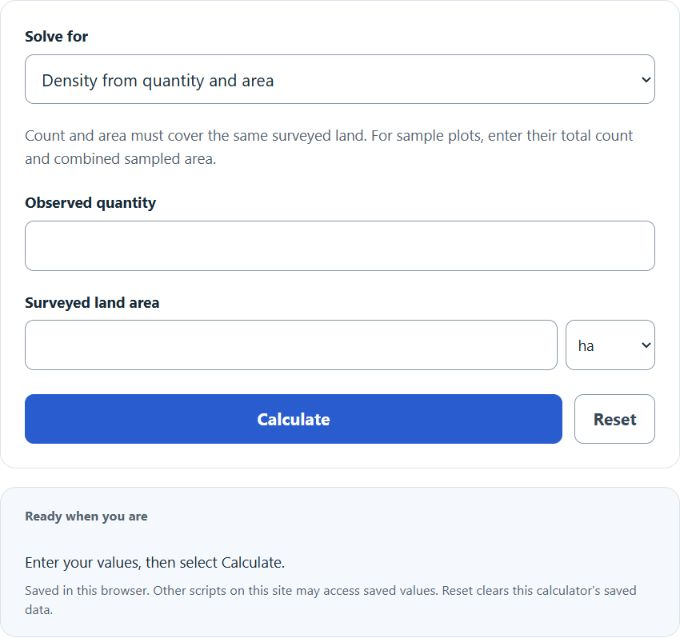
Calculate density per hectare, plan quantity with establishment losses, or reverse row spacing with acre and metric area conversions plus physical layout results.
Density Per Hectare Formula
Choose density, starting quantity, or in-row spacing in the Solve for menu.
Count and area:
Starting quantity:
In-row spacing:
- D = density per hectare
- N = total count on the surveyed land
- A_ha = land area converted to hectares
- D_target = desired established density per hectare
- N_start = whole starting quantity; ceil rounds upward
- P = whole items per planting position
- R = row spacing in meters
- S = in-row spacing in meters
- E = expected establishment percentage (greater than 0, up to 100)
One hectare equals 10,000 m². For sample plots, enter the combined observed count and combined sampled area in Density mode; extrapolation assumes representative sampling. Spacing assumes ideal uniform rows and excludes headlands, access lanes and boundary effects.
Reference Tables
The crop ranges below are retained only as illustrative numerical examples, not planting recommendations or verified local targets. Species, cultivar, climate and management affect an appropriate target; obtain current local agronomic guidance.
| Crop or stand | Illustrative range (per ha) |
|---|---|
| Field corn | 75,000–90,000 |
| Soybeans | 300,000–450,000 |
| Wheat | 2,000,000–4,000,000 |
| Apple orchard (semi-dwarf) | 800–1,500 |
| Apple orchard (high density) | 2,000–4,000 |
| Coffee | 2,500–10,000 |
| Pine plantation | 1,000–2,500 |
| Grapevines | 2,000–6,000 |
| Unit | Equals (in hectares) |
|---|---|
| 1 acre | 0.4047 ha |
| 1 km² | 100 ha |
| 1 mi² | 258.999 ha |
| 1 m² | 0.0001 ha |
| 10,000 m² | 1 ha |
Worked Examples
Count and area. You counted 1,250 trees on 3.5 hectares. Density = 1,250 ÷ 3.5 = 357.1 trees per hectare.
Sample plots. Six 5 m × 5 m plots contained 48 seedlings. Sampled area = 6 × 25 m² = 150 m² = 0.015 ha. Density = 48 ÷ 0.015 = 3,200 per hectare.
Starting quantity. A target of 1,000 established items per hectare over 2 hectares with 80% establishment needs ceil(1000 × 2 ÷ 0.8) = 2,500 starting items.
In-row spacing. A target of 50,000 established plants per hectare, 0.75 m rows, 95% establishment and one plant per position gives S = 10000 × 0.95 ÷ (50000 × 0.75) ≈ 0.253333 m.
Which method should you use? Use Density for an observed count over a known surveyed area. Use Starting quantity to plan for expected establishment losses, and In-row spacing for an ideal row layout. These calculations do not choose a suitable biological or agronomic target.