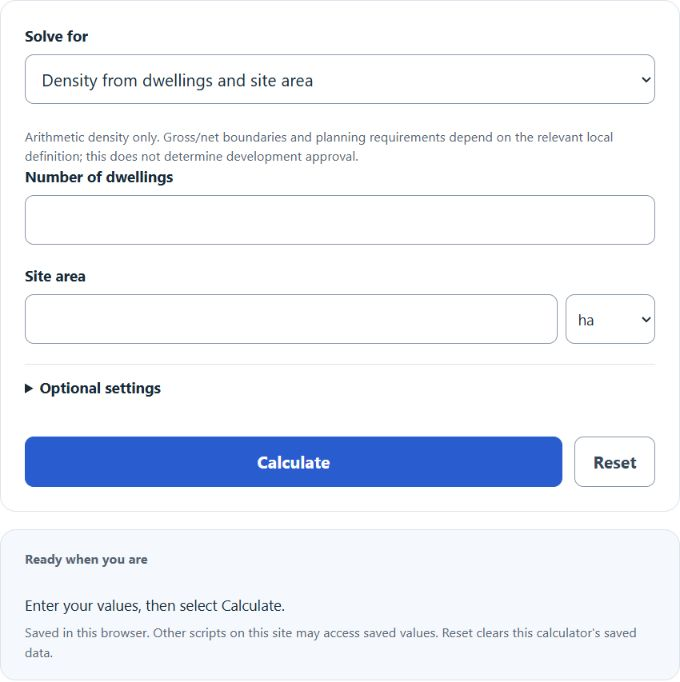
Calculate dwellings per hectare, land area, or total dwellings from any 2 values with acre, hectare, sqm, and sqkm unit conversions.
- All Construction Calculators
- Hectares Per Hour Calculator
- Cost Per Occupied Room Calculator
- Acreage Calculator – Find Acres From Land Dimensions
Dwellings Per Hectare Formula
The following formula is used to calculate the number of dwellings per hectare.
Variables:
- D/H is the number of dwellings per hectare
- TD is the total number of dwellings
- LA is the land area in hectares (1 hectare = 10,000 m² = 2.471 acres)
What is Dwellings Per Hectare?
Dwellings per hectare (DPH) divides a dwelling count by a defined land area. It is different from people per hectare: converting population density requires consistent dwelling-stock and occupancy data. A density calculation alone does not determine approval, infrastructure requirements or physical layout feasibility.
Illustrative Density Descriptions
| Classification | DPH Range | Typical Form |
|---|---|---|
| Very Low | < 10 | Rural, large-lot detached homes |
| Low | 10 to 20 | Suburban detached and semi-detached |
| Medium-Low | 20 to 40 | Terraced housing, townhouses |
| Medium | 40 to 80 | Low-rise flats, mixed-use blocks |
| High | 80 to 150 | Mid-rise apartments, urban infill |
| Very High | 150 to 400 | Urban core apartments |
| Ultra High | > 400 | High-rise towers, super-density developments |
Net vs. Gross Density: A Critical Distinction
Gross density uses the full selected site area. Net density uses the area remaining after exclusions under the chosen planning definition; which roads, open space and other uses are excluded varies. With deduction fraction r, net density = gross density / (1 − r). A 30% deduction gives a factor of 1/0.7, not a universal multiplier. Zero deduction gives equality, and zero dwellings gives both densities zero. Confirm the same definitions before comparing schemes.
Worked Density Comparisons
| Illustrative site | Dwelling density | Boundary |
|---|---|---|
| 120 dwellings / 3 ha | 40 dwellings/ha | Gross full site |
| Same 120 / 2.1 ha | 57.1429 dwellings/ha | After a chosen 30% deduction |
| 35 dwellings/ha × 2.4 ha | 84 dwellings | Matching area/density basis |
Planning Context
Planning standards depend on jurisdiction, policy version, site context and the definition of developable area. The National Planning Policy Framework applies to England; it is not a blanket UK-wide 30-DPH rule. The adopted London Plan Policy D3 uses a design-led approach to site capacity, not a universal 400-DPH cap. Consult the current adopted and emerging policies that apply to the actual site; this calculator applies no legal thresholds.
How to Calculate Dwellings Per Hectare
Divide whole dwellings by site area in hectares. For the optional net result, select the specific area or percentage excluded under your chosen definition. One international acre equals 0.40468564224 ha. Count mode multiplies density by area and rounds down; area mode divides count by density and retains the same gross/net basis as the entered density.
Example: A 3-hectare site contains 120 dwellings. D/H = 120 / 3 = 40 dwellings per hectare. If 30% of that gross site is excluded under the selected definition, net area is 2.1 ha and net density is 120 / 2.1 = approximately 57.1429 DPH. The illustrative descriptions above are not universal classifications or policy thresholds, and this arithmetic does not establish contribution requirements.