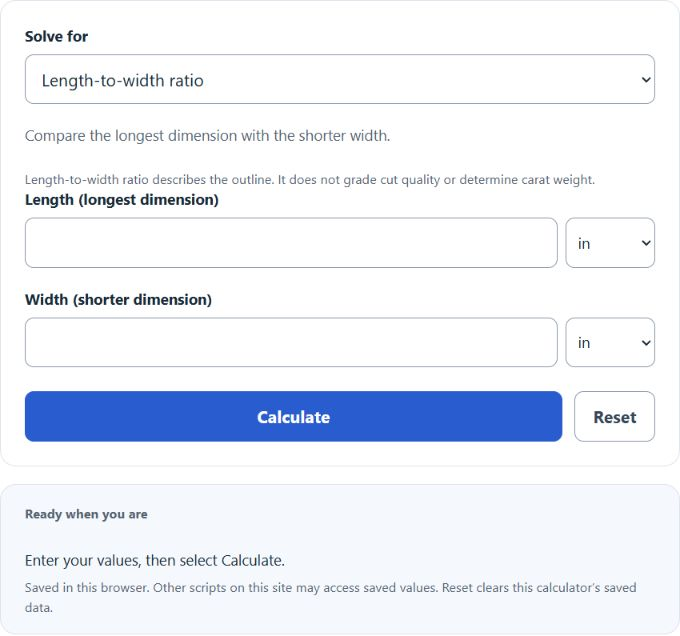
Calculate a diamond’s length-to-width ratio from length and width, or find the missing length, width, or ratio in inches, feet, cm, or meters.
- Gold Weight Calculator
- Price Per kg Calculator
- Cost Per Ounce Calculator
- Every Day Life And Education Calculators
- Pearl Weight Calculator
- Ring Size Calculator
Diamond Length-to-Width Ratio (L/W) Formula
The diamond length-to-width ratio compares the longest dimension of the diamond to its width. Select the ratio, length, or width to solve for, then enter the two required values. Length must be at least the width, and the L/W ratio must be at least 1.
- LWR = length-to-width ratio
- L = diamond length, measured along the longest dimension
- W = diamond width, measured across the shorter dimension
If you enter length and width, the calculator divides length by width to find the L/W ratio. If you enter width and the ratio, it multiplies them to find length. If you enter length and the ratio, it divides length by the ratio to find width.
The calculator converts length and width to inches internally before doing the calculation. This allows you to use different supported units, such as inches, feet, centimeters, and meters. The calculated length or width is displayed in the selected result unit.
Typical Diamond Length-to-Width Ratio Ranges by Shape
These ranges are illustrative visual preferences, not quality grades or universal targets. Appearance also depends on the diamond’s other proportions and facet arrangement.
| Diamond shape | Common L/W ratio range | General appearance |
|---|---|---|
| Round | 1.00 | Circular |
| Princess or square cushion | 1.00 to 1.05 | Square to very slightly rectangular |
| Oval | 1.30 to 1.50 | Balanced elongated oval |
| Emerald | 1.30 to 1.50 | Classic rectangle |
| Radiant | 1.00 to 1.45 | Square through elongated rectangle |
| Pear | 1.45 to 1.75 | Teardrop shape with moderate length |
| Marquise | 1.75 to 2.25 | Long, narrow outline |
Supported Unit Conversions
| Unit | Conversion to inches |
|---|---|
| Inches | 1 in = 1 in |
| Feet | 1 ft = 12 in |
| Centimeters | 1 cm ≈ 0.3937007874 in |
| Meters | 1 m ≈ 39.3700787402 in |
Example Problems
Example 1: Calculate the L/W ratio
A diamond has a length of 1.02 cm and a width of 0.68 cm.
The diamond has a length-to-width ratio of 1.50.
Example 2: Calculate the missing width
A diamond has a length of 1.05 cm and a target L/W ratio of 1.40.
The width is 0.75 cm.
FAQ
What is a good length-to-width ratio for a diamond?
A good ratio depends on the diamond shape. Round and square diamonds are usually close to 1.00. Ovals, emeralds, pears, and marquise diamonds usually have higher ratios because they are intentionally elongated. Use the ratio as a shape guide, not as a complete quality grade.
Does a higher L/W ratio mean the diamond is bigger?
No. The L/W ratio describes the outline shape, not the carat weight or total size. Two diamonds can have the same ratio but different carat weights, depths, and face-up measurements.
Can I use millimeter measurements?
The calculator fields support inches, feet, centimeters, and meters. If your diamond measurements are in millimeters, convert them to centimeters by dividing by 10. For example, 10.2 mm is 1.02 cm, and 6.8 mm is 0.68 cm.