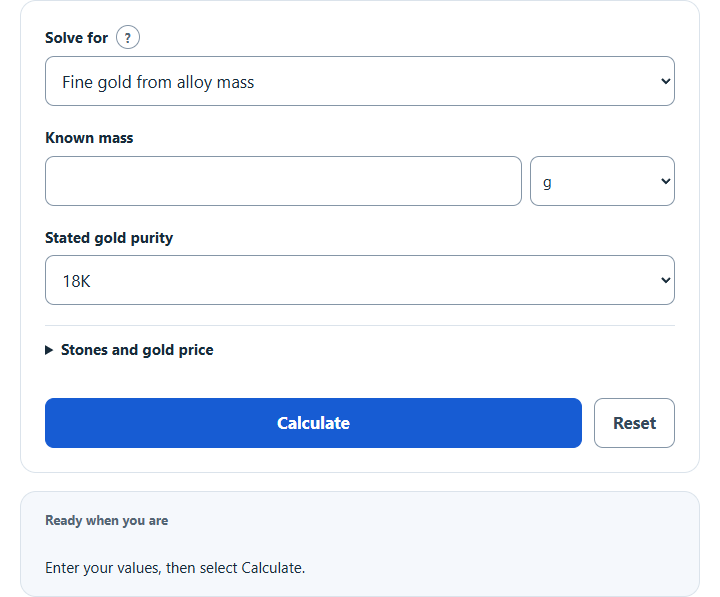
Calculate pure gold weight from gross or net weight and karat, deduct stones, see the value at your gold price, or estimate gold weight from dimensions.
- All Construction Calculators
- Karat to Percentage Calculator
- Gold Ring Weight Calculator
- Gold Density Calculator
- Coin Weight Calculator
- Gold Cost Per Pound Calculator
- Gold to Silver Price Ratio Calculator
- Price Per Gram Calculator
- Price Per Ounce Calculator
- Price Per Pound Calculator
- Cost Per Ounce Calculator
Gold Weight Formula
The following formula estimates fine-gold content from stated karat and total gold-alloy mass. The calculator also supports inverse alloy mass and four ideal solid shapes. Shape mass is volume × density; the default binary gold–copper model assumes additive component volumes and can differ from real alloys. Use known density when available.
- Where GW is the pure gold weight (ounces or grams)
- TW is the total weight of the gold metal piece (ounces or grams)
- K is the karat of the gold metal piece
Gold Weight Definition
Gold weight is defined as the actual weight of the pure gold in a piece of gold since most gold is not 100% pure gold and contains other metals and impurities.
How to calculate gold weight?
Example Problem #1:
First, determine the weight of the total gold/metal piece. For this problem, the total piece of gold is measured to be 400 grams.
Next, determine the stated karat. Nominal gold fraction is K/24; the 24K option models 100%. Use Custom percentage for actual assay purity, such as 99.9%.
In this case, the gold is determined to be a 10-karat gold piece.
Finally, calculate the weight of just the gold in the specimen using the formula above:
GW = TW * K / 24
= 400 * 10/24
≈ 166.67 grams of pure gold, rounded to two decimals.
Example Problem #2:
In this next example, the alloy mass is 300 grams and stated purity is 15 karats. Select Custom karat and enter 15.
Using the formula as we did above:
GW = TW * K / 24
= 300 * 15/24
= 187.5
In this case, even though the total weight was less, the gold weight was more because the specimen was of higher purity.