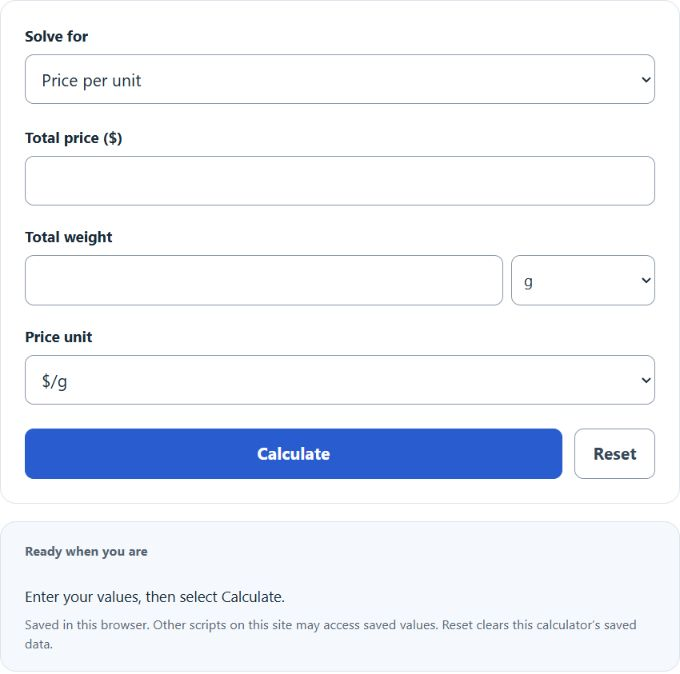
Calculate price per gram, total cost, or weight by entering any two values, with support for grams, kilograms, ounces, pounds, and more.
Watch the full explainer with transcript and worked examples.
Price Per Gram Formula
The following formula is used to calculate the price per gram of any item:
PPG = TP / TW
- PPG = price per gram ($/g)
- TP = total price of the item ($)
- TW = total weight of the item in grams (g)
If the weight is given in another unit, convert it to grams first. There are 28.3495 grams in one avoirdupois ounce, 31.1035 grams in one troy ounce (used for precious metals), and 453.592 grams in one pound. The calculator above handles all of these conversions automatically.
What Is Price Per Gram?
Price per gram is a unit rate that expresses how much one gram of a substance or product costs. It is calculated by dividing the total price of an item by its total weight in grams. This metric allows you to make direct cost comparisons between products that come in different package sizes, weights, or units — something a sticker price alone cannot do.
Price per gram is used across a wide range of everyday and professional scenarios:
Precious metals and jewelry: Gold, silver, and platinum are priced globally by the troy ounce but frequently bought and sold in gram increments. Metal prices fluctuate; use a current quote and the correct purity rather than treating the numerical example below as a live market price. Jewelers, pawn shops, and bullion dealers all rely on the price-per-gram calculation to value items and determine fair buy/sell prices. If you are purchasing a gold ring or chain, knowing the per-gram cost of the metal helps you evaluate how much of the retail price is material versus craftsmanship and markup.
Grocery shopping and food: Supermarkets often display a “unit price” on shelf tags, but the units vary — some show price per ounce, others per 100 grams, others per pound. Converting everything to a price per gram gives you a single standard for comparison. This is especially useful for items like spices, coffee, cheese, deli meats, and specialty ingredients where package sizes differ significantly between brands. A 50-gram jar of saffron at $12.00 costs $0.24/g, while a 2-gram packet at $8.00 costs $4.00/g — about a 16.7× difference that is invisible without per-gram pricing.
Supplements and health products: Protein powders, creatine, vitamins, and herbal supplements are sold in containers ranging from a few grams to several kilograms. The per-gram price reveals the actual cost efficiency of each product, cutting through marketing claims about serving sizes and scoops.
3D printing and manufacturing: Filament for 3D printers is sold by the kilogram, and the cost per gram of material directly affects the cost of each printed part. Engineers and hobbyists use price per gram to estimate production costs and compare material options like PLA, ABS, PETG, and specialty resins.
Price Per Gram Examples
Example 1: Valuing a Gold Chain
You are considering purchasing a 14K gold chain that weighs 22 grams. The jeweler is asking $2,850. What is the price per gram, and how does it compare to the raw gold value?
First, calculate the price per gram of the chain:
PPG = $2,850 / 22 g = $129.55 per gram
Using nominal 14K purity of 14/24, a hypothetical pure-gold quote of $162/g gives a metal value of $162 × 14/24 = $94.50 per gram of chain. The retail difference is about $35.05/g, or 37.1% above that metal value (27.1% of the retail price). This difference can include labor, design and margin; it does not establish a fair purchase or resale price.
Example 2: Comparing Coffee Prices
You are deciding between two bags of coffee at the store:
- Brand A: 340 g bag for $14.99
- Brand B: 1 lb (453.6 g) bag for $17.49
Calculate each:
- Brand A: $14.99 / 340 = $0.0441 per gram
- Brand B: $17.49 / 453.6 = $0.0386 per gram
Brand B costs about 12.5% less per gram despite the higher sticker price. Over a year of daily coffee, that difference adds up. Calculate each product separately using the same price unit to compare them.
Example 3: 3D Printing Filament
You need to estimate material cost for a part that will use 38 grams of PLA filament. A 1 kg spool costs $24.00.
PPG = $24.00 / 1,000 g = $0.024 per gram
Material cost for the part = 38 g × $0.024/g = $0.91
If a specialty carbon-fiber PLA spool costs $45.00 per kilogram ($0.045/g), the same part would cost $1.71 in material — nearly double. The per-gram price makes this trade-off easy to quantify.
Price Per Gram vs. Price Per Ounce
In the United States, most consumer products are labeled in ounces or pounds, while in most other countries grams and kilograms are standard. This creates confusion when comparing prices internationally or across product categories. Here is how the units relate:
- 1 avoirdupois ounce = 28.3495 grams (used for food, shipping, everyday items)
- 1 troy ounce = 31.1035 grams (used exclusively for precious metals)
- 1 pound = 453.592 grams = 16 avoirdupois ounces
- 1 kilogram = 1,000 grams = 35.274 avoirdupois ounces
The difference between avoirdupois and troy ounces trips up many people. A troy ounce is about 10% heavier than a standard ounce. If gold is quoted at $5,030 per troy ounce, dividing by 28.35 (standard ounce) instead of 31.10 (troy ounce) would overstate the per-gram price by roughly 10%. This calculator handles both systems correctly through the unit dropdown.