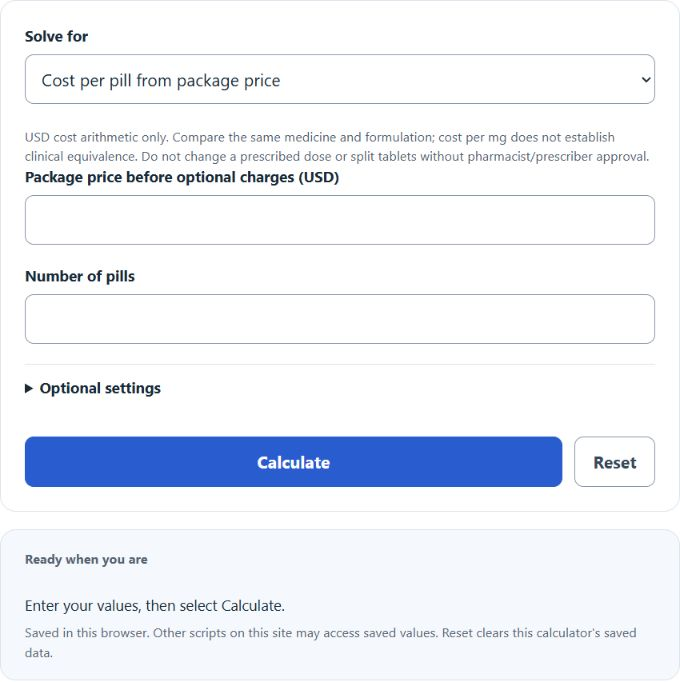
Calculate cost per pill from package price and pill count, plus cost per dose, cost per mg, days supply, and daily, monthly and yearly medication cost.
Cost Per Pill Formula
The basic cost per pill formula divides the total cost by the number of pills:
To calculate total cost instead, multiply the cost per pill by the number of pills:
To calculate the number of pills, divide the total cost by the cost per pill:
All monetary inputs and outputs use USD. No currency conversion is performed. Optional tax applies to package price only and rounds to cents before fees are added.
- CPP = cost per pill
- TC = total cost
- P = number of pills
- Adjusted total = package price plus optional tax and fees
- USD = the fixed monetary unit; no exchange rate is used
Choose a solve mode, then enter its labeled inputs. Cost per pill supports optional fees, tax, strength and an existing prescribed schedule. Total cost and budget capacity use the final unit price with no extra charges. Compare two packs on the same medicine/formulation and cost scope; strength and existing-dose inputs change the arithmetic comparison basis without assessing clinical equivalence.
Common Ways to Interpret Cost Per Pill
| Result | What it means | Example use |
|---|---|---|
| Low cost per pill | Each individual pill costs less. | Comparing bulk bottles or larger prescription fills. |
| High cost per pill | Each individual pill costs more. | Checking brand-name, specialty, or smaller-count packages. |
| Same total cost, more pills | The cost per pill decreases. | Comparing 30-count and 90-count options. |
| Same pill count, lower total cost | The cost per pill decreases. | Comparing pharmacies, discounts, or insurance prices. |
Cost per mg is not proof that products are interchangeable. Only compare an existing prescribed dose when it can be formed exactly from whole tablets, or halves explicitly approved for both exact products by a pharmacist or prescriber. Arbitrary tablet portions and a medically preferred product are not inferred. Incomplete leftover pieces are excluded from complete-dose pack counts. See FDA tablet-splitting guidance.
Sample Cost Per Pill Comparisons
| Total cost | Number of pills | Cost per pill |
|---|---|---|
| $12.00 | 30 | $0.40 |
| $25.00 | 100 | $0.25 |
| $48.00 | 120 | $0.40 |
| $90.00 | 180 | $0.50 |
Example Calculations
Example 1: Find cost per pill
You paid $36 for 90 pills. Use the formula:
Substitute the values:
The cost per pill is $0.40.
Example 2: Find total cost
A pill costs $0.75 and you need 60 pills. Use the formula:
Substitute the values:
The total cost is $45.00.
FAQs
What is cost per pill?
Cost per pill is the price of one pill. It is found by dividing the total cost by the number of pills. For example, if a bottle costs $20 and contains 50 pills, the cost per pill is $0.40.
Should shipping, tax, or fees be included in total cost?
Include them if you want the true out-of-pocket cost per pill. If you only want to compare listed product prices, leave shipping, tax, or extra fees out. Use the same method for every option you compare.
Can the number of pills result be a decimal?
Package counts and requested pill counts must be whole. Budget capacity rounds down to whole pills without exceeding the entered unit-price budget; actual dispensing and pack rules may differ. Dose-equivalents and days supply may be fractional arithmetic outputs. Do not alter a prescribed dose to fit a budget.