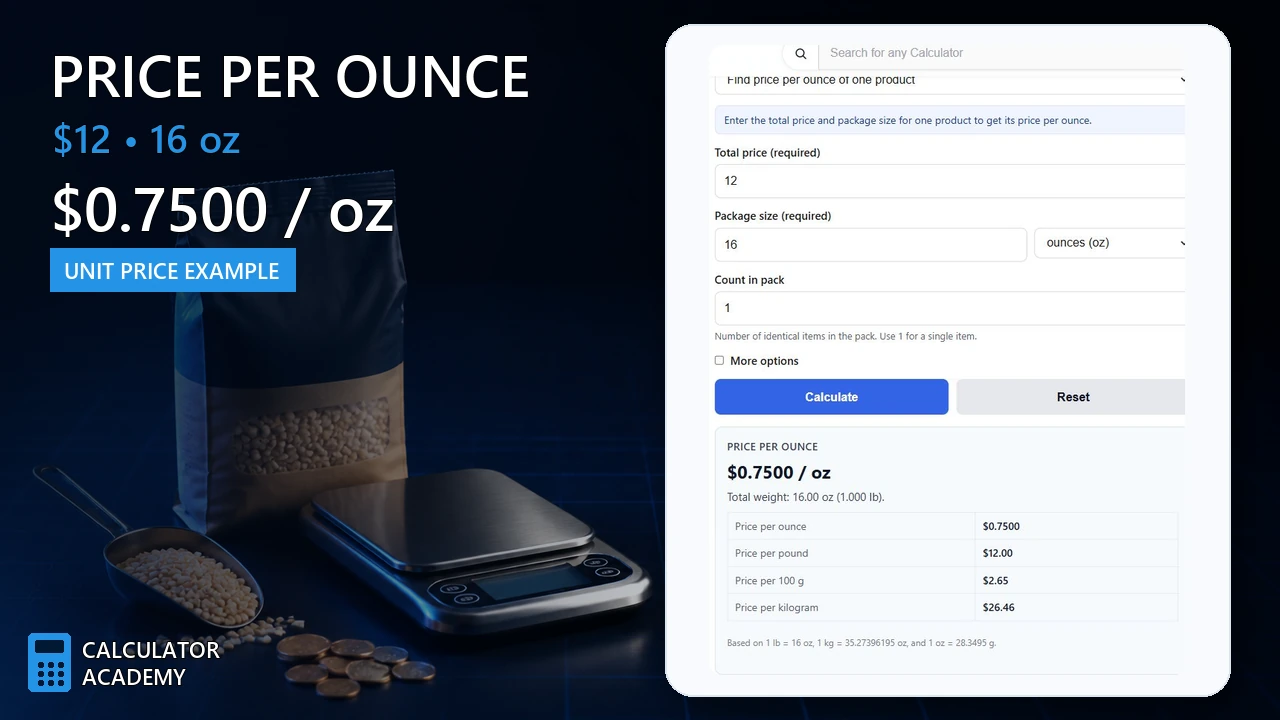
Compare package prices by entering total cost, size, unit, and count to find price per ounce, per pound, per 100 g, and the cheaper option.
Price Per Ounce Formula
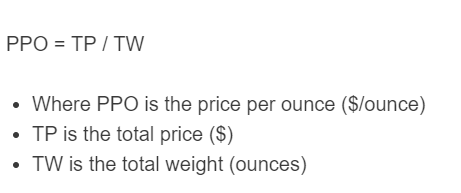
The calculator converts every package to ounces, then divides price by weight. The Compare mode runs the formula twice and reports the lower result. Target mode rearranges the formula to solve for total price.
- Total Price – the shelf price you pay for the pack.
- Package Size – the net weight on the label, in oz, lb, g, kg, or mg.
- Count – number of identical items in the pack (use 1 for a single item).
- Target $/oz – the unit price you are willing to pay.
Unit conversions used: 1 oz = 28.349523125 g, 1 lb = 16 oz, 1 kg = 35.27396195 oz.
Compare calculates $/oz for two products and shows which is cheaper, the gap per ounce, and the percent difference. Single item returns the unit price plus equivalents in $/lb and $/100 g. Target price works backward, telling you the maximum total price that hits your $/oz goal for a given package.
Reference Tables
Use these to sanity-check a result or convert between common units of pricing.
| If price per oz is | Per pound | Per 100 g | Per kg |
|---|---|---|---|
| $0.10 | $1.60 | $0.35 | $3.53 |
| $0.25 | $4.00 | $0.88 | $8.82 |
| $0.50 | $8.00 | $1.76 | $17.64 |
| $1.00 | $16.00 | $3.53 | $35.27 |
| $2.50 | $40.00 | $8.82 | $88.18 |
| $5.00 | $80.00 | $17.64 | $176.37 |
| Unit on label | Convert to oz |
|---|---|
| 1 lb | 16 oz |
| 1 kg | 35.274 oz |
| 100 g | 3.527 oz |
| 1 g | 0.0353 oz |
| 1000 mg | 0.0353 oz |
Worked Examples and FAQ
Example 1. A 12 oz bag of coffee costs $8.99. Price per ounce = 8.99 / 12 = $0.749/oz. A 32 oz bag at $19.99 works out to 19.99 / 32 = $0.625/oz. The larger bag is cheaper by about $0.12 per ounce, roughly 17% less.
Example 2. You want to pay no more than $0.40/oz for cereal. For an 18 oz box, the target total price is 0.40 × 18 = $7.20. Anything at or below $7.20 meets the target.
Does package size always matter? No. The calculator assumes you will use everything you buy. If a larger pack expires before you finish it, the effective unit price goes up.
Why does the result show $/lb and $/100 g too? Store labels in different countries and product categories use different units. Seeing all three makes cross-checking easier.
How do I handle multipacks? Enter the per-item weight in the package size field and the number of items in the count field. The calculator multiplies them before computing the unit price.
What if two packages are the same product but different brands? Unit price alone does not capture quality. Use the number as a starting point, then adjust for brand preference, ingredient differences, or pack waste.