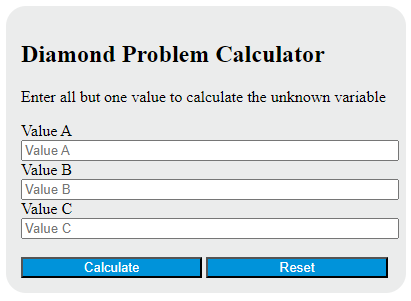
Calculate the two numbers in a diamond problem from the product and sum, and display the matching left and right values.
- All Math and Numbers Calculators
- Similarity Ratio Calculator
- Sum Product Calculator
- What Times What Equals Calculator
- Factor Theorem Calculator
- Exponent Calculator
Diamond Problem Formula
A diamond problem uses two numbers that multiply to a product and add to a sum. If the product is P and the sum is S, the two missing numbers can be found with the quadratic formula.
- P = the product, or the number at the top of the diamond
- S = the sum, or the number at the bottom of the diamond
- x = the left missing number
- y = the right missing number
- S^2 - 4P = the discriminant, which tells whether a real-number answer exists
The calculator takes the product and sum you enter, then solves for the two numbers that satisfy both equations. The left and right values may appear in either order because multiplication and addition are commutative. For example, 3 and 5 give the same product and sum as 5 and 3.
Diamond Problem Result Checks
| Discriminant | Meaning | Result type |
|---|---|---|
| S2 - 4P > 0 | There are two different real numbers. | Example: 2 and 6 |
| S2 - 4P = 0 | Both missing numbers are the same. | Example: 4 and 4 |
| S2 - 4P < 0 | No real-number pair matches the product and sum. | No real answer |
| Product | Sum | Missing numbers |
|---|---|---|
| 12 | 7 | 3 and 4 |
| 18 | 9 | 3 and 6 |
| -10 | 3 | -2 and 5 |
| 16 | 8 | 4 and 4 |
Example Diamond Problems
Example 1: Product 24 and sum 10
Find two numbers that multiply to 24 and add to 10.
The missing numbers are 4 and 6.
Example 2: Product -12 and sum 1
Find two numbers that multiply to -12 and add to 1.
The missing numbers are -3 and 4.
FAQ
What is a diamond problem?
A diamond problem is a math puzzle where you use a product and a sum to find two missing numbers. The two missing numbers must multiply to the product and add to the sum.
Can a diamond problem have negative numbers?
Yes. If the product is negative, one missing number is positive and the other is negative. For example, a product of -10 and a sum of 3 gives -2 and 5.
Why does the calculator say there is no real-number pair?
This happens when the discriminant, S2 - 4P, is negative. In that case, no two real numbers can have both the product and sum you entered. The calculator only returns real-number answers.