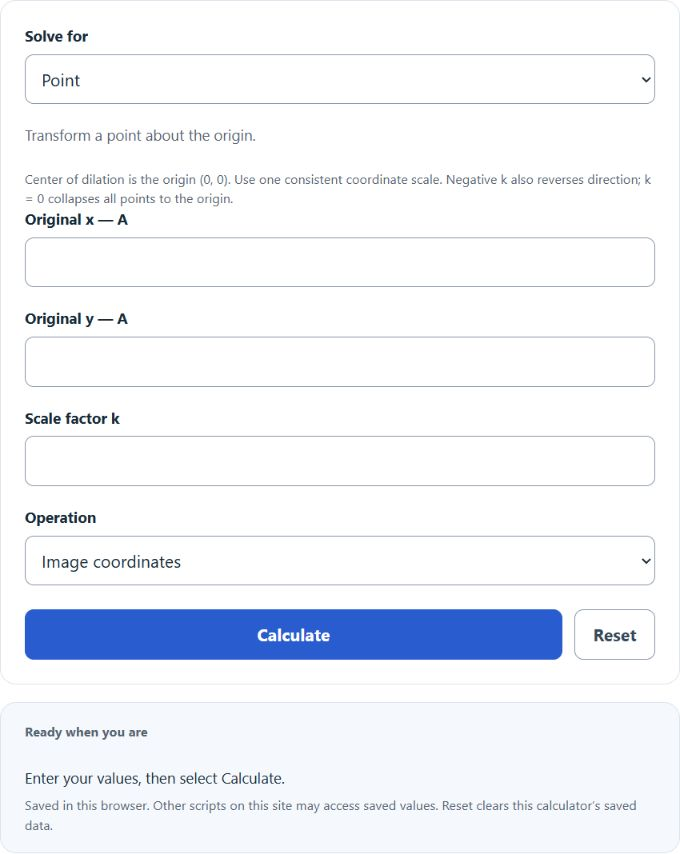
Enter the original coordinates and scale factor into the calculator to determine the new coordinates after dilation.
- All Math and Numbers Calculators
- Center of Mass Calculator (X,Y coordinates)
- Polar Coordinates Calculator
Dilation Rule Formula
The following formula calculates image coordinates for a dilation centered at the origin (0, 0). Apply it separately to every point, endpoint or vertex.
Variables:
- (x’, y’) are the new coordinates after dilation
- (x, y) are the original coordinates before dilation
- k is the scale factor
Multiply each original coordinate by k. Distances scale by |k|: values above 1 enlarge and values between 0 and 1 reduce. A negative k also reverses direction through the origin. At k = 0 every point collapses to the origin, so original coordinates cannot be uniquely recovered. For a different center, subtract the center before scaling and add it back afterward.
What is a Dilation Rule?
A dilation rule scales a figure about a fixed center. A nonzero factor preserves shape, with distances multiplied by the factor’s absolute value. This calculator uses the origin as the center; a negative factor also turns directions through the origin. Zero scale is a degenerate collapse, so it does not preserve a nondegenerate figure’s shape.
How to Calculate Dilation Rule?
The following steps outline how to calculate the Dilation Rule.
- First, determine the original coordinates (x, y).
- Next, determine the scale factor (k).
- Next, use the formula (x’, y’) = (k * x, k * y) to calculate the new coordinates after dilation.
- Finally, calculate the Dilation Rule.
- After inserting the variables and calculating the result, check your answer with the calculator above.
Example Problem :
Use the following variables as an example problem to test your knowledge.
Original coordinates (x, y) = (3, 5)
Scale factor (k) = 2