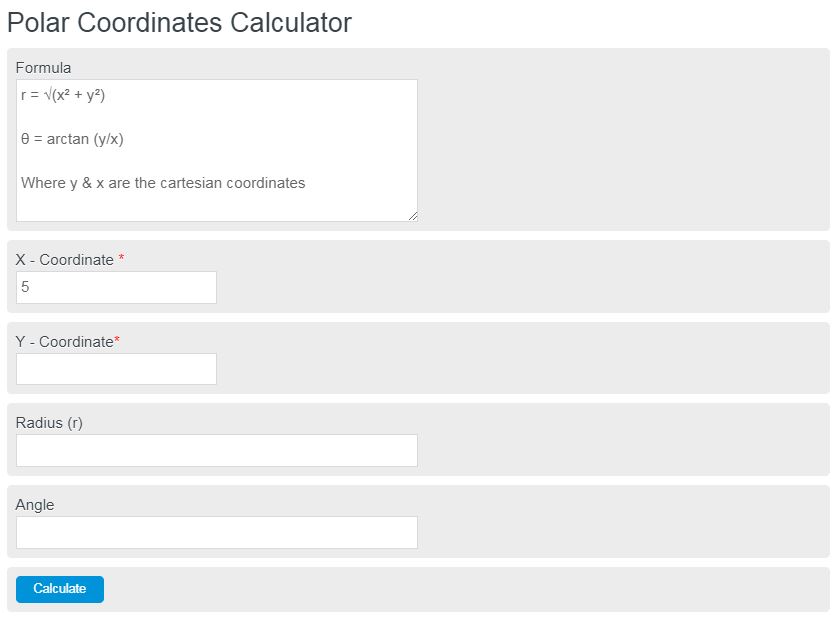
Convert polar coordinates to Cartesian x and y or convert x and y to canonical polar form, with degrees, radians, gradians, quadrant checks, and equivalent representations.
Related Calculators
- Cartesian To Parametric Calculator
- Trigonometric Ratio Calculator
- Inverse Cosine Calculator
- Distance To Angle Calculator
- All Math and Numbers Calculators
Polar Coordinates Conversion Guide
Polar coordinates describe a point by its distance from the origin and its direction from the positive x-axis. This is often the most natural way to represent circular motion, rotation, vectors, and geometry centered around a point.
Key Formulas
| Conversion | Formula | When to Use It |
|---|---|---|
| Cartesian to polar |
r = √(x² + y²) θ = atan2(y, x) |
Use when the x- and y-coordinates are known and you want radius and angle. |
| Polar to Cartesian |
x = rcos(θ) y = rsin(θ) |
Use when the radius and angle are known and you want the rectangular coordinates. |
| Degrees and radians |
θrad = θdeg × (π) / (180) θdeg = θrad × (180) / (π) |
Use when you need to switch the angle unit used by the calculator or problem. |
| Equivalent polar forms |
(r,θ) equiv (r,θ + 2π k) equiv (- r,θ + π + 2π k), k in mathbbZ |
The same point can be written with many different angles, and even with a negative radius. |
How to Convert a Point
- Find the radius using the distance from the origin.
- Find the angle using the signs of both x and y so the quadrant is correct.
- Convert the angle to degrees or radians if needed.
- Remember that multiple polar representations can describe the same point.
The angle formula is best written with atan2, not just arctan of y divided by x. A basic arctangent can lose quadrant information, while atan2 uses both coordinates and correctly places the angle in Quadrant I, II, III, or IV.
Quadrant Guide
| Quadrant | Sign of x | Sign of y | Angle Range |
|---|---|---|---|
| I | Positive | Positive | 0° to 90° |
| II | Negative | Positive | 90° to 180° |
| III | Negative | Negative | 180° to 270° |
| IV | Positive | Negative | 270° to 360° |
Quick Conversion Examples
| Cartesian Point | Polar Form | Notes |
|---|---|---|
| (1, 0) | r = 1, θ = 0° | Point lies on the positive x-axis. |
| (0, 1) | r = 1, θ = 90° | Point lies on the positive y-axis. |
| (-1, 0) | r = 1, θ = 180° | Point lies on the negative x-axis. |
| (0, -1) | r = 1, θ = 270° | Also commonly written as −90°. |
| (3, 4) | r = 5, θ ≈ 53.13° | A classic right-triangle conversion. |
| (-3, 4) | r = 5, θ ≈ 126.87° | Same radius as (3, 4), different quadrant. |
Practical Notes
- At the origin: when both coordinates are zero, the radius is zero and the angle is not unique.
- Angle conventions vary: some results are shown from 0° to 360°, while others use negative angles for clockwise rotation.
- Radius units stay the same: if x and y are in meters, then r is also in meters.
- Polar coordinates are not unique: adding a full turn gives the same point.
- Negative radius is valid: it represents the same point as a positive radius with the angle shifted by half a turn.
Common Questions
- Why use polar coordinates instead of Cartesian coordinates?
- They are often simpler for circles, rotation, angles, vectors, and any problem with radial symmetry.
- Why does the angle sometimes come out negative?
- A negative angle is still correct. It simply means the direction was measured clockwise instead of counterclockwise.
- Can one point have more than one polar form?
- Yes. The same location can be written with different angles, and it can also be written with a negative radius and a shifted angle.
- What is the most reliable way to find the angle?
- Use the two-coordinate angle function so the result lands in the correct quadrant without manual adjustment.