Calculate volumetric discharge from flow area and fluid head or mean velocity, with coefficient and common metric and US flow units.
- All Physics Calculators
- All Charge Calculators
- Volumetric Flow Rate Calculator
- Water Flow Rate Calculator
Discharge Formulas
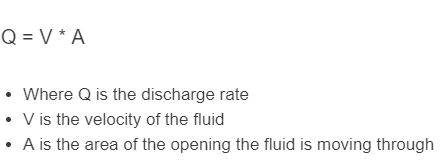
The core relationship for volumetric discharge in fluid mechanics is Q = V x A, where Q is the volume flow rate, V is the mean fluid velocity, and A is the cross-sectional area perpendicular to flow. This equation applies to any conduit geometry as long as V represents the area-averaged velocity.
For orifice discharge, the theoretical flow is corrected by a discharge coefficient: Q = Cd x A x sqrt(2gH), where Cd accounts for energy losses and vena contracta contraction, g is 9.807 m/s2, and H is the hydraulic head. Cd is always less than 1.0 because real fluid streamlines contract downstream of the opening.
For weirs, the Francis formula gives Q = 1.84 x L x H^1.5 (SI) for rectangular suppressed weirs. Contracted weirs use effective length L minus 0.2H. V-notch weirs follow Q = 2.49 x H^2.48 (Kindsvater-Shen, 90-degree, US customary), offering superior sensitivity at low flows.
In electrical contexts, discharge refers to charge flow rate: I = Q/t, where I is current in amperes, Q is charge in coulombs, and t is time in seconds.
Discharge Coefficient Reference Values
The discharge coefficient (Cd) corrects theoretical flow for friction, turbulence, and contraction losses. It depends on geometry, surface finish, Reynolds number, and throat-to-pipe diameter ratio.
| Device | Cd | Notes |
|---|---|---|
| Sharp-edged orifice | 0.59-0.65 | Most common industrial meter; varies with beta ratio |
| Rounded orifice | 0.95-0.98 | Smooth inlet reduces vena contracta |
| Borda (re-entrant) | 0.50-0.61 | Projects inward; highest contraction |
| Short tube (L/D=2-3) | 0.80-0.85 | Flow reattaches, recovering pressure |
| Venturi meter | 0.95-0.995 | Most accurate; gradual geometry |
| Flow nozzle | 0.96-0.99 | Convergent without diffuser |
| Smooth nozzle | 0.96-0.98 | Fire suppression/jet use |
| Sluice gate | 0.55-0.61 | Varies with opening ratio |
Cd near 1.0 indicates minimal energy loss. Cd near 0.6 means actual flow is about 60% of theoretical, mainly due to vena contracta contraction to 60-65% of the orifice area.
Manning’s Roughness Coefficients
In the Manning equation Q = (1/n) x A x R^(2/3) x S^(1/2), the roughness coefficient n is the most influential variable. Wrong n selection shifts discharge by 30%+.
| Material | n (low) | n (high) |
|---|---|---|
| Finished concrete | 0.011 | 0.015 |
| Unfinished concrete | 0.013 | 0.017 |
| Cast iron | 0.012 | 0.015 |
| Corrugated metal | 0.021 | 0.026 |
| PVC/HDPE | 0.009 | 0.012 |
| Clean earth | 0.018 | 0.025 |
| Earth+gravel | 0.022 | 0.030 |
| Earth+weeds | 0.025 | 0.045 |
| Clean stream | 0.025 | 0.033 |
| Pools/riffles | 0.033 | 0.050 |
| Floodplain brush | 0.040 | 0.070 |
| Floodplain timber | 0.080 | 0.150 |
PVC/HDPE (lowest n) maximizes capacity per diameter. Floodplain vegetation can have n values 10x greater, drastically reducing discharge for the same area and slope.
Types of Discharge Measurement
Discharge is expressed as volumetric (Q, in m3/s), mass (Qm = rho x Q, in kg/s), or weight (Qw = gamma x Q, in N/s). Mass discharge is essential when density varies with temperature or pressure.
Orifice plates dominate industrial metering (cheap, no moving parts). Venturi meters offer superior accuracy and lower pressure loss for large mains. Weirs and flumes are preferred for open channels where depth alone determines discharge.
Discharge in Hydrology
The USGS operates 10,000+ stream gauges converting stage to discharge via rating curves. These records drive flood forecasting, water rights, reservoir operations, and ecological flow assessments. Bankfull discharge (1.5-2 year recurrence) is the channel-forming flow. NPDES permits require accurate outfall discharge measurement for pollutant load compliance.
Unit Conversions
| From | To | Factor |
|---|---|---|
| m3/s | cfs | 35.3147 |
| m3/s | L/s | 1000 |
| m3/s | GPM | 15850.3 |
| cfs | GPM | 448.831 |
| cfs | acre-ft/day | 1.9835 |
| L/s | GPM | 15.8503 |
| m3/s | ML/day | 86.4 |
One cfs flowing 24 hours delivers ~1.98 acre-feet. A 100 acre-feet/year water right equals about 0.138 cfs continuous diversion.
FAQ
Discharge (Q) is volume of fluid passing a cross-section per unit time: Q = V x A. Units are m3/s or cfs. Can be expressed as mass flow (kg/s) by multiplying by density.
Cd accounts for losses reducing actual flow below theoretical. For sharp orifices, vena contracta contracts the jet to 60-65% of orifice area. Venturi meters (Cd 0.95-0.995) minimize losses.
Weirs for open channels (streams, canals) needing only depth measurement. Orifice plates for pressurized pipes; most common industrial meter.
n is in the denominator, so higher n reduces discharge. Doubling n halves flow. PVC (n~0.010) carries much more than corrugated metal (n~0.024) at same size and slope.