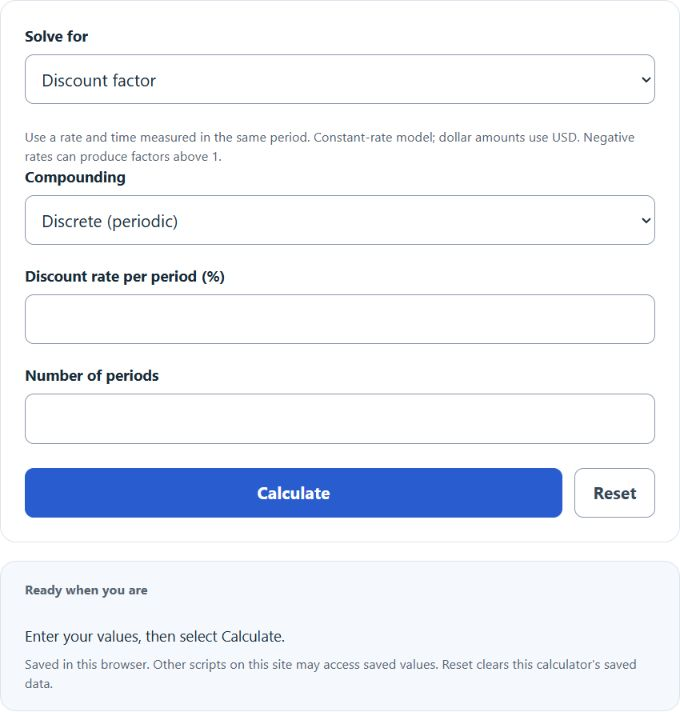
Calculate the discount factor from a rate and number of periods, get present or future value, solve for the rate or periods, and view a period-by-period factor schedule.
Discount Factor Formula
The following equation gives the discrete discount factor for a per-period effective rate. Continuous mode instead uses D = exp(−rT), with a continuously compounded rate. Keep the rate and time in matching periods. At zero elapsed periods the factor is 1; inverse rate or time may not be uniquely defined.
- Where D is the discount factor
- r is the discount rate per period as a decimal (r = Rate% ÷ 100)
- T is the number of compounding periods.
To calculate the discount factor, convert the rate from percent to a decimal (divide by 100), then divide 1 by (1 + r) raised to the power of the number of periods. (If you have a nominal APR compounded m times per year for t years, the equivalent exponent is T = m·t and the per-period rate is r = (APR/100)/m.)
Discount Factor Definition
What is a discount factor? A discount factor (also called the PVIF for a single future payment) is the number you multiply a future value by to convert it into a present value for a given rate and number of periods. For example, a 1% rate per period over 10 periods has a discount factor of 0.9053 (since 1/(1.01)10 ≈ 0.9053). Multiply 0.9053 by the future/original amount to get the discounted (present) value; the implied reduction is (1 − 0.9053) = 0.0947 (about 9.47%) of the future/original amount.
Discount Factor Example
How to calculate a discount factor?
- First, determine the rate.
Determine the discount percentage rate.
- Next, determine the number of compounding periods.
Determine the total number of compounding periods of the discount.
- Finally, calculate the discount factor.
Calculate the discount factor using the formula above.
FAQ
A discount factor is the factor used to convert a future value into a present value for a given rate and number of periods (PV = FV × discount factor).