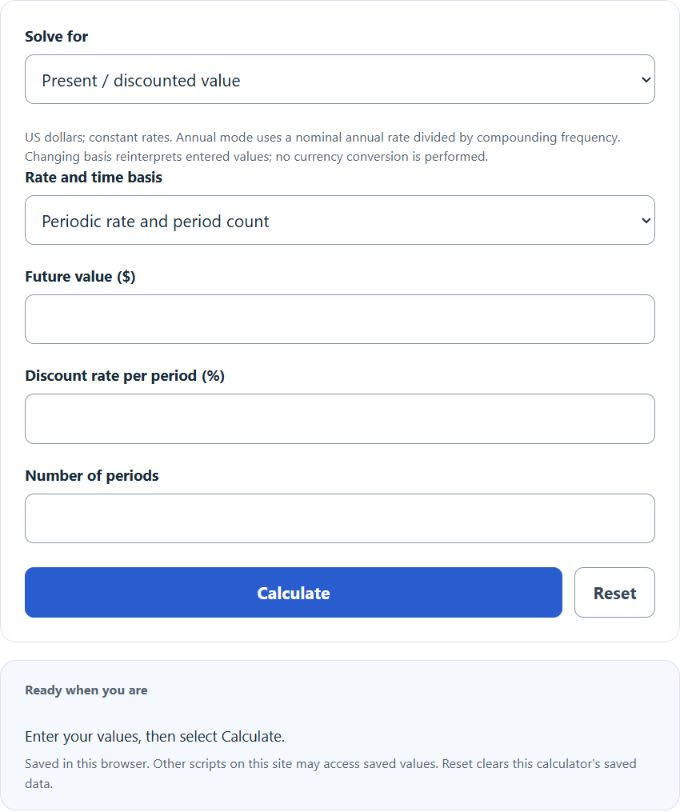
Calculate present value, future value, discount rate, or time with aligned periodic or nominal annual rates and a rate-sensitivity comparison.
Related Calculators
- Promissory Note Value Calculator
- Net Single Premium Calculator
- Reverse ROI Calculator
- Final Cost Calculator
- All Business Calculators
Discounted Value Formula
The following equation is used to calculate the Discounted Value.
- Where DV is the discounted value ($)
- FV is the future value ($)
- r is the effective discount rate per period as a decimal. In nominal annual mode, r = annual percent/(100 × compounding frequency), and n = years × frequency.
- n is the number of periods
To calculate the discounted value, divide the future value by (1 plus the discount rate) raised to the power of the number of periods.
What is a Discounted Value?
Definition:
A discounted value is the present value of a future amount under a chosen constant rate and timing model. Inflation, tax or risk are reflected only if included in the chosen assumptions. The calculator reports US dollars and supports periodic or nominal annual rates, inverse rate/time solves and a ±2 percentage-point sensitivity comparison.
How to Calculate Discounted Value?
Example Problem:
The following example outlines the steps and information needed to calculate the Discounted Value.
First, determine the future value. In this example, the future value is $1,000.00.
Next, determine the discount rate. We will use 5% in this scenario.
Then, determine the number of periods over which you want to discount. Suppose there are 3 periods.
Finally, calculate the discounted value using the formula above:
DV = FV / (1 + r)^n
DV = $1,000 / (1 + 0.05)^3
DV ≈ $863.84
FAQ
Why is discounted value important?
Discounted value is significant because it accounts for the fact that money available in the present is worth more than the same amount in the future due to its potential earning capacity. This concept allows individuals, businesses, and investors to evaluate the profitability of future cash flows or investment returns in today’s terms.
How does the discount rate affect the discounted value?
The discount rate directly impacts how much a future value is reduced when converting it to present terms. A higher discount rate decreases the present value, indicating greater uncertainty or a preference for immediate returns. Conversely, a lower discount rate increases the present value, suggesting that future funds are relatively more valuable.
What factors should be considered when choosing a discount rate?
Factors that influence the choice of discount rate include inflation, risk tolerance, opportunity cost, prevailing market interest rates, and the time horizon of the investment or cash flow. Each of these can affect how aggressively or conservatively one discounts future cash flows.