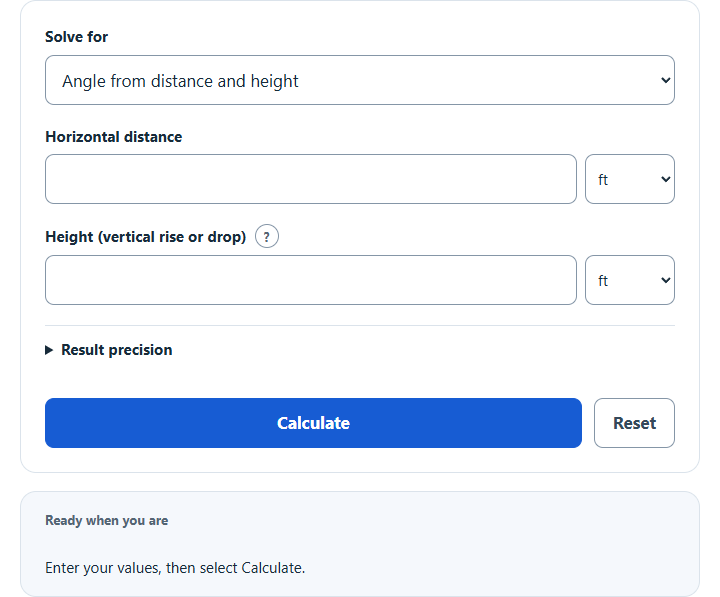
Calculate the angle of elevation or depression from distance and height, or find the height or distance from an angle, with grade and line-of-sight length.
Related Calculators
- Arcsin Calculator (Radians or Degrees)
- Angle Offset Calculator
- Tangent Ratio Calculator
- Radial Distance Calculator
- All Math and Numbers Calculators
Calculator Functions
| Function | What it does | What it requires |
|---|---|---|
| Angle from distance and height | Finds the angle of elevation or depression to a target | Requires the horizontal distance and the height difference |
| Height from distance and angle | Finds the height difference a sight line reaches at a known distance | Requires the horizontal distance and the angle of elevation |
| Distance from height and angle | Finds the horizontal distance to a target of known height | Requires the height difference and the angle of elevation |
| Angular size (object size, distance or angle) | Finds how wide an object appears in degrees, or the object size or viewing distance that gives a stated angle | Requires two of object size, viewing distance and angular size |
Distances and heights can be entered in feet, meters, yards, inches or centimeters, and angles in degrees or radians. A negative height or angle means the target is below eye level. The first three functions also return the line-of-sight distance, the grade in percent and the rise-to-run ratio, and results can be shown to 1, 2 or 4 decimal places.
Distance to Angle Formulas
| θ | Angle above the horizontal, in degrees. Below the horizontal it is an angle of depression |
| H | Height difference between the eye or instrument and the target |
| D | Horizontal distance to the target, in the same unit as H |
The eye, the point level with it under the target, and the target form a right triangle. H is the side opposite the angle and D is the side next to it, so their ratio is the tangent of the angle [1]. Degrees turn into a distance only when one side of the triangle is known as well.
Angle from distance and height
The main formula applies directly. A target 5 m higher than the eye and 10 m away is at arctan(5 ÷ 10) = 26.57°. A drop of 20 ft over 100 ft gives an angle of depression of 11.31°.
Height from distance and angle
A sight line at 30° reaches 100 × tan(30°) = 57.74 ft above eye level at 100 ft away. The angle must be between −90° and 90°.
Distance from height and angle
A point 50 ft above eye level seen at 20° is 50 ÷ tan(20°) = 137.37 ft away. Height and angle need the same sign, and neither can be zero.
Angular size (object size, distance or angle)
a is the full angle across an object of size S seen from distance L, with the viewer centered on it. Each half of the object forms its own right triangle, which is where the 2 and the S ÷ 2 come from. Solved for the other two values, S = 2 × L × tan(a ÷ 2) and L = S ÷ (2 × tan(a ÷ 2)). An object 1 m across seen from 10 m spans 5.72°, and an object that spans 0.5° at 100 m is 0.87 m across.
Line of sight, grade and rise to run
Grade = H ÷ D × 100
The line of sight is the straight distance from the eye to the target. Grade is the slope as a percent, and rise to run is 1 : (D ÷ H). For H = 5 and D = 10, the line of sight is 11.18, the grade is 50% and the ratio is 1 : 2.
Limits of This Estimate
- The triangle is flat: a level reference line, a vertical height and a straight line of sight. The curve of the ground, bending of light in air and uneven terrain are ignored, which matters over long distances.
- H is measured from the eye or instrument, not from the ground. For the height of a tree or building above the ground, add the eye height to the result.
- Small errors in a measured angle grow with distance. At 1,000 ft, reading 5° as 6° changes the height from 87.49 ft to 105.10 ft.
Sources
- NIST Digital Library of Mathematical Functions, Section 4.42, Solution of Triangles: sine, cosine and tangent as side ratios of a right triangle