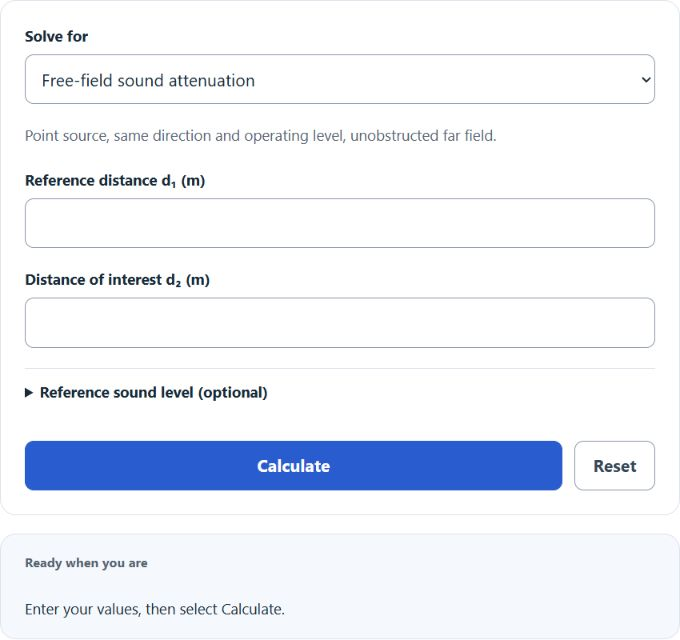
Calculate sound distance attenuation with the inverse square law, find the sound level at any distance, or solve linear attenuation from a coefficient.
Distance Attenuation Formula
For sound spreading from a point source in a free field, distance attenuation follows the inverse square law:
A = 20 * log10(d2 / d1)
To find the sound level at the farther distance, subtract the attenuation from the source level:
L2 = L1 - 20 * log10(d2 / d1)
For a uniform absorbing medium with a constant coefficient at the specified frequency, absorption loss grows linearly with path length, separately from geometric spreading:
A = a * d
Where:
A is the distance attenuation in decibels (dB). d1 is the reference distance and d2 is the distance of interest, in the same length units, so only their ratio matters. L1 is the sound level at the reference distance and L2 is the sound level at the distance of interest, both in dB. In the linear form, a is the attenuation coefficient in dB per meter and d is the path length in meters.
The factor of 20 appears because sound pressure level is based on the square of pressure. Each time you double the distance, the level drops by about 6 dB.
Distance and Decibel Drop Reference
The table below shows the attenuation predicted by the inverse square law for common distance ratios, along with the resulting level if you start at 100 dB.
| Distance ratio (d2/d1) | Attenuation (dB) | Level from 100 dB |
|---|---|---|
| 1 | 0.0 | 100.0 |
| 2 | 6.0 | 94.0 |
| 4 | 12.0 | 88.0 |
| 10 | 20.0 | 80.0 |
| 100 | 40.0 | 60.0 |
Example Problems
Example 1. A machine produces 95 dB measured at 1 meter. You want the level at 8 meters in a free field. The distance ratio is 8, so the attenuation is 20 * log10(8) = 18.06 dB. The level at 8 meters is 95 – 18.06 = 76.94 dB.
Example 2. A signal loses 3 dB per meter as it passes through a material and travels 4 meters. Using the linear form, the attenuation is 3 * 4 = 12 dB.
FAQ
Why does the formula use 20 instead of 10? Pressure ratios use 20 log10 and power or intensity ratios use 10 log10. For inverse-square geometric spreading, intensity falls as 1/r², so the distance-ratio loss still uses 20 log10(d2/d1).
Does this apply indoors? The inverse square law assumes an unobstructed far field for a point source. Indoors, reflections, interference and absorption can change the level; outdoors, ground, barriers and weather can also matter. The simple model is not a guaranteed upper or lower bound or a safe-exposure assessment.
How much does sound drop when distance doubles? Each doubling of distance reduces the level by about 6 dB, since 20 * log10(2) is roughly 6.02 dB.