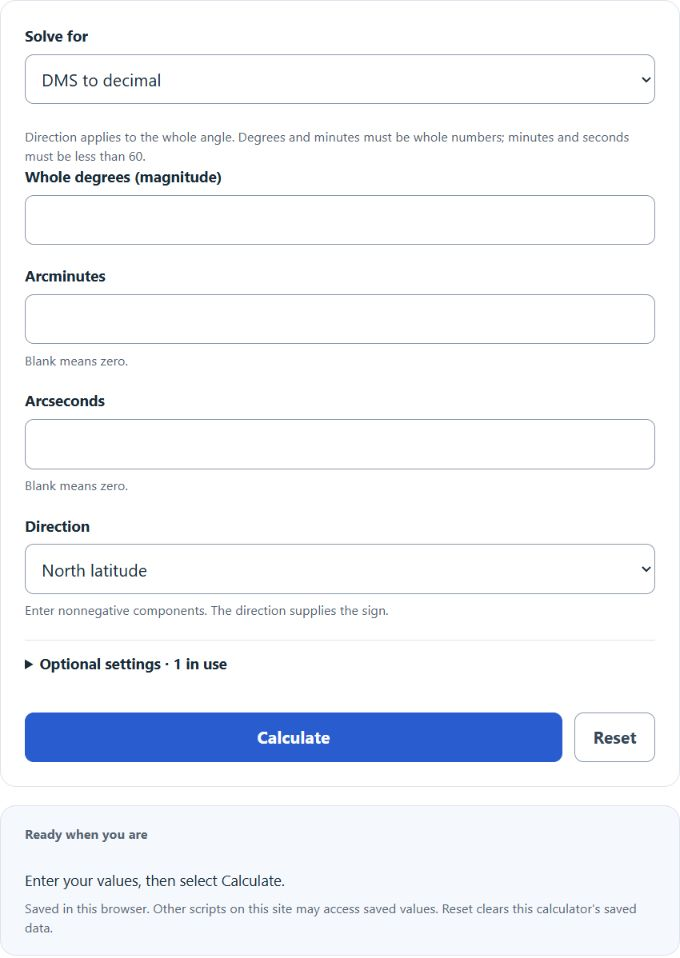
Calculate decimal degrees from degrees, minutes, and seconds (DMS), and convert decimal coordinates back to DMS for latitude and longitude.
DMS to Decimal Degrees Formula
To convert a coordinate from degrees, minutes, and seconds (DMS) to decimal degrees (DD), divide the minutes by 60 and the seconds by 3600, then add both to the whole degrees.
DD = sign × (D + M/60 + S/3600)
Where:
- DD is the result in decimal degrees
- D is the whole degrees
- M is the minutes (0 to 59)
- S is the seconds (0 to less than 60)
For a coordinate in the southern or western hemisphere, make the result negative. North and east stay positive.
To reverse the conversion and turn a decimal degree value back into DMS, take the absolute value and split it apart:
A = |DD|; D = floor(A); M = floor((A - D)*60); S = ((A - D)*60 - M)*60
The DMS degrees field accepts a nonnegative whole-degree magnitude. Blank minutes or seconds mean zero. Full latitude is limited to 90° and longitude to 180°; plain angles are limited to 10,000° for reliable precision. The minutes and seconds fields each represent a sixtieth of the unit above them, so 60 minutes equal 1 degree and 60 seconds equal 1 minute. The hemisphere selector sets the sign of the answer: choosing S or W flips the decimal result to a negative number, while N or E keeps it positive. The axis selector in the reverse mode decides whether the output uses N/S labels for latitude or E/W labels for longitude.
Decimal Place Precision and Real Distance
Decimal places set the display resolution, not measurement accuracy. The following approximate spacings use about 111 km per degree at the equator for longitude; longitude spacing decreases with latitude. Latitude spacing is of similar magnitude and varies slightly with latitude.
| Decimal places | Degree size | Approx. ground distance |
|---|---|---|
| 0 | 1.0 | 111 km |
| 1 | 0.1 | 11.1 km |
| 2 | 0.01 | 1.11 km |
| 3 | 0.001 | 111 m |
| 4 | 0.0001 | 11.1 m |
| 5 | 0.00001 | 1.11 m |
| 6 | 0.000001 | 0.11 m |
Five or six decimal places represent roughly 1.1 m or 0.11 m of equatorial spacing. The source measurement may be much less accurate. The conversions below show how individual minute and second amounts add up.
| DMS amount | Decimal degrees |
|---|---|
| 1 minute | 0.016667 |
| 15 minutes | 0.25 |
| 30 minutes | 0.5 |
| 45 minutes | 0.75 |
| 1 second | 0.000278 |
| 30 seconds | 0.008333 |
Example Problems
Example 1. Convert 40° 26' 46" N to decimal degrees.
Divide the minutes and seconds: 26 / 60 = 0.433333 and 46 / 3600 = 0.012778. Add them to the degrees: 40 + 0.433333 + 0.012778 = 40.446111. The point is north, so the result stays positive at 40.446111 degrees.
Example 2. Convert -73.985700 (a longitude) back to DMS.
Take the absolute value, 73.985700. The whole degrees are 73. The remaining 0.985700 times 60 is 59.142, so the minutes are 59. The leftover 0.142 times 60 is 8.52, so the seconds are about 8.52. The value was negative on the longitude axis, so the result is 73° 59' 8.52" W.
Frequently Asked Questions
How do you convert DMS to decimal degrees by hand?
Keep the whole degrees as they are, divide the minutes by 60, and divide the seconds by 3600. Add all three numbers together. For example, 10° 30' 0" becomes 10 + 0.5 + 0 = 10.5 degrees.
Are south and west coordinates negative?
Yes. In decimal degrees, latitudes south of the equator and longitudes west of the prime meridian are written as negative numbers. Northern latitudes and eastern longitudes are positive. The hemisphere or axis selector handles this sign for you.
How many decimal places should you keep?
Choose a display resolution appropriate to your source data and task. Six decimal places represent about 0.11 m of equatorial spacing; four and five represent about 11 m and 1.1 m. Extra digits do not improve the underlying measurement.