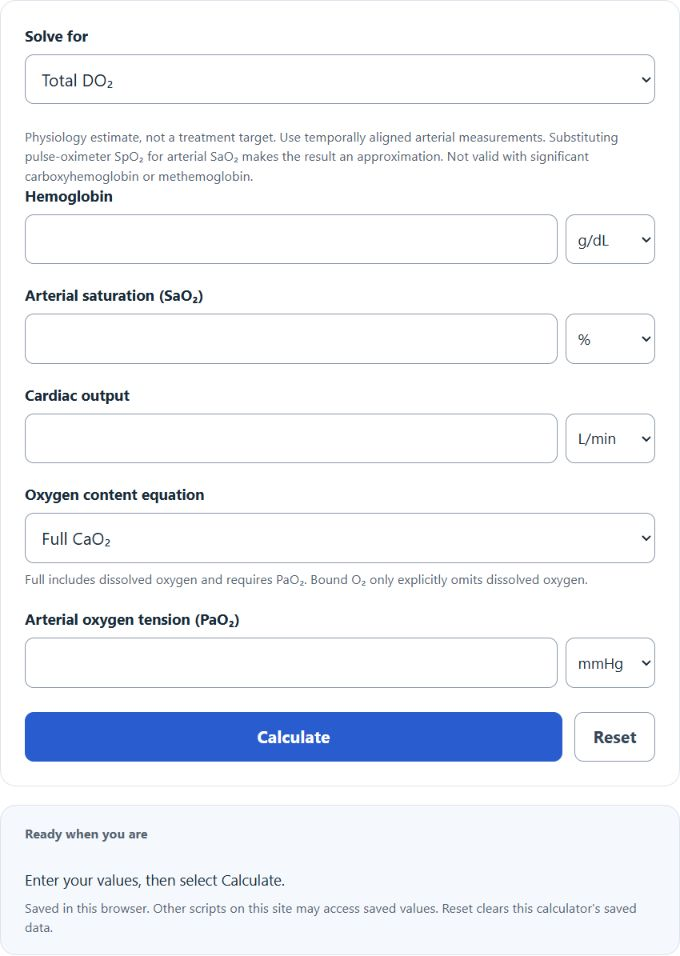
Calculate whole-body oxygen delivery (DO₂) or indexed oxygen delivery (DO₂I) using an explicit full arterial-oxygen-content equation or hemoglobin-bound approximation.
Oxygen Delivery Formulas
Systemic oxygen delivery begins with arterial oxygen content. The full equation is CaO2 (mL O2/dL) = 1.34 × Hb (g/dL) × SaO2 (fraction) + 0.0031 × PaO2 (mmHg). Total oxygen delivery is DO2 (mL O2/min) = CaO2 × cardiac output (L/min) × 10 dL/L. Indexed oxygen delivery is DO2I (mL O2/min/m²) = CaO2 × cardiac index (L/min/m²) × 10.
The factor of 10 is a unit conversion, not a physiologic coefficient. CaO2 is stated per deciliter while cardiac output and cardiac index are stated per liter. Because one liter contains 10 deciliters, multiplying by 10 cancels the volume units correctly. Published binding and solubility constants vary slightly by convention; this calculator consistently uses 1.34 and 0.0031.
Variables and Units
| Variable | Meaning | Accepted units |
|---|---|---|
| Hb | Hemoglobin concentration | g/dL or g/L |
| SaO2 | Arterial oxygen saturation used as a fraction in the equation | Percent or fraction |
| PaO2 | Arterial oxygen tension contributing the dissolved term | mmHg or kPa |
| CO | Cardiac output for total DO2 | L/min or mL/min |
| CI | Cardiac index for DO2I | L/min/m² or mL/min/m² |
| CaO2 | Arterial oxygen content | mL O2/dL |
The calculator converts 10 g/L to 1 g/dL, 1 kPa to 7.50062 mmHg, and 1000 mL/min to 1 L/min. Saturation of 98% is entered as 98 with Percent selected or 0.98 with Fraction selected. All required values must be finite and greater than zero; saturation cannot exceed 100%.
What DO2 Means
DO2 is the amount of oxygen carried in arterial blood to the systemic circulation each minute. It is oxygen delivery, not an oxygen “dose” and not a medication calculation. The equation combines how much oxygen each deciliter of arterial blood contains with how much blood the heart moves each minute. DO2I uses cardiac index so the flow term is already normalized to body surface area.
Arterial oxygen content is different from oxygen tension and saturation. PaO2 describes dissolved oxygen pressure. SaO2 here describes functional arterial saturation, the fraction of available hemoglobin binding sites carrying oxygen. This calculator assumes no significant carboxyhemoglobin or methemoglobin; it is unsuitable for suspected dyshemoglobinemia because functional saturation with total hemoglobin can overstate oxygen content. CaO2 expresses the actual oxygen volume contained in blood. Two people can have similar saturation but different CaO2 and DO2 because hemoglobin concentration or cardiac output differs.
How to Use the DO2 Calculator
- Select total DO2 when the flow measurement is cardiac output, or DO2I when it is cardiac index.
- Select the full CaO2 equation when an arterial PaO2 is available. Choose the hemoglobin-bound approximation only when intentionally omitting dissolved oxygen.
- Enter hemoglobin, arterial oxygen saturation, and cardiac output or cardiac index with the matching units.
- For the full equation, enter PaO2 from the arterial sample and select mmHg or kPa.
- Calculate, then check the normalized units, CaO2 terms, and limitation note shown with the result.
Do not enter cardiac output in the indexed mode or cardiac index in the total mode. DO2I should not be divided by body surface area again, because cardiac index already includes that normalization. If PaO2 is unavailable, the calculator never silently inserts zero into a result labeled “full”; the approximation must be selected explicitly and is labeled throughout.
Worked Total Oxygen Delivery Example
Use hemoglobin 15 g/dL, SaO2 98%, PaO2 100 mmHg, and cardiac output 5 L/min. The hemoglobin-bound content is 1.34 × 15 × 0.98 = 19.698 mL O2/dL. Dissolved content is 0.0031 × 100 = 0.310 mL O2/dL. Therefore CaO2 is 20.008 mL O2/dL.
Next calculate DO2: 20.008 × 5 × 10 = 1000.4 mL O2/min. The ×10 converts liters of blood flow to deciliters so it can multiply the content unit. The displayed result is a global arithmetic estimate based on measurements that should be physiologically and temporally aligned.
Worked Indexed Oxygen Delivery Example
Keep the same CaO2 of 20.008 mL O2/dL and use a cardiac index of 3 L/min/m². DO2I is 20.008 × 3 × 10 = 600.24 mL O2/min/m². No additional body-surface-area step is needed. If the flow measurement were entered as 3000 mL/min/m², the calculator would first convert it to the same 3 L/min/m².
Full Equation Versus Approximation
Most arterial oxygen content is hemoglobin-bound under ordinary conditions, which is why the dissolved term is often much smaller. In the example, 19.698 mL/dL is bound and 0.310 mL/dL is dissolved. Small does not mean nonexistent. Omitting PaO2 is a deliberate approximation, and the relative importance of the dissolved component changes at unusually high PaO2.
The calculator offers both choices so the assumption is visible. The approximate equation is 1.34 × Hb × SaO2, followed by the same flow and ×10 calculation. It must not be used to infer a transfusion threshold, oxygen target, or treatment decision. Changes to hemoglobin, saturation, pressure, or flow require clinical context rather than optimizing a single computed number.
SaO2 Versus SpO2
The equation is written for arterial oxygen saturation, SaO2. Pulse oximetry reports SpO2, an estimate based on light absorption, and the two labels are not interchangeable. Substituting SpO2 can be useful only as an explicitly recognized approximation. Motion, poor perfusion, nail products, sensor position, device performance, skin-pigmentation-related limitations, and dyshemoglobins can affect pulse-oximeter readings.
Standard two-wavelength pulse oximetry also cannot reliably identify all abnormal hemoglobin species. When carbon monoxide exposure, methemoglobinemia, or another dyshemoglobinemia is relevant, co-oximetry and clinical evaluation matter. A seemingly reassuring SpO2 should not be treated as a complete measure of oxygen content.
Interpretation and Limitations
Global DO2 does not prove that every organ receives or uses adequate oxygen. Regional blood flow, microcirculation, diffusion distance, hemoglobin affinity, metabolic demand, and oxygen extraction can differ. Oxygen consumption, VO2, is a separate quantity. The relationship between delivery and consumption is dynamic, especially in shock, anesthesia, critical illness, exercise, or rapid physiologic change.
Inputs may come from different methods with different timing and uncertainty. A blood gas drawn at one moment, hemoglobin from another sample, and cardiac-output estimate from a later hemodynamic state may not represent one coherent snapshot. The calculator does not provide normal/abnormal bands, treatment targets, transfusion advice, or a forecast. Clinicians interpret measurements, trends, organ function, perfusion signs, and the full clinical situation together.
Display precision should not be confused with measurement precision. A result with decimals is still limited by the accuracy and timing of each input, the selected constants, and the assumptions of a global circulation model. Recalculation is most useful for transparent arithmetic and consistent units, not for creating certainty beyond the underlying measurements.
Frequently Asked Questions
Why is there a factor of 10?
CaO2 is per deciliter while flow is per liter. Ten deciliters per liter aligns those units.
Can I use cardiac output in DO2I mode?
No. Use cardiac output for total DO2 and cardiac index for DO2I. The result units and meaning differ.
Does a calculated DO2 set a transfusion or oxygen target?
No. The calculator performs physiology arithmetic and intentionally offers no treatment threshold or recommendation.
Sources
- Physiology, monitoring, and optimisation of perioperative tissue oxygenation, formula review using 1.34 and 0.0031.
- Monitoring of Tissue Oxygenation, peer-reviewed overview of oxygen content, delivery, and consumption.
- U.S. Food and Drug Administration, Pulse Oximeters, device purpose and limitations.