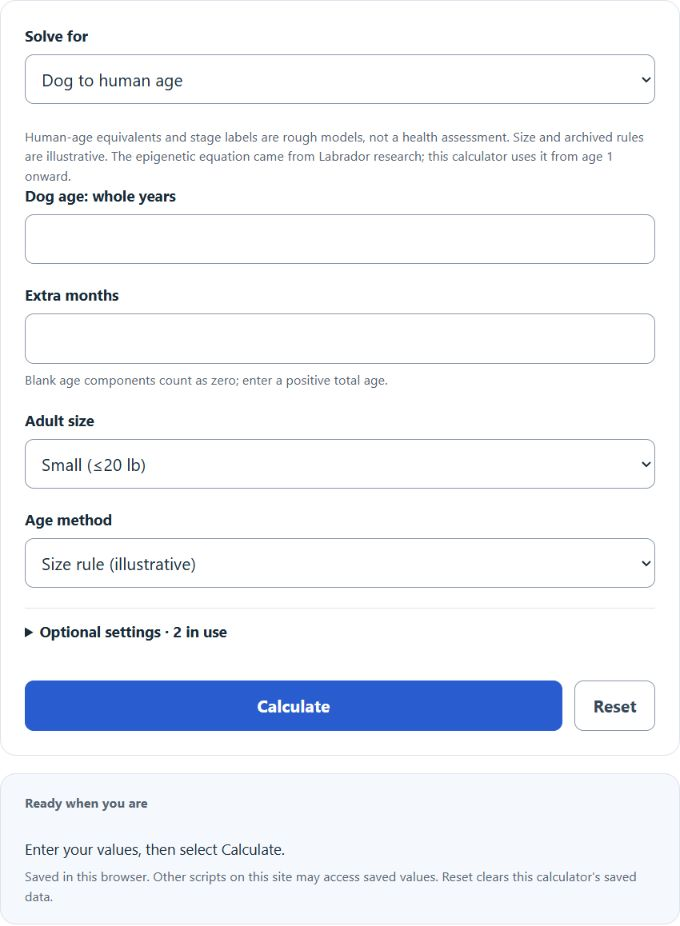
Calculate your dog’s age in human years from your dog’s age in dog years.
Dog Age Formula
This calculator compares five age formulas, reverses a selected formula, and includes personal birthdate and adoption-date arithmetic. These are estimates, not measurements of an individual dog’s health.
Epigenetic: HumanAge = 16 * ln(DogAge) + 31
Seven-year rule: HumanAge = 7 * DogAge
General rule: 15*a for 0<a≤1; 15+9*(a-1) for 1<a≤2; 24+5*(a-2) for a>2
- HumanAge = the dog's age expressed in human years
- DogAge = the dog's actual age in years (months are added as a fraction)
- ln = the natural logarithm
- Size = the dog's adult weight band (small, medium, large, or giant), used by the size-adjusted method
The epigenetic equation was developed from Labrador DNA methylation data; breed generalization is limited. The general rule adds 15, then 9, then 5 human-equivalent years per dog year. This calculator interpolates the first two years linearly. Its illustrative size rule substitutes 4, 5, 6, or 7 after year two; the archived rule uses 10.5 per year through year two, then 4 per year. These legacy heuristics are not validated breed-specific clinical scales. Birthdate arithmetic uses the chosen as-of date, clamps February 29 anniversaries to February 28 outside leap years, and clamps month subtraction to valid month ends.
Human-Year Equivalents by Size
The table below evaluates this calculator’s illustrative size rule. It is an arithmetic cross-check, not a veterinary reference chart.
| Dog age | Small | Medium | Large | Giant |
|---|---|---|---|---|
| 1 year | 15 | 15 | 15 | 15 |
| 2 years | 24 | 24 | 24 | 24 |
| 5 years | 36 | 39 | 42 | 45 |
| 8 years | 48 | 54 | 60 | 66 |
| 12 years | 64 | 74 | 84 | 94 |
For this calculator, adult-weight bands are small ≤20 lb, medium >20–50 lb, large >50–100 lb, and giant >100 lb.
Examples
Example 1. A 4-year-old dog using the epigenetic formula: HumanAge = 16 * ln(4) + 31 = 16 * 1.386 + 31 = 22.2 + 31 = about 53 human years.
Example 2. A 3-year-old dog using the AVMA method: 15 + 9 + 5 * (3 - 2) = 15 + 9 + 5 = 29 human years.
FAQ
Why do the methods give different answers? They use different assumptions. Only the epigenetic equation is logarithmic; the size and general rules are piecewise linear, and the seven-year rule is a flat multiplier. Compare mode exposes the resulting range.
Which method is most accurate? No supported formula establishes an individual dog’s biological age. The epigenetic study involved 104 Labradors up to age 16, so applying it to other breeds or beyond that range needs caution. Size and archived rules here are illustrative. Ask a veterinarian about health and life stage.
Does size really change how a dog ages? Size and breed affect aging patterns, but the simple size rates used here do not establish a validated clinical conversion. Their purpose is to show how an assumed later-life rate changes a numerical comparison.