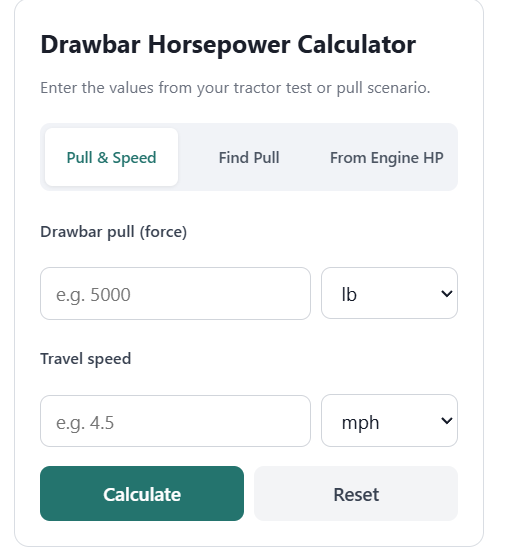
Enter your drawbar pull and travel speed — or estimate drawbar horsepower from engine horsepower and surface condition — to find the usable power delivered at the tractor’s drawbar.
Related Calculators
- All Automotive Calculators
- Tractive Effort To Horsepower Calculator
- Net Horsepower To Gross Horsepower Calculator
- Corrected Horsepower Calculator
Formula
From pull and speed:
DBHP = (F × V) / 375
where DBHP = drawbar horsepower (hp), F = drawbar pull (lb), V = travel speed (mph). The constant 375 converts lb·mph to hp.
Solve for pull:
F = (DBHP × 375) / V
From engine horsepower:
DBHP = EHP × ηoverall
where EHP = engine (flywheel) horsepower, ηoverall = driveline efficiency × tractive efficiency of the surface.
Interpretation
Drawbar horsepower is the power actually available at the hitch to pull an implement, after losses in the engine accessories, transmission, final drive, and tire slip. It is always lower than engine or PTO horsepower. A typical overall ratio of DBHP to engine HP looks like this:
- Concrete, 2WD: ~0.75–0.78 (tractive efficiency ≈ 0.87)
- Concrete, 4WD/MFWD: ~0.78–0.80 (TE ≈ 0.89)
- Firm soil or sod: ~0.65–0.70 (TE ≈ 0.77)
- Tilled / cultivated soil: ~0.55–0.60 (TE ≈ 0.65)
- Soft or sandy soil: ~0.45–0.50 (TE ≈ 0.55)
If your calculated DBHP is much lower than expected for the surface, check for excessive wheel slip (over ~15% on soil), underinflated tires, or insufficient ballast. A result higher than ~0.80 of engine HP on soil is unrealistic and usually means the speed or pull reading is off.
Typical Drawbar HP by Tractor Class
| Tractor class | Engine HP | DBHP on tilled soil |
|---|---|---|
| Compact / utility | 20–45 | 11–25 |
| Small farm | 45–90 | 25–50 |
| Mid row-crop | 90–180 | 50–105 |
| Large MFWD row-crop | 180–300 | 105–180 |
| Articulated 4WD | 300–600+ | 180–360+ |
FAQ
What units should I enter for pull and speed?
Use any combination — the calculator converts pull from lb, kgf, or N and speed from mph, km/h, ft/s, or m/s before applying the formula. The 375 constant in the formula itself only works with lb and mph.
Why is drawbar horsepower lower than PTO horsepower?
PTO horsepower is measured at the power take-off shaft and only accounts for engine and gearbox losses. Drawbar horsepower subtracts further losses from the final drive, rolling resistance of the tires, and wheel slip on the ground, which is why it's always smaller.
What efficiency should I use if I don't know the surface?
For general field work on cultivated soil, 0.55–0.60 is a safe estimate. Use a higher value (0.75+) only if you're testing on concrete or a hard-surfaced test track. When in doubt, use the tilled soil preset.
Does drawbar horsepower change with speed?
Yes. At very low speeds the tractor may be pull-limited by traction, and at high speeds it becomes engine-power-limited. Peak DBHP typically occurs in the mid-gear range where the tractor can hold full engine load without excessive slip.