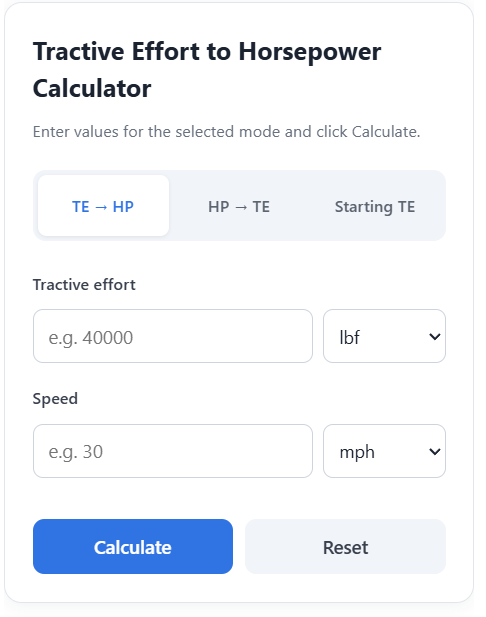
Enter the tractive effort and speed to convert to horsepower, or switch modes to work backward from horsepower or to estimate starting tractive effort from adhesive weight and rail conditions.
Related Calculators
- All Automotive Calculators
- Drawbar Horsepower Calculator
- Fan Horsepower Calculator
- Corrected Horsepower Calculator
Formula
TE → HP: HP = (TE × v) / 375
where TE = tractive effort in lbf, v = speed in mph, 375 = unit constant (ft·lbf/min per hp ÷ 88).
HP → TE: TE = (HP × 375) / v
where HP = horsepower, v = speed in mph, TE = tractive effort in lbf.
Starting TE: TEstart = W × μ
where W = adhesive weight on driven wheels (lb), μ = coefficient of adhesion between wheel and rail.
SI form: P (kW) = F (kN) × v (m/s)
where P = power, F = tractive effort, v = speed.
Interpretation
The result tells you how much power is being delivered at the wheel–rail interface at a given speed, or conversely how much pull a given power rating can produce at that speed. Tractive effort is highest at low speed and falls as speed rises, because power is fixed and HP = TE × v. The starting TE mode gives the ceiling set by friction — above this value the wheels slip no matter how much engine power is available.
Typical reference points for locomotives:
- Switcher: 1,000–2,000 hp, starting TE 60,000–90,000 lbf
- Road freight (single unit): 3,000–4,400 hp, starting TE 140,000–200,000 lbf
- Heavy AC freight: 4,400–6,000 hp, starting TE up to 200,000+ lbf
- Coefficient of adhesion: 0.25 dry clean rail, 0.15 wet, 0.33 with sand, 0.07 icy
Why 375?
The constant 375 comes from unit conversion. One horsepower equals 33,000 ft·lbf per minute. One mph equals 88 ft per minute. Dividing gives 33,000 / 88 = 375, so multiplying lbf by mph and dividing by 375 yields horsepower directly.
| Unit System | Formula | Output |
|---|---|---|
| Imperial | HP = (lbf × mph) / 375 | horsepower |
| Imperial (ft/s) | HP = (lbf × ft/s) / 550 | horsepower |
| SI | kW = kN × m/s | kilowatts |
FAQ
Is this the horsepower at the rail or at the engine?
It’s rail horsepower (also called drawbar or traction HP). Engine (gross) horsepower is higher because it doesn’t account for transmission, generator, and auxiliary losses — typically 80–85% of gross HP reaches the rail.
Why does my answer go to infinity at zero speed?
The HP = TE × v relationship means any finite power produces infinite force at zero speed, which is unphysical. At low speeds, tractive effort is limited by adhesion (W × μ), not by power. Use the Starting TE tab for that regime.
What coefficient of adhesion should I use?
Use 0.25 for dry clean rail as a default, 0.33 if sanders are active, and 0.15 or less for wet, leafy, or contaminated rail. Modern AC traction locomotives with creep control can sustain effective values up to around 0.37.
Does this work for cars or trucks?
Yes — the formula HP = (lbf × mph) / 375 is a general power–force–speed identity. It applies to any vehicle, though “tractive effort” is normally a rail term; for road vehicles you’d typically call it drawbar pull or wheel force.