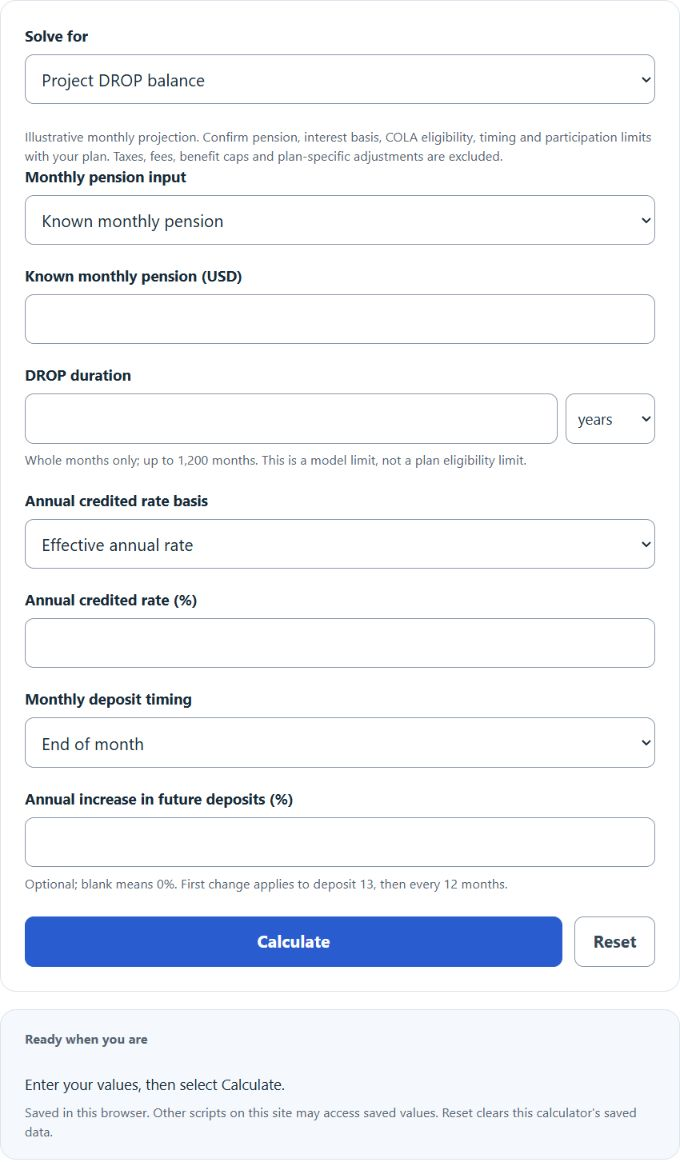
Project monthly pension deposits, DROP interest, COLA assumptions, and year-by-year balances, or reverse-solve the time or credited rate for a target lump sum.
DROP Retirement Calculator Formula
The following simplified equations are commonly used to estimate a DROP account balance. Note that actual DROP programs vary (deposit timing, interest crediting, COLAs, caps, and plan-specific rules).
- Where Bannual is the estimated annual retirement benefit at DROP entry ($/yr)
- S is the salary used for the plan’s benefit calculation ($/yr) (often a “final average salary” figure)
- YOS is years of service at DROP entry (years)
- M is the plan’s benefit multiplier/accrual rate (decimal per year, e.g., 0.02)
- IR is the nominal annual interest rate in this displayed formula (decimal form), compounded monthly
- D is the DROP participation duration (years)
In the displayed level-deposit formula, the pension benefit (salary × years of service × multiplier) is deposited at each month-end and the nominal annual rate is divided by 12. At zero interest, DROP equals monthly pension × number of months. For an effective annual rate r, use monthly rate (1+r)1/12 − 1 instead. The calculator offers both bases, beginning- or end-of-month deposits, and annual changes to future deposits. Confirm your plan’s actual crediting and COLA rules.
What is a DROP Retirement Calculator?
Definition:
A DROP Retirement Calculator is a tool used to estimate the potential balance in a Deferred Retirement Option Plan (DROP) account. In many DROP programs, you continue working while the retirement benefit you would have received (had you retired at DROP entry) is credited to a DROP account, along with plan-defined interest. This calculator provides a simplified estimate and should be checked against your plan’s official rules.
How to Calculate DROP Retirement?
Example Problem:
The following example outlines the steps and information needed to estimate a DROP account balance using the simplified model above.
First, determine the years of service at DROP entry. In this example, an individual has 25 years of service.
Next, determine the salary figure used in the benefit formula. Suppose that figure is $50,000 per year.
Next, determine the plan’s benefit multiplier (accrual rate). Assume a multiplier of 2% per year (0.02). (Your plan may differ.)
Next, determine the DROP participation duration. Let’s say this individual plans to stay in the plan for 5 years, with a projected nominal annual interest rate of 5% (0.05 in decimal), compounded monthly with end-of-month deposits and no deposit increases in this example.
Finally, calculate the estimated annual benefit, convert it to a monthly deposit, and compute the future value of monthly deposits with monthly interest crediting:
Bannual = S × YOS × M = 50,000 × 25 × 0.02 = $25,000 per year
PMT = Bannual ÷ 12 = 25,000 ÷ 12 ≈ $2,083.33 per month
i = IR ÷ 12 = 0.05 ÷ 12 ≈ 0.0041667 per month, n = 12D = 60 months
DROP = PMT × ((1 + i)n − 1) ÷ i ≈ $141,679.34, using unrounded PMT = 25,000/12 and i = 0.05/12. Selecting an effective annual 5% rate instead produces approximately $141,278.62.
FAQ
What factors can affect my total DROP benefits?
The amount of DROP benefits depends on your plan’s benefit formula (e.g., years of service, salary used for benefit calculation, and the plan multiplier), your DROP participation length, and the plan’s credited interest rate. Plan rules (caps, COLAs, crediting frequency, distribution options) can also affect your final balance.
Do I pay taxes on DROP benefits immediately?
Tax obligations vary depending on your plan specifics, your residency, and the tax regulations in effect at retirement. Many plans allow you to roll the DROP funds into a tax-deferred account, but it’s advisable to consult a financial or tax professional for personalized guidance.
Is a DROP plan suitable for everyone?
A DROP plan may not always be the ideal choice depending on individual retirement goals, financial needs, and plan details. It’s recommended to review your plan’s official materials and consider professional advice before deciding to enter a DROP plan.