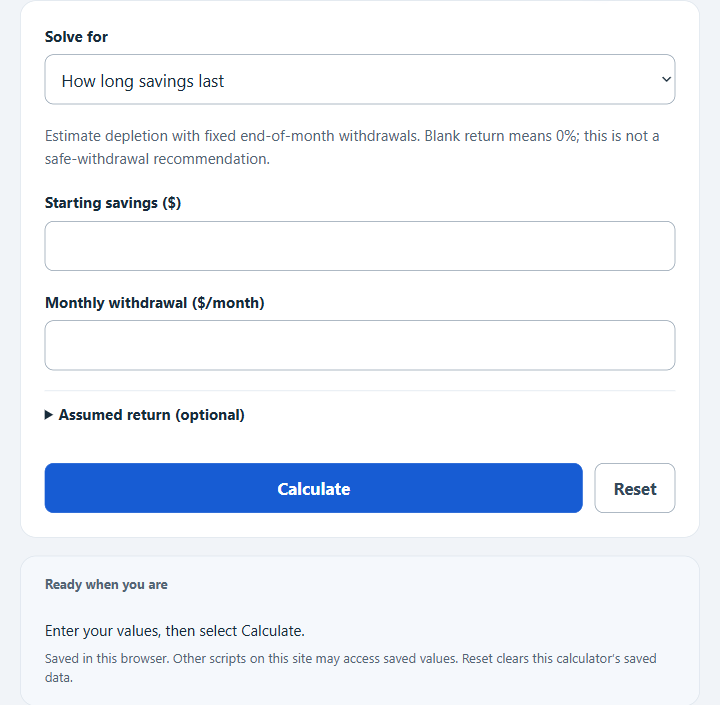
Estimate a depletion period or fixed month-end withdrawal using starting savings and a constant assumed nominal annual return. Blank return means 0%; this is not a safe-withdrawal recommendation.
Asset Depletion Formula
The calculator uses level withdrawals at the end of each month. Enter a nominal annual percentage; divide it by 100 and then by 12 to obtain monthly rate r. Fractional durations are annuity-equation estimates, not guaranteed full withdrawals.
How long will savings last?
If there is no investment return, the calculation is simple depletion:
If the remaining balance earns a monthly return, the calculator uses:
- n = number of months your savings will last
- P = starting savings or assets
- W = monthly withdrawal
- r = monthly return, calculated as annual return ÷ 12
Monthly withdrawal amount
If there is no investment return, the calculator divides your assets by the number of months:
If the remaining balance earns a monthly return, the calculator uses the payment formula:
- W = monthly withdrawal amount
- P = starting savings or assets
- r = monthly return, calculated as annual return ÷ 12
- n = total number of months, calculated as years × 12
The “How long will it last?” function estimates the number of months before the balance reaches zero. If the monthly growth is greater than or equal to the withdrawal, the calculator reports that the balance does not run out under those assumptions.
The “Monthly withdrawal” function estimates the fixed monthly amount that would deplete the starting balance over your chosen number of years, while applying the selected return to the remaining balance.
Withdrawal Rates and Return Assumptions
These tables illustrate withdrawal amounts and return assumptions. They do not identify safe withdrawal rates or expected returns for any asset class.
| Annual withdrawal rate | Monthly withdrawal on $500,000 | Arithmetic interpretation |
|---|---|---|
| 3% | $1,250 | Lower starting withdrawal amount |
| 4% | $1,667 | 4% of starting balance per year |
| 5% | $2,083 | 5% of starting balance per year |
| 6% | $2,500 | Higher starting withdrawal amount |
| Annual return setting | Illustrative assumption | Planning note |
|---|---|---|
| 0% | No-growth cash estimate | Shows pure depletion with no interest or investment gain |
| 2% | 2% nominal annual return | Monthly assumed rate = 2% / 12 |
| 4% | 4% nominal annual return | Monthly assumed rate = 4% / 12 |
| 6% to 8% | 6% to 8% nominal annual return | Hypothetical inputs, not asset-class forecasts |
Example Asset Depletion Calculations
Example 1: How long $500,000 lasts with $3,500 monthly withdrawals
Assume you have $500,000 in savings, withdraw $3,500 per month, and select a 4% annual return.
Using the unrounded monthly rate, the result is about 194.311 months, or 16.193 years. Market returns are not constant in practice.
Example 2: Monthly withdrawal from $500,000 over 25 years
Assume you want $500,000 to last 25 years and select a 4% annual return.
The result is about $2,639 per month, or about $31,670 per year.
Asset Depletion Calculator FAQ
What does asset depletion mean?
Asset depletion means using savings or investment assets to support spending over time. In this calculator, your assets are reduced by a fixed monthly withdrawal and, if selected, increased by an assumed return on the remaining balance.
Does the calculator include taxes, inflation, or fees?
No. The calculation uses the starting savings amount, withdrawal amount or time period, and the selected annual return. It does not adjust for income taxes, investment fees, inflation, required minimum distributions, or changes in spending. If those items apply, your real-world result may be lower than the estimate shown.
Why can the result say there is no finite depletion?
If the selected return produces monthly growth that is greater than or equal to the monthly withdrawal, the formula does not reach a zero balance. For example, $500,000 at a 4% annual return has estimated first-month growth of about $1,667. If you withdraw less than that, the balance grows under the calculator’s fixed-return assumption.