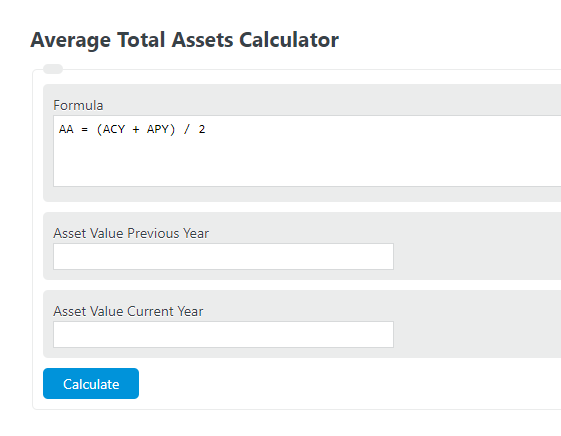
Calculate average total assets from beginning and ending balances or a list of balances, with results shown in dollars, thousands, and millions.
Average Total Assets Formula
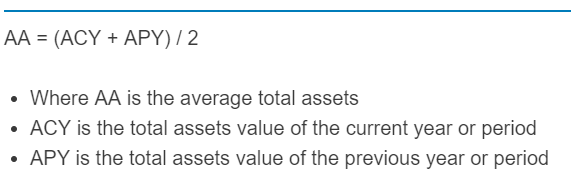
Two-point average (beginning and ending balance):
Multi-period average (any number of balances):
- Beginning Total Assets: total assets at the start of the period, from the prior balance sheet.
- Ending Total Assets: total assets at the end of the period.
- A1...An: each interim total asset balance (monthly, quarterly, etc.).
- n: number of balances used.
Use the same currency and units across all balances. The two-point version is standard for annual ratios. Use the multi-period version when assets shifted significantly mid-year, such as after an acquisition, divestiture, or large capex round.
Reference Tables
Average total assets feeds directly into efficiency and profitability ratios. Here is how it plugs in and what the output usually means.
| Ratio | Formula | What it measures |
|---|---|---|
| Return on Assets (ROA) | Net Income / Average Total Assets | Profit per dollar of assets |
| Asset Turnover | Net Sales / Average Total Assets | Revenue generated per dollar of assets |
| DuPont ROE component | Avg Total Assets / Avg Equity | Equity multiplier (leverage) |
| Industry | Typical Asset Turnover | Typical ROA |
|---|---|---|
| Retail | 2.0 - 3.0 | 5% - 10% |
| Manufacturing | 0.8 - 1.5 | 4% - 8% |
| Software / Tech | 0.4 - 0.8 | 8% - 20% |
| Banks | Not meaningful | 1% - 1.5% |
| Utilities | 0.3 - 0.5 | 2% - 4% |
Example and FAQ
Example. A company starts the year with $1,250,000 in total assets and ends with $1,395,000.
Average Total Assets = ($1,250,000 + $1,395,000) / 2 = $1,322,500
If net income for the year was $92,000, ROA = $92,000 / $1,322,500 = 6.96%.
Why average instead of ending balance? Income statement figures cover the full period. Pairing them with a single point-in-time asset balance overstates or understates capital deployed. The average matches the income flow to the asset base that produced it.
When should you use more than two balances? When a large asset change happened mid-period. Quarterly or monthly balances smooth out timing distortions from acquisitions, share buybacks funded with cash, or major capex.
Where do the asset figures come from? The "Total assets" line on the balance sheet. Use audited or quarter-end figures for consistency, and pull both balances from balance sheets prepared on the same accounting basis.