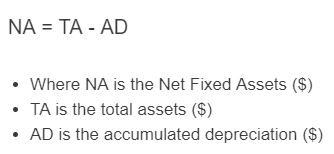
Calculate cost-model net fixed assets from gross recorded cost, accumulated depreciation and optional accumulated impairment in USD.
Net Fixed Assets Formula
Net fixed assets represent the book value of a company’s long-term tangible assets after subtracting accumulated depreciation from the original recorded cost. This calculator uses the standard balance-sheet relationship below:
In this formula:
- NFA = net fixed assets
- GFA = gross fixed assets at historical cost
- AD = accumulated depreciation recorded on those assets
If your analysis also includes impairment charges, the broader carrying-value concept may be expressed as:
This calculator uses the cost model and subtracts both accumulated depreciation and any accumulated impairment entered; blank impairment means zero. It does not calculate market value or a revaluation-model balance.
What Net Fixed Assets Mean
Net fixed assets measure how much of a company’s property, plant, and equipment remains on the books after depreciation has been recognized over time. It is a useful figure for evaluating the size, age, and capital intensity of an asset base.
Typical fixed assets include:
- Buildings and improvements
- Machinery and production equipment
- Vehicles
- Office equipment and furniture
- Leasehold improvements
Net fixed assets generally do not include current assets such as cash or inventory, and they are usually analyzed separately from intangible assets such as patents, trademarks, and goodwill.
How to Calculate Net Fixed Assets
- Find gross fixed assets at cost. Use the original recorded purchase cost of the fixed assets being evaluated.
- Find accumulated depreciation. Use the total depreciation recognized to date for those same assets.
- Subtract depreciation and accumulated impairment from cost. Use balances for the same asset group and date, without double counting impairment. Depreciation plus impairment cannot exceed that cost.
That process can be summarized as:
Example Calculation
Suppose a company reports fixed assets at cost of $900,000 and accumulated depreciation of $260,000. The net fixed assets are:
So the company’s net fixed assets equal $640,000. This means $640,000 of book value remains on the balance sheet for the assets being analyzed.
How to Interpret the Result
| Result Pattern | What It Usually Suggests |
|---|---|
| High net fixed assets relative to gross fixed assets | The asset base is newer, less depreciated, or recently expanded. |
| Low net fixed assets relative to gross fixed assets | The assets are older, more heavily depreciated, or nearing replacement. |
| Rising net fixed assets over time | The company may be investing in capital expenditures faster than assets are being depreciated. |
| Falling net fixed assets over time | The company may be underinvesting, disposing of assets, or allowing the asset base to age. |
Net fixed assets are especially useful when reviewed over multiple periods rather than in isolation. These patterns are possible explanations, not proof of physical condition or replacement needs; depreciation policies, impairment, disposals and measurement bases also matter. See IAS 16 for the distinction between cost and revaluation models and IAS 36 for impairment.
Why Businesses Track Net Fixed Assets
- Financial analysis: helps assess operational capacity and capital intensity
- Lending and credit review: provides insight into asset backing and reinvestment needs
- Internal planning: helps determine when major equipment replacement may be approaching
- Ratio analysis: supports metrics such as asset turnover and return on assets
- Valuation review: gives context for the condition and age of productive assets
Common Inputs and Data Sources
You can usually find the values needed for this calculator in a company’s balance sheet and fixed asset notes. When gathering inputs, make sure the figures refer to the same asset group and reporting period.
- Gross fixed assets: original cost before depreciation
- Accumulated depreciation: total depreciation recorded to date
- Same scope: both numbers should refer to the same property, plant, and equipment base
Common Mistakes
- Using market value instead of historical cost
- Mixing depreciation from unrelated asset categories
- Including current assets such as inventory or receivables
- Ignoring impairment when a more complete carrying-value analysis is needed
- Comparing companies with very different depreciation methods without adjustment
Net Fixed Assets vs. Gross Fixed Assets
| Measure | Description | Use |
|---|---|---|
| Gross Fixed Assets | Total recorded cost before depreciation | Shows original investment in fixed assets |
| Net Fixed Assets | Recorded cost after accumulated depreciation | Shows remaining book value on the balance sheet |
Related Efficiency Insight
Analysts often compare net fixed assets with revenue to understand how effectively a company is using its long-term asset base. One common supporting ratio is fixed asset turnover:
A higher turnover ratio can indicate more efficient use of plant and equipment, although the result should always be interpreted alongside industry norms and asset age.
Frequently Asked Questions
Are net fixed assets the same as property, plant, and equipment?
They are closely related. Net fixed assets usually refer to the carrying value of tangible long-term operating assets, which commonly aligns with net property, plant, and equipment.
Can net fixed assets be zero?
Yes. If accumulated depreciation equals the recorded cost of the depreciable assets, the book value can be reduced to zero even if the assets are still in use.
Is land included in net fixed assets?
Land may be included in fixed assets, but it is generally not depreciated. If land is part of the total fixed assets figure, its accumulated depreciation is typically zero.
Do higher net fixed assets always mean a stronger business?
No. A larger number may reflect recent investment, but it can also mean the business is highly capital intensive. The figure is most useful when compared across time, against revenue, and with peers in the same industry.
Should accumulated depreciation ever exceed gross fixed assets?
For the same asset group, accumulated depreciation normally should not exceed the depreciable cost base. If it appears to, review the inputs for consistency or scope mismatch.