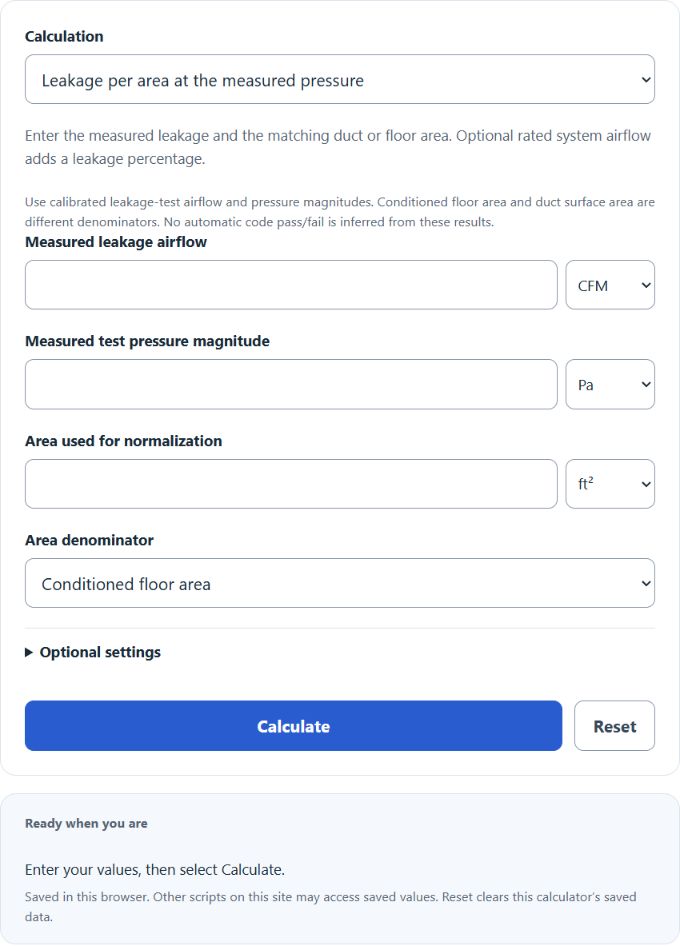
Express measured duct leakage per 100 square feet and optionally as a fraction of rated system airflow. You can also estimate leakage at another test pressure using a stated flow exponent.
Leakage formulas
Leakage per 100 ft² = 100Q / A, where Q is leakage in CFM and A is the chosen area in square feet. Choose conditioned floor area or duct surface area consistently; the two denominators produce different metrics.
Q₂ = Q₁(P₂/P₁)n estimates a reference-pressure flow. Pressures are positive test-pressure magnitudes, and n is a measured or assumed exponent. A pressure estimate does not replace a protocol that requires a direct test at the reference pressure.
Optional leakage percentage = 100Q / rated system airflow. Leakage measured under a test pressure is not automatically the leakage during system operation.
Worked example
A measured 50 CFM at 25 Pa for 1,000 ft² of conditioned floor area gives 100 × 50 / 1,000 = 5 CFM per 100 ft². Separately, 200 CFM at 50 Pa with n = 1 predicts 100 CFM at 25 Pa, or 10 CFM per 100 ft² for the same area. At 1,000 CFM rated airflow, that predicted test leakage is 10%.
Frequently asked questions
What does CFM25 mean?
Leakage airflow measured at a 25 Pa duct test pressure. Record whether the test measures total leakage or leakage to outside.
Does this decide whether a test passes?
No. Requirements depend on the applicable protocol, area definition and jurisdiction. Compare the matching reported metric with the rule that applies to your project.
Should I always use n = 0.65?
No. It is an assumption unless measured for the system. Enter the exponent justified by your test data or procedure.
Test reference: DOE/PNNL Building America: duct leakage tests.