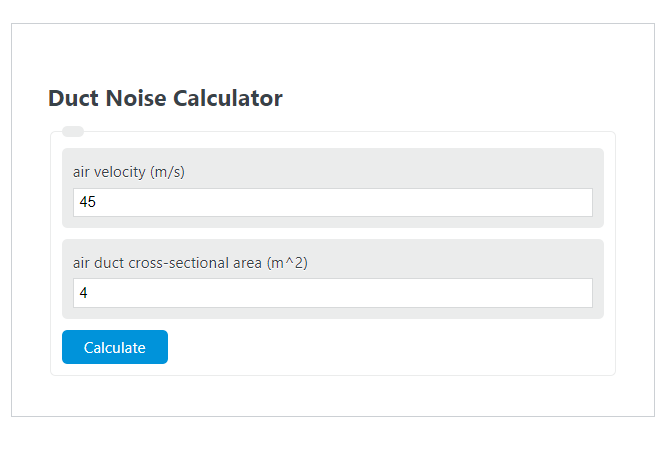
Estimate HVAC duct outlet noise from straight-run and elbow losses, combine background sound correctly, or reverse-solve the attenuation rate needed for a target.
- All Construction Calculators
- Face Velocity Calculator
- Return Air Duct Size Calculator
- CFM To LPM Calculator
Duct Noise (Index) Formula
The following two example problems outline the steps and information needed to calculate the Duct Noise Index (DN). This DN value is a simplified, relative index derived from velocity and area; it is not a full prediction of HVAC sound pressure level (SPL) or sound power in real installations.
Variables (use base-10 logarithms):
- DN is the Duct Noise Index (dB, relative)
- V is the air velocity (m/s)
- A is the air duct cross-sectional area (m²)
How to Calculate Duct Noise (Index)?
The following steps outline how to calculate the Duct Noise Index (DN).
- First, determine the air velocity (m/s).
- Next, determine the air duct cross-sectional area (m²).
- Next, gather the formula from above: DN = 10 + 50*LOG10(V / 1 m/s) + 10*LOG10(A / 1 m²).
- Finally, calculate the Duct Noise Index (DN).
- After inserting the variables and calculating the result, check your answer with the calculator above.
Example Problem :
Use the following variables as an example problem to test your knowledge.
air velocity (m/s) = 2.35
air duct cross-sectional area (m²) = 1.25
DN = 10 + 50*LOG10(V / 1 m/s) + 10*LOG10(A / 1 m²) = ?
Result: DN = 10 + 50·LOG10(2.35) + 10·LOG10(1.25) ≈ 29.52 dB (relative).