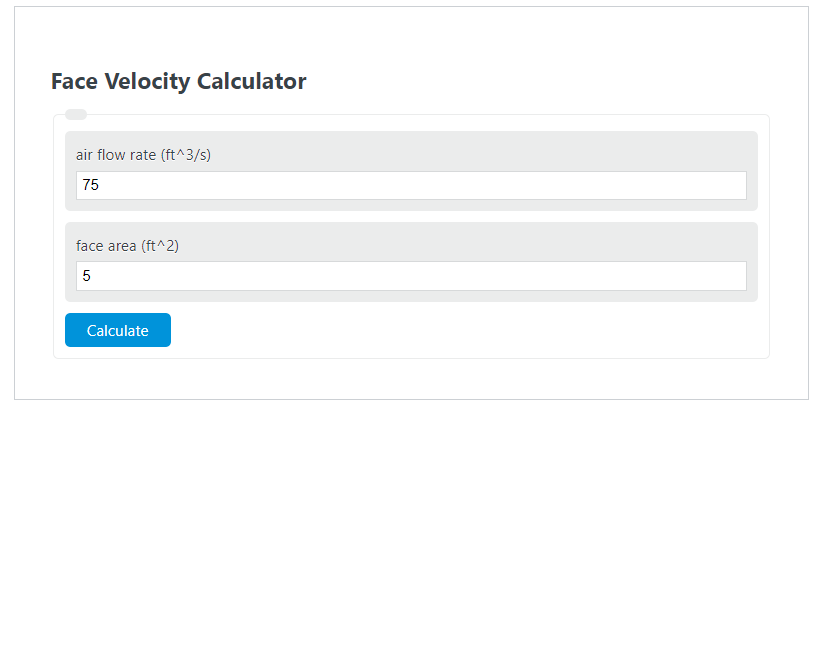
Calculate face velocity, airflow rate, or open face area using CFM and FPM or metric airflow, area, and velocity units.
- All Construction Calculators
- All Velocity Calculators
- Duct Velocity Calculator
- Compressed Air Velocity Calculator
- Pneumatic Cylinder Airflow Calculator
Face Velocity Formula
- V = face velocity (fpm)
- Q = volumetric airflow (CFM)
- A = open face area (ft²)
Rearranged for the airflow mode: Q = V × A. Face area depends on shape: A = width × height for rectangular openings, A = π × D² / 4 for round openings. The calculator converts all inputs to CFM and ft² before solving, so you can mix units freely. Results assume the full opening is unobstructed; for louvers, grilles, or filters with a free area less than the gross area, multiply the gross area by the manufacturer’s free area ratio before entering it.
Typical Face Velocity Ranges
Use these ranges as a sanity check on the result, not as design code. Always confirm against the equipment spec sheet and applicable standard (ASHRAE, SMACNA, ANSI Z9.5, etc.).
| Application | Typical Face Velocity | Notes |
|---|---|---|
| HVAC pleated filter | 250–500 fpm | Higher velocity raises pressure drop |
| HEPA filter | 90–250 fpm | Per filter rating |
| Supply register / grille | 300–700 fpm | Above 700 fpm gets noisy |
| Return grille | 400–600 fpm | Lower in occupied zones |
| Lab fume hood | 80–120 fpm | 100 fpm is the common target |
| Cooling coil | 400–550 fpm | Above 550 fpm risks moisture carryover |
| Paint spray booth | 100 fpm (downdraft) / 100–125 fpm (crossdraft) | OSHA / NFPA 33 minimums |
| Unit Conversion | Equivalent |
|---|---|
| 1 fpm | 0.00508 m/s |
| 1 m/s | 196.85 fpm |
| 1 CFM | 1.699 m³/h = 0.4719 L/s |
| 1 ft² | 0.0929 m² = 144 in² |
Worked Example
Problem: A 20 in × 25 in pleated filter sees 1,000 CFM. What is the face velocity?
- Convert area: (20/12) × (25/12) = 1.667 × 2.083 = 3.472 ft²
- Apply the formula: V = 1,000 / 3.472 = 288 fpm
- Compare: 288 fpm sits at the low end of the 250–500 fpm filter range, so pressure drop and noise should be acceptable.
FAQ
Is face velocity the same as duct velocity? No. Face velocity is measured at the open face of a filter, coil, hood, grille, or louver. Duct velocity is measured inside the duct, where the cross-section is usually smaller and the air moves faster.
Should I use gross area or free area? Use free (net) area for louvers, grilles, and perforated faces. Use gross area for filters and coils unless the manufacturer specifies otherwise.
Why does my fume hood need a sash-position adjustment? Face velocity is measured across the actual sash opening. As you raise the sash, the area grows and velocity drops unless airflow increases. Variable air volume hoods modulate Q to hold V constant.