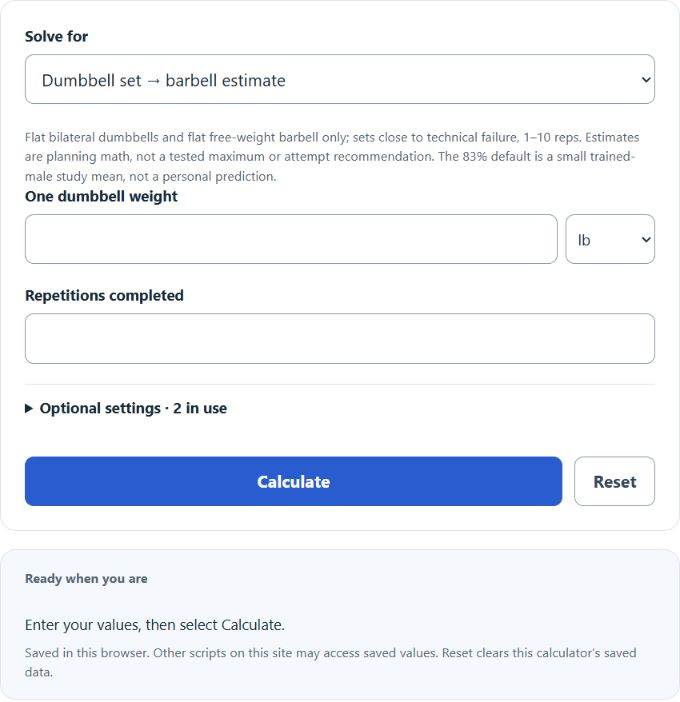
Convert a flat dumbbell bench set to a flat barbell bench planning estimate—or reverse it. Enter the weight of one dumbbell and a near-failure set of 1–10 reps; results separate pair load, same-rep planning math, estimated 1RM, ratio, and limitations.
How do you convert dumbbell bench to barbell bench?
There is no universal personal conversion. For a transparent planning estimate, this page uses the combined weight of two dumbbells and an optional research anchor: total dumbbell 1RM ÷ barbell 1RM = 0.83. That 0.83 value is the center result from one small study, not a prediction interval or a promise of what an individual can lift.
For the simplest same-rep comparison, double the per-hand dumbbell weight and divide by the selected ratio. If you enter a multi-rep set, the calculator separately estimates a dumbbell-pair 1RM and then an estimated barbell 1RM. Those are two different outputs and should not be conflated.
Dumbbell-to-barbell bench formula
The calculator keeps the per-hand dumbbell load, combined pair load, reps-to-1RM estimate, and cross-exercise ratio separate. This prevents the common mistake of doubling the dumbbell twice or applying the repetition factor twice.
At the default research anchor, q = 0.83 and its reciprocal barbell multiplier is about 1.205. The ratio and its reciprocal are labeled separately because both being called a “conversion factor” can produce a roughly 20% direction error.
Which calculator mode should you use?
| What you have | Mode | What it calculates |
|---|---|---|
| A flat dumbbell set performed with two equal dumbbells | Dumbbell set → barbell estimate | A same-rep barbell planning load and a separate estimated barbell 1RM. |
| A flat free-weight barbell set | Barbell set → dumbbell target | A mathematical per-hand dumbbell target for selected reps. It is not a suggested attempt. |
| Recent known 1RMs for both flat movements | Compare known 1RMs | Your descriptive dumbbell-pair ÷ barbell ratio, which you can enter as a custom assumption. |
Why does the calculator default to 83%?
In a 2011 crossover study of 12 resistance-trained young men, total dumbbell 1RM was 17% lower than barbell 1RM. Expressed in the direction used here, the study-center ratio was approximately 0.83. The paper directly compared the movements, making it a useful research anchor, but the small, narrow sample cannot establish a universal individual factor. See the study on PubMed or through its DOI.
A related 2012 study of 11 trained young men reported mean 1RMs of 89.5 kg with dumbbells and 106.4 kg with a barbell, a derived ratio of about 0.841. It came from the same research group and a similar population, so it supports context rather than broad independent validation. See PubMed and the DOI record.
Training history can move the relationship. In a 10-week intervention, the dumbbell-training group’s ratio calculated from group-mean 6RMs changed from about 0.81 before training to about 0.99 afterward. Those are protocol-specific group means, not personal bounds, but they show why a recent personal ratio can be more informative than an experience label. Read the full study or its DOI.
Common per-hand dumbbell 1RM conversions
The following charts answer common pound and kilogram searches without hiding the assumptions. Every row treats the per-hand number as an existing one-repetition maximum, doubles it once, and divides the pair by 0.83. Because reps equal one, the same-rep planning value and estimated barbell 1RM are numerically identical. These are study-anchor estimates, not tested barbell maxes.
| One dumbbell | Two-dumbbell total | Estimated barbell 1RM |
|---|---|---|
| 20 lb per hand | 40 lb | 48.2 lb |
| 25 lb per hand | 50 lb | 60.2 lb |
| 30 lb per hand | 60 lb | 72.3 lb |
| 35 lb per hand | 70 lb | 84.3 lb |
| 40 lb per hand | 80 lb | 96.4 lb |
| 45 lb per hand | 90 lb | 108.4 lb |
| 50 lb per hand | 100 lb | 120.5 lb |
| 55 lb per hand | 110 lb | 132.5 lb |
| 60 lb per hand | 120 lb | 144.6 lb |
| 65 lb per hand | 130 lb | 156.6 lb |
| 70 lb per hand | 140 lb | 168.7 lb |
| 75 lb per hand | 150 lb | 180.7 lb |
| 80 lb per hand | 160 lb | 192.8 lb |
| 85 lb per hand | 170 lb | 204.8 lb |
| 90 lb per hand | 180 lb | 216.9 lb |
| 95 lb per hand | 190 lb | 228.9 lb |
| 100 lb per hand | 200 lb | 241.0 lb |
| One dumbbell | Two-dumbbell total | Estimated barbell 1RM |
|---|---|---|
| 10 kg per hand | 20 kg | 24.1 kg |
| 12.5 kg per hand | 25 kg | 30.1 kg |
| 15 kg per hand | 30 kg | 36.1 kg |
| 17.5 kg per hand | 35 kg | 42.2 kg |
| 20 kg per hand | 40 kg | 48.2 kg |
| 22.5 kg per hand | 45 kg | 54.2 kg |
| 25 kg per hand | 50 kg | 60.2 kg |
| 27.5 kg per hand | 55 kg | 66.3 kg |
| 30 kg per hand | 60 kg | 72.3 kg |
| 32.5 kg per hand | 65 kg | 78.3 kg |
| 35 kg per hand | 70 kg | 84.3 kg |
| 40 kg per hand | 80 kg | 96.4 kg |
| 45 kg per hand | 90 kg | 108.4 kg |
| 50 kg per hand | 100 kg | 120.5 kg |
Worked examples with reps
Two 70 lb dumbbells for 8 reps
Using the default Brzycki formula and 0.83 ratio: the pair load is 140 lb; the Brzycki factor is 36 ÷ 29 = 1.241379; estimated dumbbell-pair 1RM is 173.8 lb; and estimated barbell 1RM is 173.8 ÷ 0.83 = 209.4 lb. The separate same-rep planning load is 140 ÷ 0.83 = 168.7 lb for 8 reps. Neither value is a tested performance result.
Two 32 kg dumbbells for 5 reps
The pair load is 64 kg. Brzycki gives a factor of 1.125, so the estimated dumbbell-pair 1RM is 72.0 kg and the estimated barbell 1RM is 86.7 kg. The same-rep planning load is 77.1 kg for 5 reps.
A known 100 kg barbell 1RM to an 8-rep dumbbell target
At a 0.83 ratio, estimated dumbbell-pair 1RM is 83 kg, or 41.5 kg per hand. Dividing that per-hand value by the Brzycki 8-rep factor gives 33.4 kg per hand. This is a mathematical target estimate, not a safe first attempt or a loading recommendation.
| Assumed pair/barbell ratio | Same-rep planning load | Estimated barbell 1RM |
|---|---|---|
| 75% scenario | 186.7 lb for 8 reps | 231.7 lb |
| 83% research anchor | 168.7 lb for 8 reps | 209.4 lb |
| 90% scenario | 155.6 lb for 8 reps | 193.1 lb |
Brzycki vs Epley formulas
Both choices estimate a one-rep maximum from a set close to technical failure. Neither was developed as a cross-exercise dumbbell-to-barbell equation. The calculator limits reps to 1–10 because prediction uncertainty generally grows as rep counts rise, and bench research supports keeping linear prediction to low-repetition sets.
| Method | Factor | Treatment on this page |
|---|---|---|
| Brzycki (default) | 36 ÷ (37 − reps) | Returns exactly 1.000 at one rep. Mayhew et al. found Brzycki comparatively accurate for barbell bench sets of 10 or fewer reps to failure; that does not validate the modality ratio. |
| Epley (optional) | 1 + reps ÷ 30 | For one rep, this calculator special-cases the factor to 1.000 so the entered one-rep load remains unchanged. |
See the original Brzycki DOI, the Mayhew bench-validation abstract, and the Reynolds low-rep comparison. A 2024 meta-regression covering roughly 7,000 people also found substantial person-to-person variation in repetitions at a given percentage of 1RM; see the full text.
How to interpret a personal ratio
If you already know comparable, recent 1RMs for both movements, personal ratio = (2 × dumbbell 1RM per hand) ÷ barbell 1RM. For example, 50 lb dumbbells and a 120 lb barbell 1RM produce 100 ÷ 120 = 0.833, or 83.3%.
A personal result describes those records; it is not guaranteed to predict the next session. Compare the same flat variations with similar range of motion, pause style, fatigue state, and training period. Recheck it after a block emphasizing one movement. Do not replace a missing personal measurement with a beginner, intermediate, advanced, sex, or bodyweight multiplier.
Why dumbbell and barbell bench numbers differ
Independent implements
Each dumbbell must be controlled independently, while a barbell links both hands. This changes stability requirements and how force can be expressed.
Exercise-specific practice
A lifter who trains one implement more often may become disproportionately better at its setup, balance, bar path, and sticking region.
Technique and range
Grip width, arm path, depth, pause style, and repetition standard can change the comparison. The calculator applies no automatic technique correction.
Setup and fatigue
Getting heavy dumbbells into position and stabilizing them can limit a set independently of pressing strength. Session order and recent fatigue also matter.
Saeterbakken et al. observed higher biceps activity and lower triceps activity with dumbbells than with a barbell at 1RM, while pectoralis-major and anterior-deltoid activity did not differ. That finding does not establish that either exercise is universally safer or better for hypertrophy.
Why there are no sex, experience, bodyweight, or incline modifiers
| Proposed modifier | Why it is not in the equation |
|---|---|
| Beginner / intermediate / advanced | No validated tier-specific conversion factors were found. Exercise-specific familiarity is better handled with a personal ratio. |
| Sex or gender | The main direct ratio study used trained young men and did not validate sex-specific multipliers. |
| Bodyweight | Bodyweight can contextualize relative strength, but it does not have a validated role in this modality ratio. |
| Incline or decline angle | The direct evidence is for flat pressing. An incline or decline bench is a different condition, so this page will not invent an angle multiplier. |
| Machine or Smith bar | Guided and machine paths change the task. The output is restricted to a free barbell. |
Pounds, kilograms, and per-hand vs pair totals
- One dumbbell: the number printed on one implement.
- Dumbbell pair: twice the one-dumbbell load. Two 70 lb dumbbells equal 140 lb combined.
- Barbell total: the bar plus all plates.
- Unit conversion: 1 lb = 0.45359237 kg. Switching the calculator unit converts the entered physical mass; it does not relabel the same number.
Use the result as math, not as an attempt prescription
Frequently asked questions
Are two dumbbells equal to a barbell of the same total weight?
Not necessarily. The two movements differ in stability and exercise-specific skill. The 0.83 anchor means the combined dumbbell 1RM was lower than barbell 1RM on average in one small trained-male study, but an individual’s ratio can be different.
What is a 50 lb dumbbell bench equivalent to?
If 50 lb means one dumbbell and one rep, the two-dumbbell total is 100 lb. At the 0.83 study anchor, the mathematical barbell estimate is 120.5 lb. If 50 lb was used for multiple reps, enter the rep count because estimated 1RM changes. This is not a guarantee of barbell performance.
Should I enter one dumbbell or both?
Enter the weight of one dumbbell. The calculator doubles it exactly once and displays the combined pair load in the result.
Does the calculator work for incline dumbbell bench?
No. The evidence anchor is for flat pressing. The page does not apply an unsupported incline-to-flat multiplier; use a calculator designed and sourced for that separate comparison.
Why do Brzycki and Epley give different answers?
They are different mathematical models of the repetitions-to-1RM relationship. Differences increase as rep count rises. The calculator defaults to Brzycki, limits inputs to 10 reps, and labels both as estimates.
Is the 75% to 90% sensitivity table a typical range?
No. Those values are deliberately selected assumptions showing how much the answer changes when the ratio changes. They are not a confidence interval, prediction interval, or claim about typical lifters.
Methodology and primary sources
This page defines one ratio direction, doubles the per-hand dumbbell weight once, special-cases a one-rep set to the entered load for both rep formulas, rounds only for display, and never applies sex, bodyweight, experience, or bench-angle multipliers. Formula review date: August 10, 2026.
- Saeterbakken AH, van den Tillaar R, Fimland MS. Direct 1RM and muscle-activity comparison, 12 resistance-trained young men. PubMed · DOI
- Van den Tillaar R, Saeterbakken A. Chest-press sticking-region comparison. PubMed · DOI
- Saeterbakken AH, et al. Ten-week chest-press training intervention. Full text · DOI
- Heinecke ML, et al. Fixed-load dumbbell repetitions and barbell 1RM in college football players; the study-specific regression is not rescaled here. PubMed · DOI
- Brzycki M. Original reps-to-fatigue method. DOI
- Mayhew JL, et al. Bench-press repetition prediction across training backgrounds. PubMed
- Reynolds JM, et al. Comparison of 5RM, 10RM, and 20RM tests for 1RM prediction. PubMed · DOI
- Nuzzo JL, et al. Meta-regression of repetitions at percentages of 1RM. Full text · DOI
- Grgic J, et al. Systematic review of measured 1RM reliability. Full text · DOI
- American College of Sports Medicine. 2026 resistance-training position stand emphasizing individualized prescription. Full text
- National Strength and Conditioning Association. Basics of Strength and Conditioning Manual, including spotting fundamentals.