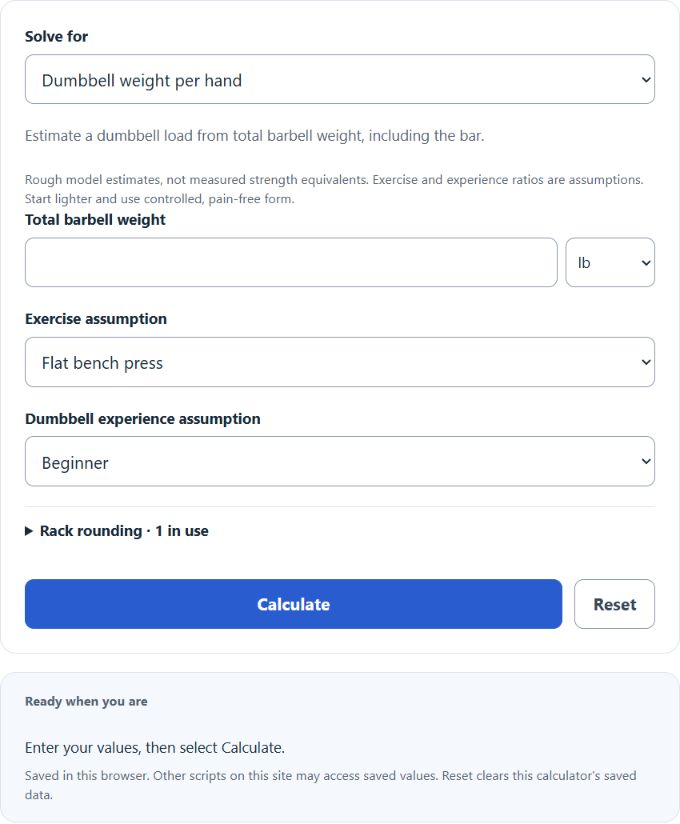
Convert barbell weight to dumbbell weight per hand or reverse it using exercise and experience adjustments, rack rounding, pair totals, and a transition range.
Safety note: This estimate is a rough starting point and can vary by exercise, technique, and experience. Start lighter than the estimate, use controlled form, and increase gradually; stop if you feel pain. If you’re new to lifting, pregnant, or managing an injury/medical condition, consider guidance from a qualified clinician or trainer.
Dumbbell Weight Formula
Variables:
- DBW is the Dumbbell Weight (total for both dumbbells)
- BBW is the barbell weight
The formula, table and example below use the flat bench press and intermediate-experience assumptions (0.40 per hand; 0.80 for the pair). Other exercise and experience selections use different heuristic ratios; none is an individually validated strength prediction. To calculate Dumbbell Weight (total), multiply the barbell weight by 0.80. If you want the approximate weight per dumbbell, divide the total by 2.
How to Calculate Dumbbell Weight?
The following steps outline how to calculate the Dumbbell Weight.
- First, determine the barbell weight.
- Next, use the formula from above: DBW (total) = BBW × 0.80.
- Finally, calculate the Dumbbell Weight (total). To estimate the per-dumbbell weight, divide the total by 2.
- After inserting the variables and calculating the result, check your answer with the calculator above.
Example Problem :
Use the following variables as an example problem to test your knowledge.
Barbell weight (BBW) = 125 lbs
Dumbbell weight (total) = 125 × 0.80 = 100 lbs
Dumbbell weight (each) = 100 ÷ 2 = 50 lbs
Frequently Asked Questions
Why is there a 20% reduction when converting barbell weight to dumbbell weight?
This calculator uses an approximation that many people use less total load with dumbbells due to added stability and coordination demands. The difference varies by exercise, range of motion, and training experience, so treat the result as a starting point and adjust based on stable, pain-free form.
Can I use this formula for any type of dumbbell exercise?
Not perfectly. It can be a rough starting estimate, but the “right” conversion can differ significantly between exercises (pressing vs. rowing vs. squatting patterns), and between individuals. When in doubt, start lighter and build up.
Is it necessary to adjust the dumbbell weight if I’m switching from a barbell exercise to a dumbbell equivalent?
Often, yes. Many lifters need to reduce the total load when switching to dumbbells. If you can complete your sets with controlled reps and stable form, you may not need as large a reduction; if stability breaks down, reduce further.
How can I check the accuracy of my calculated dumbbell weight?
Use the calculation as a starting point, then test it with good technique. If reps feel unstable or you cannot maintain proper form, lower the weight. Increase gradually once the movement feels controlled.