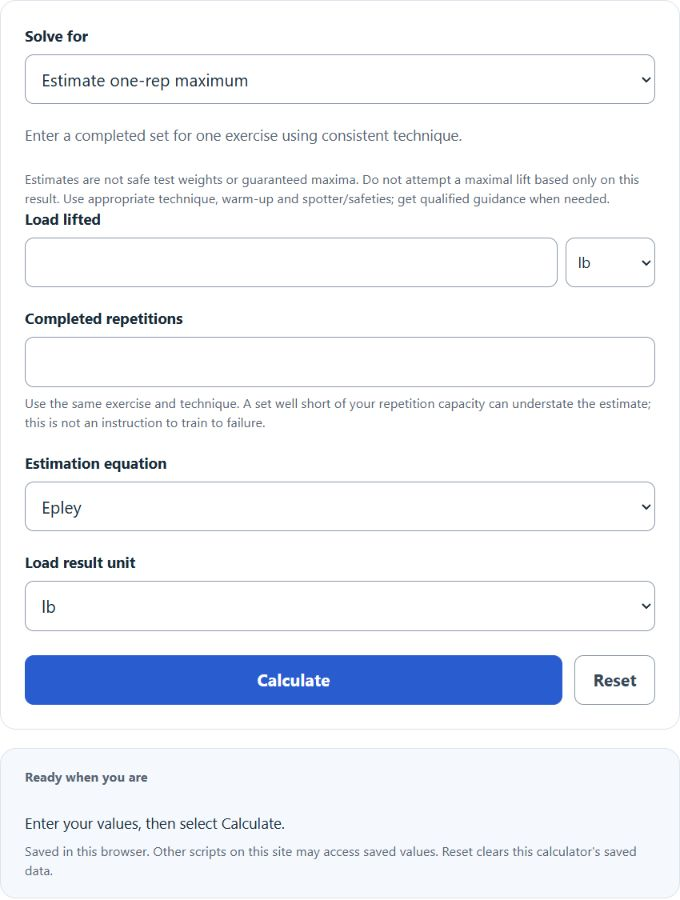
Estimate your one-rep max from weight and reps with Epley, Brzycki, or Lander formulas, or calculate a training weight from your 1RM.
Safety note: This calculator provides an estimate (not a guaranteed safe or exact max). Do not attempt a true 1-rep max based only on this result. Use proper warm-ups, technique, and a spotter/safeties when appropriate, and stop if you feel pain, dizziness, or unusual symptoms. If you’re new to lifting or have an injury/medical condition, get guidance from a qualified professional.
1RM Calculator
This calculator estimates a one-rep max (1RM) using common 1RM prediction equations. All 1RM predictions are approximations, and they tend to be most reliable when based on lower-rep sets (roughly 1–10 reps, up to ~12).
- Approximate reference only: these rep/percentage pairs vary by exercise and individual and are not outputs of every prediction equation.
- 1 Rep – 100% max lift
- 2 Reps – 95% max lift
- 3 reps – 93% max lift
- 4 reps – 90% max lift
- 5 reps – 87% max lift
- 6 reps – 85% max lift
- 7 reps – 83% max lift
- 8 reps – 80% max lift
- 9 reps – 77% max lift
- 10 reps – 75% max lift
- 11 reps – 73% max lift
- 12 reps – 70% max lift
As reps increase, estimates can become less reliable—especially beyond about 10–12 reps.
One Rep Max Calculator
Why would you need to know your max lift of any given exercise?
Some strength programs use percentages of a known or estimated 1RM as one input when planning loads. The appropriate workload also depends on the exercise, experience, technique, recovery and coaching; a predicted 1RM is not a required first step for every program.
An estimated 1RM may help track a consistent exercise over time. It does not determine safe frequency, prove a competition-valid lift or select safe attempts. Frequent maximal testing and competition planning require an appropriate program and qualified guidance.
For more information on lifting, visit our bench press calculator.
For more related calculators, visit our health & fitness calculators.
Reference: Published 1RM equation comparison; research on variation in strength-endurance profiles. Results depend on the exercise, effort, technique and individual; equation estimates are not safe maximal test weights.