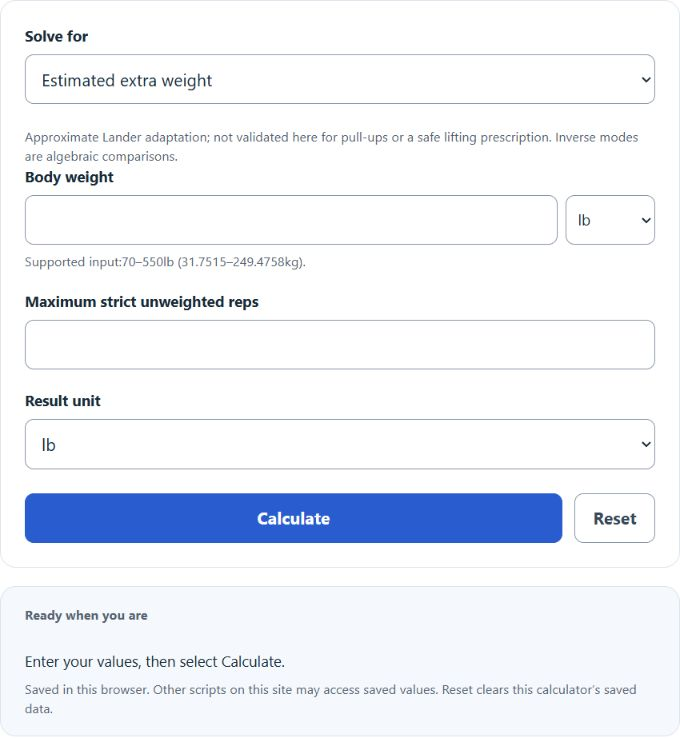
Calculate your estimated max weighted pullup extra weight from body weight and max unweighted pullups, with lb and kg unit options. Select a solve mode; the Lander adaptation is approximate and is not a validated pull-up prescription.
Safety notes
- Warm up first (easy pulling, scapular control, and a few progressive sets).
- Use strict form and full, controlled range of motion; stop the set when form breaks down.
- For weighted reps, use secure loading (belt/vest), controlled tempo, and avoid “grinding” painful reps.
Disclaimer: This calculator provides an estimate for educational purposes and is not medical advice. Near-failure and max-effort training can increase injury risk; consider using submaximal tests and consult a qualified coach/clinician if you’re new to resistance training, returning from injury, or have medical conditions. Stop if you feel pain, dizziness, or numbness.
Max Weighted Pullup Formula
The calculator uses the Lander rep-max equation adapted for pull-ups. It treats your total pull-up load as your body weight plus any extra weight, then returns the estimated extra weight you could add for a one-rep max weighted pull-up.
- E = estimated max weighted pull-up extra weight
- BW = body weight
- R = maximum number of unweighted pull-ups
- 101.3 and 2.67123 = Lander equation constants
Select “Model-equivalent unweighted reps” and enter body weight plus added weight to solve the unrounded algebraic rep estimate:
Select “Back-calculated body weight” and enter pull-ups plus added weight to solve the model-implied body weight:
- Estimate max extra weight: enter body weight and max unweighted pull-ups. This is the main use of the calculator.
- Estimate pull-ups: enter body weight and a max weighted pull-up extra weight to estimate the matching unweighted pull-up count.
- Back-calculate body weight: enter pull-ups and extra weight to solve for body weight. This is mathematically valid, but it may not be meaningful for training.
Descriptive Added-Load Ratios
Compare the model estimate with body weight using the ratios below. These bins are descriptive, not validated strength standards or safe lifting targets.
| Estimated extra weight | Relative to body weight | General interpretation |
|---|---|---|
| 0 to 10% of body weight | E / BW = 0.00 to 0.10 | Model added load up to 10% of body weight |
| 10% to 25% of body weight | E / BW = 0.10 to 0.25 | Model added load 10% to 25% of body weight |
| 25% to 50% of body weight | E / BW = 0.25 to 0.50 | Model added load 25% to 50% of body weight |
| 50% or more of body weight | E / BW ≥ 0.50 | Model added load at least 50% of body weight |
Input Ranges Used by the Calculator
| Input | Expected range | Notes |
|---|---|---|
| Body weight | 70 to 550lb, or 31.7515 to 249.4758kg | Use your current body weight in the selected unit. |
| Unweighted pull-ups | 1 to 30 reps | Use strict full-range reps for the most useful estimate. |
| Extra weight | 0 to 330lb, or 0 to 149.6855kg | This is added weight only, not body weight plus added weight. |
Example Calculations
Example 1: Estimate max weighted pull-up extra weight
Suppose you weigh 180 lb and can do 10 strict unweighted pull-ups.
Your estimated max weighted pull-up is about 61.3 lb of extra weight.
Example 2: Estimate pull-ups from a weighted pull-up
Suppose you weigh 75 kg and your estimated max weighted pull-up uses 25 kg of extra weight.
The algebraic estimate is 9.8457 model-equivalent reps, approximately 10 when rounded. This is not a measured repetition count.
FAQ
Does the result mean I should immediately try that weight?
No. The result is an estimate, not a guarantee. A true one-rep max weighted pull-up depends on technique, grip, fatigue, body position, range of motion, and how recently you trained. Use conservative jumps, warm up properly, and stop if your form breaks down.
Should I enter total weight or extra weight?
Enter extra weight only in the max weighted pull-up field. For example, if you weigh 180 lb and attach a 45 lb plate, enter 180 lb as body weight and 45 lb as extra weight. Do not enter 225 lb as the weighted pull-up value.
Why does the estimate become less reliable at high pull-up counts?
Rep-max formulas are best for moderate rep ranges. Very high unweighted pull-up counts involve more endurance, pacing, and technique, so they do not always convert cleanly into a one-rep weighted pull-up estimate. This calculator retains 1–30 forward input reps, but that range is not validated here for pull-ups. High-rep extrapolation is especially uncertain; do not treat a computed load as a safe lifting prescription.