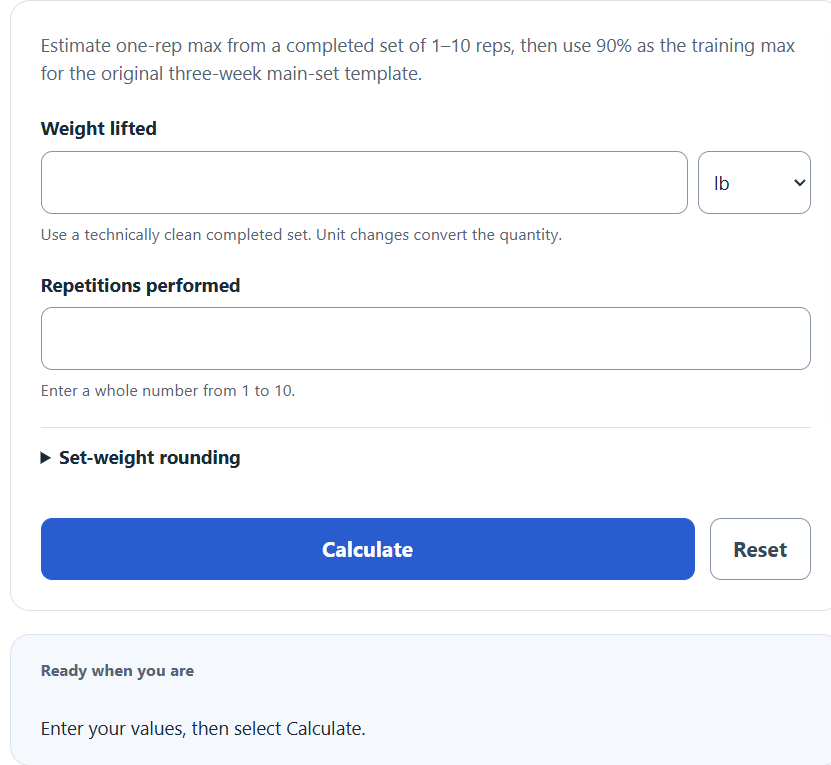
Estimate your 1RM, 90% training max, and Wendler 5/3/1 weekly set weights from weight lifted and reps performed in lbs or kg, with rounding.
Safety note: Educational use only; not medical advice. Strength training carries injury risk—use conservative loads, prioritize technique, and consider working with a qualified coach. If you have cardiovascular disease, uncontrolled high blood pressure, are pregnant/postpartum, have an injury, are under 18, or have medical concerns, consult a clinician before attempting heavy lifts. For “+” sets, avoid grinding to failure; stop with pain, dizziness, or chest symptoms.
Using the 5/3/1 Calculator
This calculator takes a recent set of 1–10 reps, estimates your one-rep max, reduces it to a Training Max (TM), and then applies the standard 5/3/1 percentages. The key idea is simple: train from a conservative TM, not from an all-out max.
Quick Setup Guide
| Step | What to do | Why it matters |
|---|---|---|
| 1 | Enter a recent set using the same unit throughout. | Mixing lb and kg will distort the estimate. |
| 2 | Use a technically clean set for 1–10 reps. | Higher-rep sets make any 1RM estimate less reliable. |
| 3 | Use the calculated TM for programming. | 5/3/1 is built around submaximal training. |
| 4 | Use optional rounding to round each work set to a load you can actually set up; blank or zero leaves loads unrounded. | Barbells, plates, and dumbbells move in fixed increments. |
Standard Weekly Percentages
| Week | Set 1 | Set 2 | Set 3 | Target |
|---|---|---|---|---|
| Week 1 (5s) | 65% × 5 | 75% × 5 | 85% × 5+ | Build volume with controlled effort |
| Week 2 (3s) | 70% × 3 | 80% × 3 | 90% × 3+ | Shift toward heavier strength work |
| Week 3 (5/3/1) | 75% × 5 | 85% × 3 | 95% × 1+ | Top strength exposure without maxing out |
| Week 4 (common deload option) | 40% × 5 | 50% × 5 | 60% × 5 | Reduce fatigue and recover |
Note: The calculator covers the nine main work sets in weeks 1–3. The deload percentages above are a reference only. Warm-ups, assistance work, and template-specific variations are separate decisions.
Example
If you lift 185 lb for 8 reps, the estimate is:
| Item | Value |
|---|---|
| Estimated 1RM | 229.7 lb |
| Training Max (90%) | 206.7 lb |
| Week 1, rounded to nearest 5 lb | 135 / 155 / 175 lb |
| Week 2, rounded to nearest 5 lb | 145 / 165 / 185 lb |
| Week 3, rounded to nearest 5 lb | 155 / 175 / 195 lb |
How to Progress Each Cycle
| Lift category | Common TM increase next cycle | Practical takeaway |
|---|---|---|
| Upper-body lifts | +5 lb | Small jumps keep technique stable and progress sustainable. |
| Lower-body lifts | +10 lb | Lower-body lifts usually tolerate slightly larger increases. |
When Your Numbers Feel Off
- Too heavy early: lower your TM and rebuild from a more conservative base.
- Last set turns into a grind: stop before form breaks down; the goal is quality reps, not failure.
- Estimate seems inflated: use a cleaner, lower-rep set for your input.
- Rounding changes the feel: keep rounding consistent from week to week.
Common Mistakes
- Using a true max instead of a training max.
- Entering sloppy reps just to get a higher estimate.
- Relabeling a weight without converting it. The calculator converts entered weights when you change lb/kg.
- Treating every + set like a mandatory all-out AMRAP.
- Ignoring recovery, sleep, and assistance volume.
FAQ
Should I calculate from my true 1RM or from a rep set?
A clean rep set is often the better starting point because it gives a practical estimate without requiring a max test.
What does the + mean on the final set?
It means the final set is typically performed for at least the prescribed reps, with additional reps only if technique stays solid.
Should I round before or after percentages are applied?
Calculate from TM first, then round each final work set to the nearest usable load.
What rep range gives the best estimate?
The calculator is intended for sets from 1 to 10 reps, with moderate rep ranges usually giving the most practical results.
Does this calculator replace a full program?
No. It gives the main work-set loads; exercise selection, warm-ups, assistance work, and recovery still need to be planned.