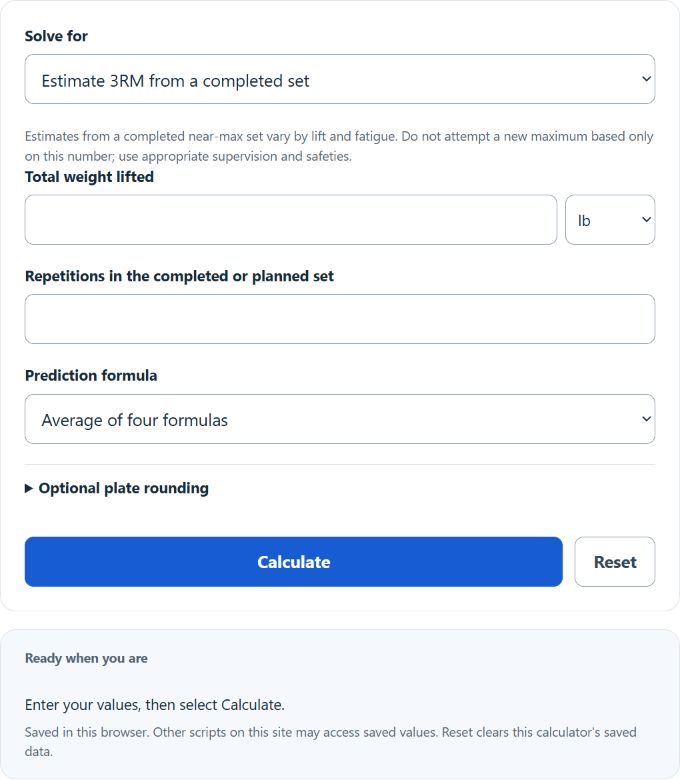
Estimate a three-rep max and one-rep max from a completed set, reverse-plan a target set, compare four formulas, and round the load for available plates.
Safety note: This calculator provides an estimate only. Use proper form, warm up, and use a spotter/safeties for heavy barbell lifts. Do not attempt a new max based only on this number. If you’re new to lifting, injured, pregnant, have cardiovascular risk, or have been advised to avoid heavy exertion, consult a qualified coach or clinician.
3 Rep Max Formula
The calculator estimates a 3 rep max from a lifted weight and reps using an estimated max lift as the middle step. It accepts pounds or kilograms and converts between units as needed.
- 3RM = estimated 3 rep max
- E = estimated max lift of the exercise
- W = weight lifted
- R = completed or planned reps, from 1 to 15
Choose Estimate 3RM and enter the total weight and completed reps, or choose Plan a set and enter the target 3RM and planned reps. The primary equations above illustrate Epley; select a formula explicitly or use the four-formula average.
Each method estimates 1RM, then inverts the same method at three reps. A completed one-rep maximum is treated as the given 1RM in every method; this is a calculator convention. The Brzycki option uses the unrounded-coefficient form 36/(37 − R).
Optional plate rounding uses the entered bar and smallest plate per side. A blank plate size omits rounding; a blank bar means zero. Nearest rounding can exceed the estimate and assumes enough identical plates on both sides.
The calculator requires an explicit whole-number rep count. It does not infer missing fields. The average and formula range describe model variation, not a confidence interval or guaranteed performance.
Rep Multipliers for Estimated Max
These rounded Epley multipliers illustrate one selectable method; the other methods differ. At one rep, this calculator uses a factor of 1 for every formula.
| Reps | Estimated max multiplier | Formula step |
|---|---|---|
| 1 | 1.00 | W * 1.00 |
| 2 | 1.0667 | W * 1.0667 |
| 3 | 1.1 | W * 1.1 |
| 5 | 1.1667 | W * 1.1667 |
| 8 | 1.2667 | W * 1.2667 |
| 10 | 1.3333 | W * 1.3333 |
| 12 | 1.4 | W * 1.4 |
Illustrative Epley Percentages Near a 3RM
| Value | Approximate percent of estimated max | Typical use |
|---|---|---|
| 1RM | 100% | Maximum single rep estimate |
| 3RM | 90.91% | Heavy triples and strength testing |
| 5RM | About 85.71% | Heavy working sets |
| 8RM to 10RM range | About 75% to 78.95% | Moderate strength and hypertrophy work |
Example Problems
Example 1: Estimate 3RM from weight and reps
You lift 200 lb for 6 reps.
With Epley selected, the estimated 3 rep max is 218.18 lb.
Example 2: Plan a set from a target 3RM
Your target 3RM is 150 kg. Choose Plan a set, select Epley, and enter 4 planned reps.
The estimated load for four reps is 145.59 kg.
FAQ
Is a 3 rep max the same as 93% of a 1 rep max?
No fixed percentage is used across every method. Epley gives about 90.91% of its estimated 1RM; each selected formula is inverted at three reps. Real performance can vary depending on the lift, technique, fatigue, rest time, and how close the set was to failure.
Why does the calculator allow 1 to 15 reps?
Rep-max estimates become less reliable as reps get higher. A set of 3 to 8 reps usually gives a more useful strength estimate than a high-rep set. The accepted range preserves sets of 1 through 15 reps, with a warning above 10 reps. Higher-repetition estimates are especially uncertain.
Should you use pounds or kilograms?
You can use pounds or kilograms. Changing an input unit converts its current quantity. The primary result uses the lifted-weight unit in estimate mode or the target-weight unit in plan mode, and a secondary result gives the other unit.