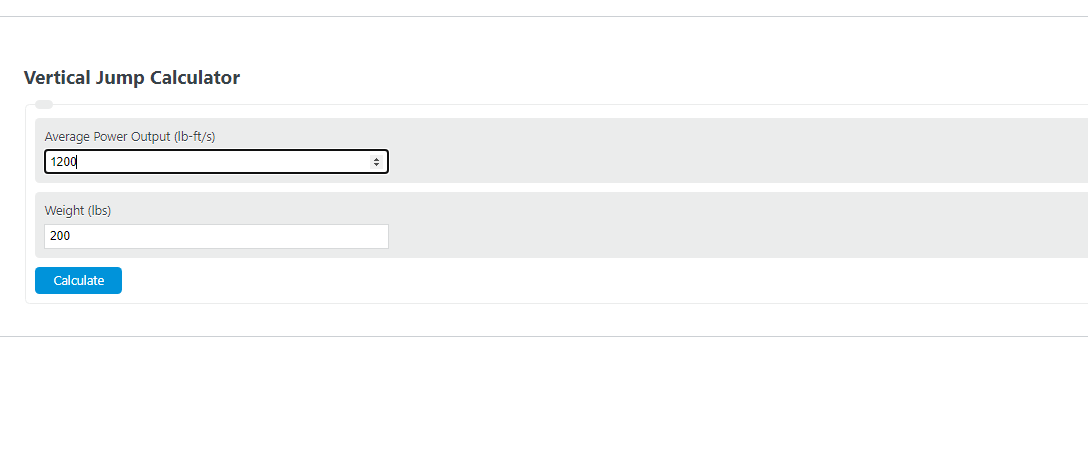
Calculate your vertical jump from standing reach and highest touch, or find how much height you need to touch or dunk on a 10 ft rim.
Vertical Jump Formula
The following formulas can be used to estimate a vertical jump height.
- Where V is your vertical jump height (same units as H), Htouch is your highest touch height, and Hreach is your standing reach height.
- t is total flight time in seconds (time from takeoff to landing), and h is vertical jump height in meters using the flight-time method.
- g is gravitational acceleration (about 9.81 m/s²). The flight-time method assumes takeoff and landing occur at the same height.
To calculate vertical jump height using the reach method, subtract your standing reach from your highest touch. To estimate from flight time, use h = g·t²/8 and convert units as needed (1 m = 100 cm ≈ 39.37 in).
If you want an estimate of peak jump power (watts), common regression equations (such as Sayers or Harman) use jump height (cm) and body mass (kg) and are often discussed in the context of countermovement jump (CMJ) testing. For example, with a 60 cm jump and an 80 kg body mass, the Sayers estimate is 60.7×60 + 45.3×80 − 2055 = 5211 W. For normative tables, check peer-reviewed sports science references or recognized strength & conditioning testing resources, since norms vary by age, sport, and protocol.
Vertical Jump Definition
A vertical jump is typically defined as the maximum jump height, measured as the difference between your standing reach height and your maximum jump reach (highest touch) height.
How to calculate a vertical jump?
Example Problem #1:
First, measure standing reach (standing flat-footed and reaching up as high as possible). For this example, the standing reach is 93 in.
Next, measure the highest touch height during your jump. For this example, the highest touch is 120 in (a 10 ft rim).
Finally, subtract standing reach from highest touch to estimate a vertical jump:
V = 120 in − 93 in
= 27 in (2.25 ft).