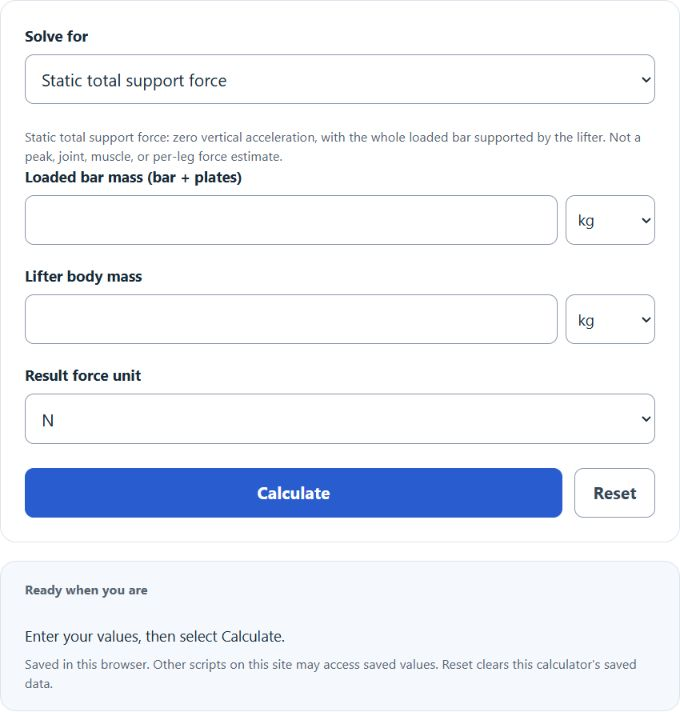
Select the quantity to solve for, then enter the known masses or force. The result is combined weight, equal to total vertical floor support only at zero vertical acceleration with the whole loaded bar supported by the lifter.
Squat Force Formula
The squat force calculator uses the combined mass of the loaded bar and the lifter, then multiplies that total by gravitational acceleration. In base units, weight inputs are converted to kilograms and force is calculated in newtons.
- SF = static total support force (combined weight), in newtons (N) before optional conversion to pound-force (lbf)
- LW = loaded weight of the bar, in kilograms (kg)
- BW = body weight of the lifter, in kilograms (kg)
- g = gravitational acceleration, 9.81 m/s2
Select static total support force to add loaded bar mass and body mass, then multiply by 9.81. Select loaded bar mass to divide the force by 9.81 and subtract body mass. Select lifter body mass to divide the force by 9.81 and subtract loaded bar mass.
This is a simplified force calculation. It treats the system as the combined mass of the lifter and loaded bar under gravity. It does not estimate joint forces, ground reaction force peaks, acceleration during the lift, bar speed, stance width, depth, or technique differences.
Common Unit Conversions for Squat Force
| Quantity | Conversion | Used for |
|---|---|---|
| Mass | 1 lb = 0.45359237 kg | Loaded weight and body weight inputs |
| Mass | 1 kg = 2.20462262 lb | Displaying calculated mass in pounds |
| Force | 1 lbf = 4.44822162 N | Converting pound-force to newtons |
| Force | 1 N = 0.22480894 lbf | Displaying calculated force in pound-force |
Example Squat Force Values
| Loaded Bar | Body Weight | Total Mass | Squat Force |
|---|---|---|---|
| 60 kg | 70 kg | 130 kg | 1275.3 N |
| 100 kg | 80 kg | 180 kg | 1765.8 N |
| 225 lb | 180 lb | 405 lb | about 405.1383 lbf, or 1802.1452 N (using g = 9.81) |
Example Calculations
Example 1: Calculate squat force
You enter a loaded bar weight of 100 kg and a body weight of 80 kg.
Use the formula:
Substitute the values:
The squat force is 1765.8 N.
Example 2: Calculate loaded bar weight
You enter a squat force of 1471.5 N and a body weight of 75 kg.
Use the rearranged formula:
Substitute the values:
The loaded bar weight is 75 kg.
FAQ
Is squat force the same as the weight on the bar?
No. The weight on the bar is only the external load. This calculator’s squat force includes the loaded bar plus the lifter’s body weight, then converts that total mass into force using gravity.
Why does the calculator include body weight?
During a squat, your legs support and move your body mass in addition to the bar. Including body weight gives a simple estimate of the total gravitational force involved in the movement.
Does this calculate the actual force on my knees, hips, or spine?
No. Joint and spine forces depend on body position, lever arms, acceleration, depth, stance, torso angle, and technique. This calculator only estimates total gravitational force from the lifter and loaded bar.