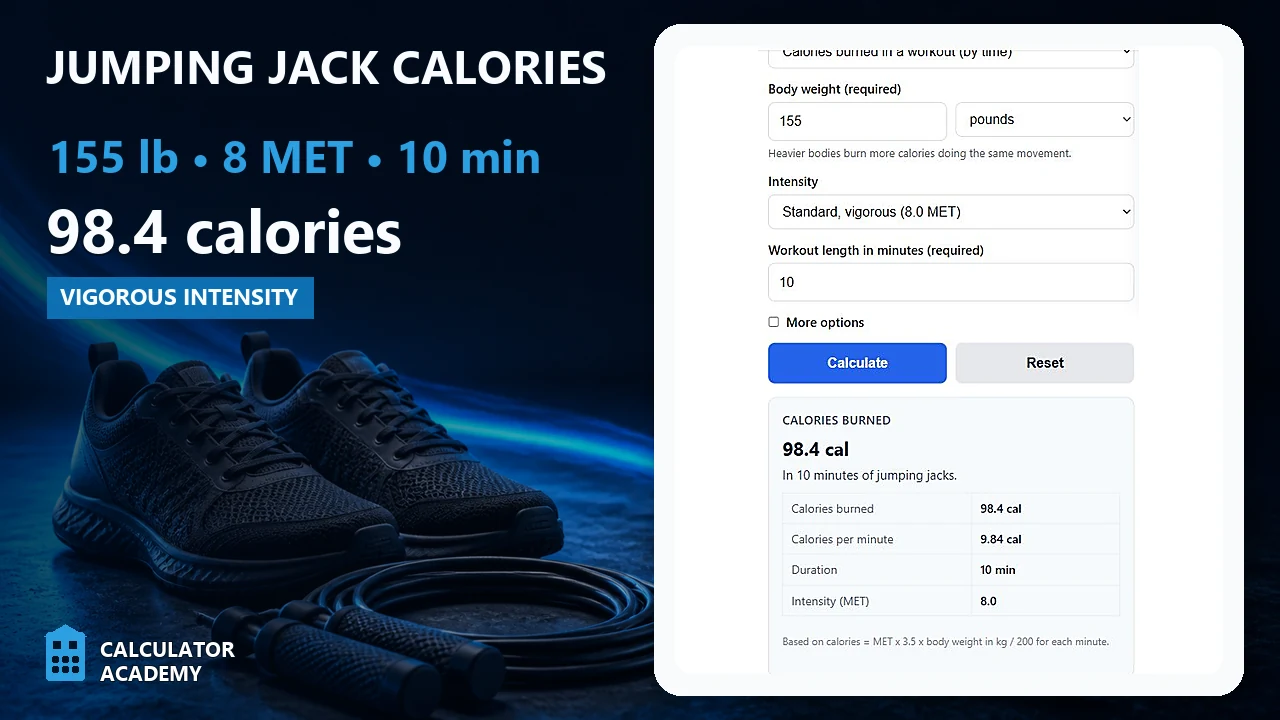
Estimate calories burned from jumping jacks using your body weight, workout time or jack count, cadence, and exercise intensity in METs.
Quick Reference: Calories Burned by Body Weight
The table below shows estimated calories burned during 10 minutes of vigorous jumping jacks (10 MET) at various body weights. These values are derived from the standard MET formula used by the Compendium of Physical Activities.
| Body Weight (lb) | Body Weight (kg) | Calories / 10 min | Calories / 30 min |
|---|---|---|---|
| 120 | 54.4 | 91 | 272 |
| 140 | 63.5 | 106 | 317 |
| 160 | 72.6 | 121 | 363 |
| 180 | 81.6 | 136 | 408 |
| 200 | 90.7 | 151 | 454 |
| 220 | 99.8 | 166 | 499 |
| 250 | 113.4 | 189 | 567 |
How Jumping Jacks Compare to Other Exercises
Jumping jacks rank among the most calorie-efficient bodyweight exercises relative to equipment and space requirements. At vigorous intensity (10 MET), they deliver energy expenditure comparable to jogging at 6 mph (9.8 MET) and exceed steady cycling at 12–14 mph (8.0 MET). More intense alternatives include burpees (10–14 MET) and jump rope (12.3 MET), but jumping jacks uniquely require zero equipment and minimal space — making them one of the most accessible high-calorie-burn exercises available.
| Exercise | MET Value | Cal/10 min (180 lb) | Equipment Needed |
|---|---|---|---|
| Jumping Jacks (vigorous) | 10.0 | 136 | None |
| Running (6 mph) | 9.8 | 133 | Shoes / space |
| Burpees | 10–14 | 136–190 | None |
| Jump Rope | 12.3 | 167 | Rope |
| Cycling (12–14 mph) | 8.0 | 109 | Bicycle |
| Jumping Jacks (moderate) | 8.0 | 109 | None |
What Jumping Jacks Do to Your Body
Jumping jacks are a compound plyometric movement that engages multiple muscle groups simultaneously: the deltoids and upper trapezius during arm elevation, hip abductors and adductors during lateral leg movement, gastrocnemius and soleus during the push-off phase, quadriceps during leg extension, and glutes throughout the concentric and eccentric phases. Core stabilizers — including the rectus abdominis and transverse abdominis — activate to maintain trunk alignment during each jump cycle.
Each landing generates approximately 3.5 times your body weight in ground reaction force. For a 180 lb person, that means roughly 630 lb of force per landing — repeated hundreds of times per session. This loading pattern triggers mechanotransduction in osteocytes, stimulating bone remodeling. A study published in the American Journal of Health Promotion found that performing just 10–20 jumps twice daily over 16 weeks significantly improved hip bone mineral density in previously sedentary adults, establishing jumping jacks as one of the simplest evidence-backed interventions for osteoporosis prevention.
At 7.5+ MET, jumping jacks are classified as vigorous-intensity cardiovascular exercise by the American College of Sports Medicine. This places them in the same intensity category as singles tennis, competitive basketball, and moderate-pace running — activities that produce measurable improvements in VO2 max, resting heart rate, and blood pressure when performed regularly.
The Jumping Jack Calorie Formula
Where JJC is total calories burned (kcal), MET is the metabolic equivalent intensity factor (8 for moderate, 10 for vigorous, 12 for very vigorous), BW is body weight in pounds (divided by 2.20462 to convert to kg), and JJT is jumping jack time in minutes (divided by 60 to convert to hours). This is the standard MET-based energy expenditure equation used across exercise science.
Origin of the Jumping Jack
The jumping jack is attributed to General John “Black Jack” Pershing, who introduced the exercise at West Point Military Academy around 1885 as a calisthenics drill. The name derives from the string-pull children’s toy whose limbs splay outward in a similar straddle-and-close pattern. The U.S. military formally designates it the “side-straddle hop” and continues to include it in basic training fitness assessments. The exercise reached mainstream American fitness culture in the 1950s and 1960s through Jack LaLanne’s pioneering television shows, which helped establish jumping jacks as one of the most universally recognized exercises in the world.
Frequently Asked Questions
How many jumping jacks does it take to burn 100 calories?
It depends on your body weight and intensity. A 200 lb person at vigorous intensity (10 MET) burns roughly 15.1 kcal per minute, reaching 100 calories in about 6.6 minutes — or approximately 660 jumping jacks at a cadence of 100/min. A 140 lb person would need about 9.5 minutes (roughly 950 jacks) to hit the same target. Use the calculator above for a personalized estimate.
Are jumping jacks good cardio?
Yes. Any activity exceeding 6.0 MET qualifies as vigorous-intensity exercise per the American College of Sports Medicine. Vigorous jumping jacks at 10 MET produce heart rate elevation and oxygen consumption comparable to running at 6 mph (9.8 MET), making them an effective standalone cardiovascular conditioning tool.
What muscles do jumping jacks work?
Jumping jacks engage the deltoids, upper trapezius, hip abductors and adductors, gastrocnemius (calves), quadriceps, gluteus medius and maximus, and core stabilizers including the rectus abdominis and transverse abdominis. The simultaneous upper- and lower-body activation is why jumping jacks are classified as a compound full-body exercise.
Do jumping jacks build bone density?
Yes. Each jumping jack landing generates approximately 3.5 times body weight in ground reaction force — enough to stimulate osteocyte-driven bone remodeling through mechanotransduction. A controlled study found that 10–20 jumps twice daily over 16 weeks significantly improved hip bone mineral density. This makes jumping jacks one of the simplest, most accessible exercises for skeletal health.
How do jumping jacks compare to running for calorie burn?
Running at 6 mph registers approximately 9.8 MET; vigorous jumping jacks register 10.0 MET. The per-minute calorie burn at equivalent effort is nearly identical. The key difference is practical: jumping jacks require no equipment, no outdoor space, and can be performed in brief high-intensity intervals, while running suits longer steady-state aerobic sessions and engages lower-body muscles more selectively.